
JOURNAL
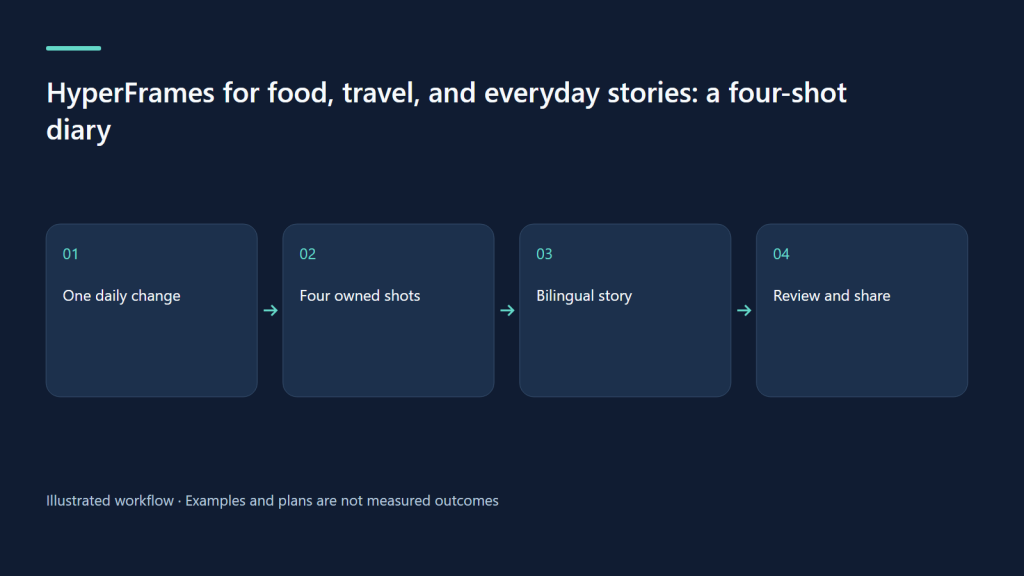
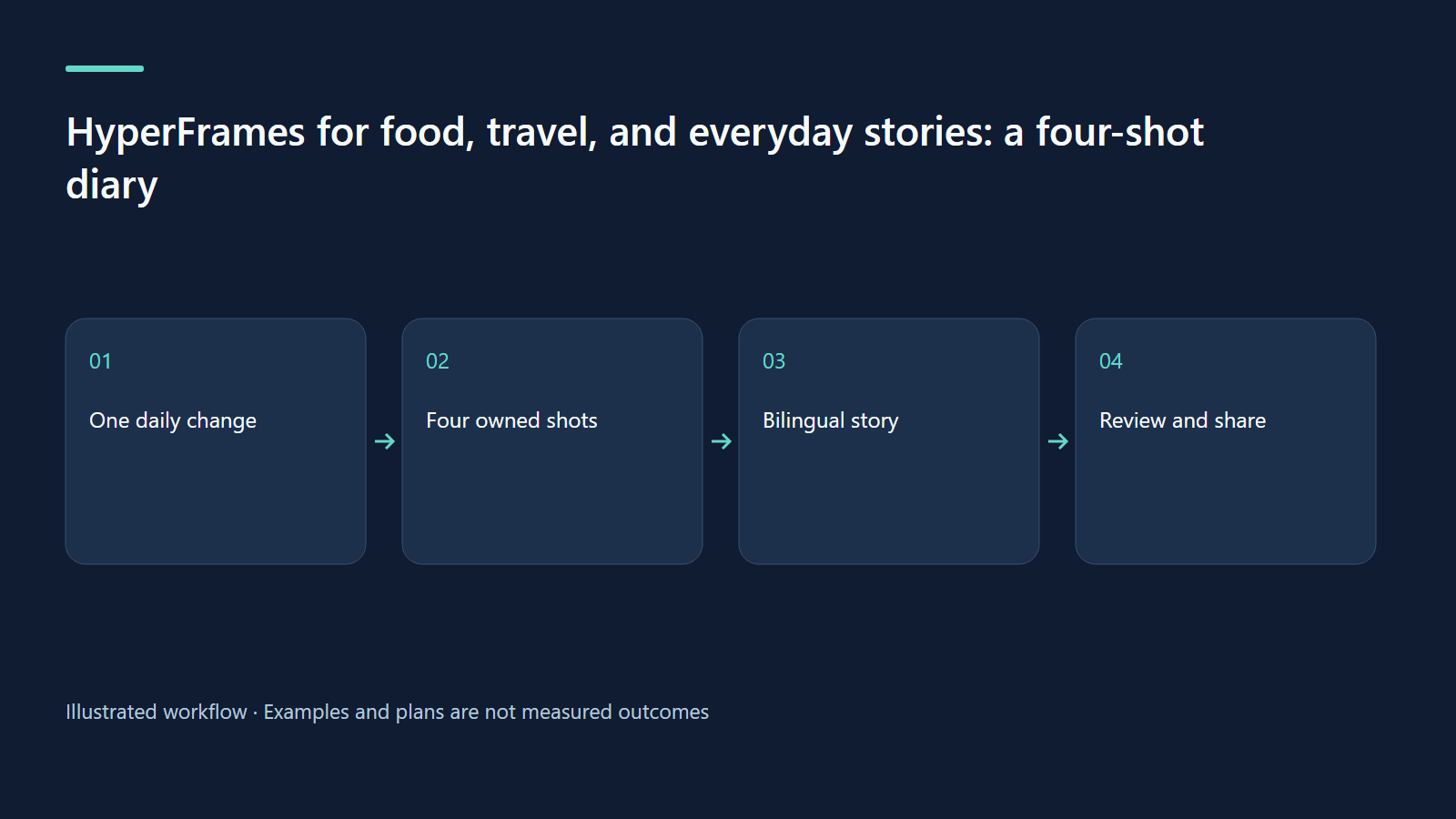
HyperFrames for food, travel, and everyday stories: a four-shot diary
Build a personal café-corner or travel diary with owned assets and reviewed bilingual storytelling.
On this page
The small story hiding inside an ordinary day
A weekend coffee corner, a rainy walk, or a family meal plan can become a useful short film without pretending to be a restaurant commercial. The strongest starting question is “What changed?” Perhaps you turned an unused shelf into a calm place to make a drink, noticed three signs on a neighbourhood walk, or learned why one travel photograph matters to a relative. That change gives the audience a reason to follow the sequence.
This article proposes a 45-second “Our Saturday café corner” story. It documents choices and atmosphere rather than prescribing a recipe. You can adapt it into a travel diary, a shopping-plan explanation, or a before-and-after organisation film. None of these scenarios is presented as a newly rendered asset. Keep the first film small enough to finish using media you already own.
Route according to the material you want to show
A narrated story made from your own photographs and clips fits a custom general-video brief. An explanation built entirely from invented diagrams can use faceless-explainer. A music-led montage without narration can instead follow music-to-video. The official workflow guide helps distinguish the input and intended result.
A café website is a different brief: showing its real pages or promoting its business moves toward the product/site workflow. A map mentioned in a personal diary does not automatically turn the project into a website tour. Say whether the viewer should hear your story, see an existing place, or simply feel a musical sequence. That single choice prevents an agent from sourcing unrelated stock footage or building a promotional call to action you never wanted.
Make a story promise, then gather only supporting shots
For the café-corner example, the promise is “three ordinary objects make one quiet weekend moment.” Select a wide shot of the corner, a cup detail, an arrangement shot, and a final still. An empty surface at the beginning is more useful than twelve beautiful but repetitive close-ups. If you do not have a before picture, tell the story as a sequence of choices rather than fabricating a transformation.
Travel stories need a similar spine: arrival, one discovery, and one remembered detail. Keep dates and locations accurate, but omit home addresses and future travel schedules from a public version. A food story can explain planning, preferences, or presentation without giving cooking temperatures or medical nutrition claims. If you want an instructional recipe, research its safety independently before writing its steps.
A worked storyboard for the Saturday café corner
This proposed storyboard has an opening observation, two choices, and a payoff. The footage remains grounded in what the family actually captured. An overlay may identify an object or a decision, but it should not make a made-up claim about cost savings, sustainability, or health. A handwritten shopping note can work well after names, receipts, and account details have been removed.
The same architecture supports a travel variant: replace the empty shelf with an arrival shot, the cup with a locally photographed detail, and the final arrangement with a favourite view. Use a map only if it clarifies the route. Label it as a simple illustrative route when it is schematic rather than navigational. Do not imply current opening hours, prices, or transport availability without a fresh official check.
| Beat | Media plan | What to verify |
|---|---|---|
| Opening, roughly 0–7 s | Owned wide photo of the quiet corner; one observation | Does it establish a real starting point? |
| Choice one, 7–17 s | Cup detail; label says why this object matters | Is this a personal preference, not a health claim? |
| Choice two, 17–30 s | Short arrangement clip; gentle narrated explanation | Are private notes or screens visible? |
| Payoff, 30–45 s | Final still; invitation to notice one small daily ritual | Can both language captions be read comfortably? |
A prompt that keeps the story personal
The original prompt below deliberately requests a diary rather than a product advertisement. It names the exact media folder and gives the agent a reason to reject unsupported facts. Add one sentence about the feeling you want: calm, curious, playful, or reflective. Give concrete editing instructions such as “hold the final cup shot long enough to read the label,” rather than stacking adjectives.
Ask for a storyboard and a list of missing assets before a render. If one key photograph is unavailable, revise the narrative to work with what exists. A synthetic image can illustrate a mood, but should not be labelled as documentary evidence of a café, meal, or destination you visited. If a generated visual is used, state its role in the review notes and avoid mixing it into factual proof.
Use /hyperframes to plan a custom narrated everyday diary, approximately 45 seconds, from my approved files in ./cafe-corner/. Title: Our Saturday café corner. Deliver separate English and Vietnamese scripts and captions. Show a real starting point, two object choices, and the final quiet moment. General-video route because we are editing owned photos/clips; no website capture. Use warm cream, dark readable text, gentle moves, and one short caption per shot. Do not invent prices, nutrition advice, safety instructions, café visits, or before footage. Ask the storyboard to flag any unsupported fact. Keep music below narration and use only licensed audio. Provide asset/permission notes, phone crop review, and export review checklist. No publication.Build an asset ledger for objects, voices, and places
List each photograph, its owner, capture date, proposed role, and permission to share. Add music and voice files with their licence terms. “Found online” is not a usable rights record. A streaming subscription or a song heard in a venue is not a blanket licence to embed it in an exported film. If the rights are unclear, choose a track with documented permission or keep the initial review silent.
Check the edges of every frame for bystanders, children, addresses, screens, payment cards, and vehicle plates. For a café-at-home film, hands and objects often tell the story perfectly well. For a travel film, ask companions which images they are comfortable sharing. Store the full-resolution originals privately and create a separate approved selection so the agent does not accidentally reach into a whole family archive.
Create English and Vietnamese versions with the same facts
Translate the point of the story rather than every word literally. “Our quiet corner” might need a warmer Vietnamese phrase than a dictionary translation. Preserve object names, counts, sequence, and any genuine quotations. A travel place name should follow the official spelling where available; a family nickname should be explained only when the person agrees.
Create separate caption layouts and timing for each voice track. Vietnamese diacritics need sufficient line height, while a longer English phrase may need a shorter rewrite. Check that translated overlays do not imply an extra claim: “simple” must not become “healthy,” and “we spent less this week” must not become a universal saving promise. Listen to each export with someone who understands that language. A correct transcript alone does not prove the spoken words are clear.
Troubleshoot the ordinary problems first
If a vertical crop removes the cup handle or a person’s head, specify the focal point and review the crop rather than adding more transitions. If a shot is shaky, use a stable still or shorten the chosen range. If music masks the story, lower the bed under narration and check the whole sentence at normal phone volume. Never use a louder voice to conceal an unresolved balance problem.
When the project plays but the export fails, keep the first exact error and follow the official rendering guide. Its lint/check/render loop addresses technical validity, while your review addresses truth and storytelling. Both matter. Watch the exported file itself, including its last second, to catch a clipped end card or an unexpected audio tail.
Try the four-shot exercise before collecting more footage
Choose one everyday change and write a sentence that explains it. Select four owned shots, write one caption per shot, and remove any detail that the caption cannot support. Make a storyboard on paper before asking the agent to build. The exercise succeeds when another adult can retell the change without needing extra background. It does not need to be publicly posted.
For a family learning spin-off, the first-film family workshop is a relevant next step; the Studio walkthrough supplies a separate delivery example. Keep those examples distinct from this proposed diary. Your completion checklist is practical: four authorised assets, one clear story promise, checked facts, two reviewed language versions, intelligible audio, and an agreed destination.
Continue learning
Related reading
· 7 min read
HyperFrames
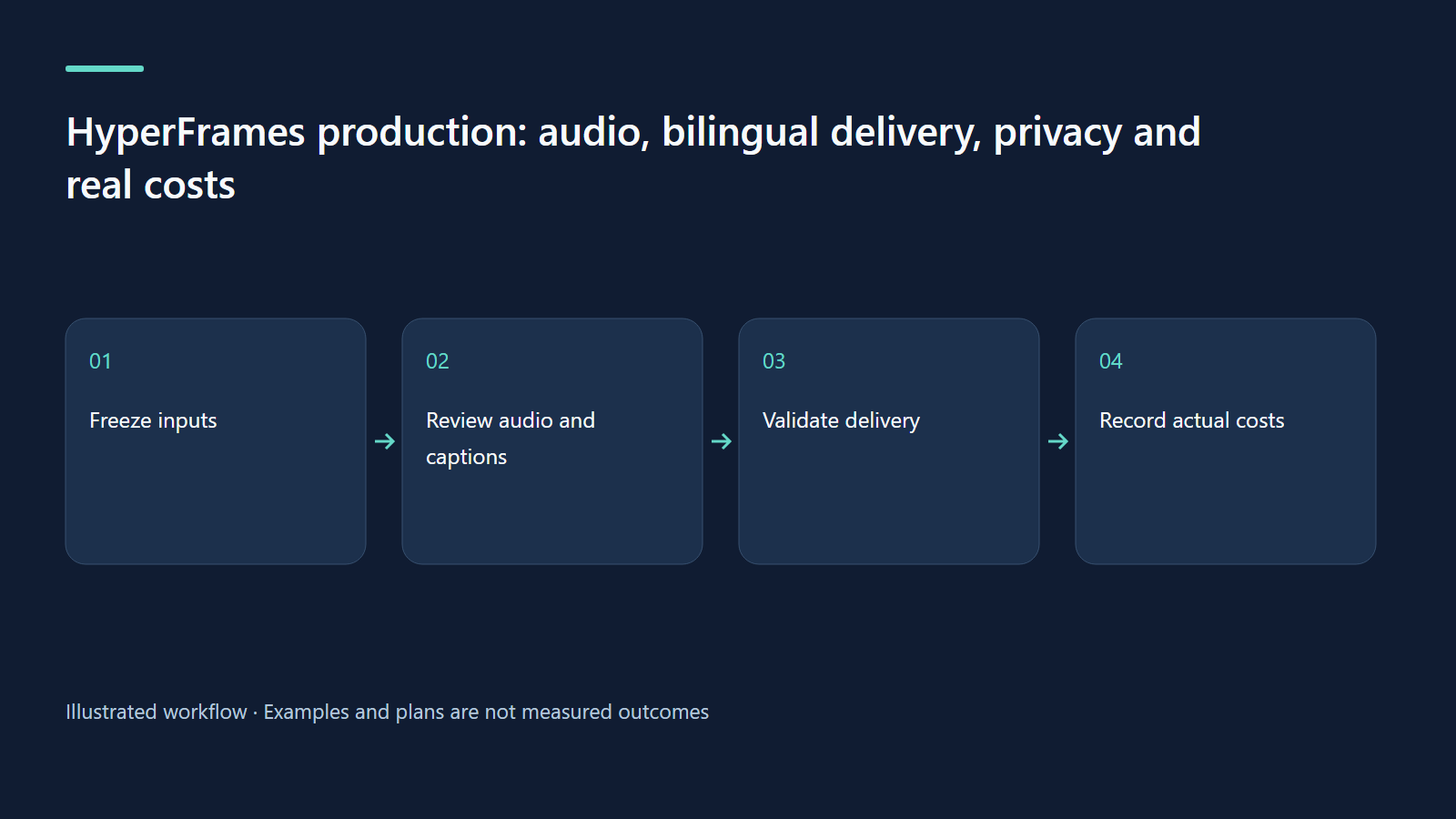
HyperFrames production: audio, bilingual delivery, privacy and real costs
Build a repeatable delivery process with audible exports, honest captions and transparent hypothetical budgeting.
Read more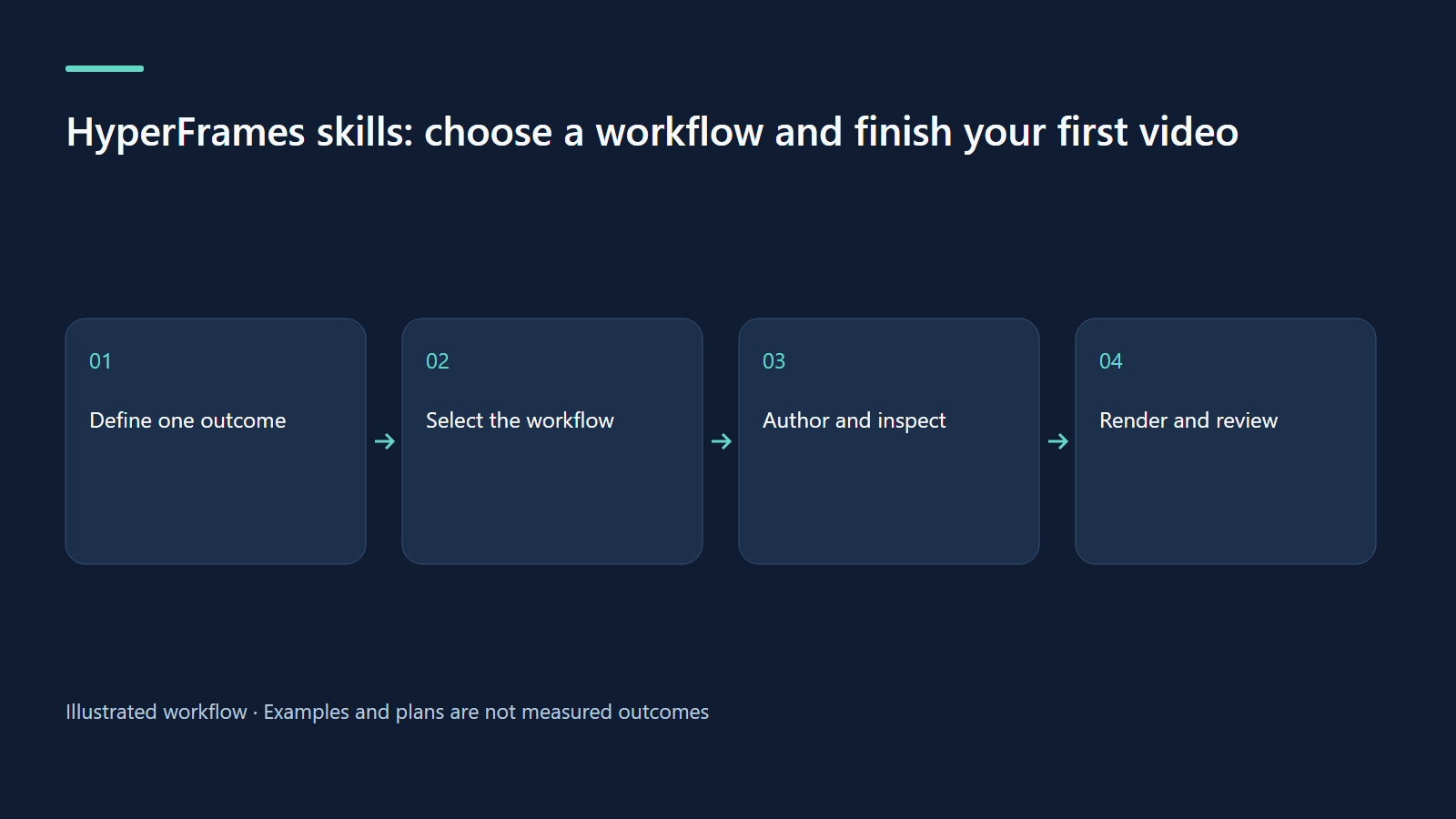
· 7 min read
HyperFrames
HyperFrames skills: choose a workflow and finish your first video
Install skills, choose the right route and deliver one checked video with an honest evidence boundary.
Read more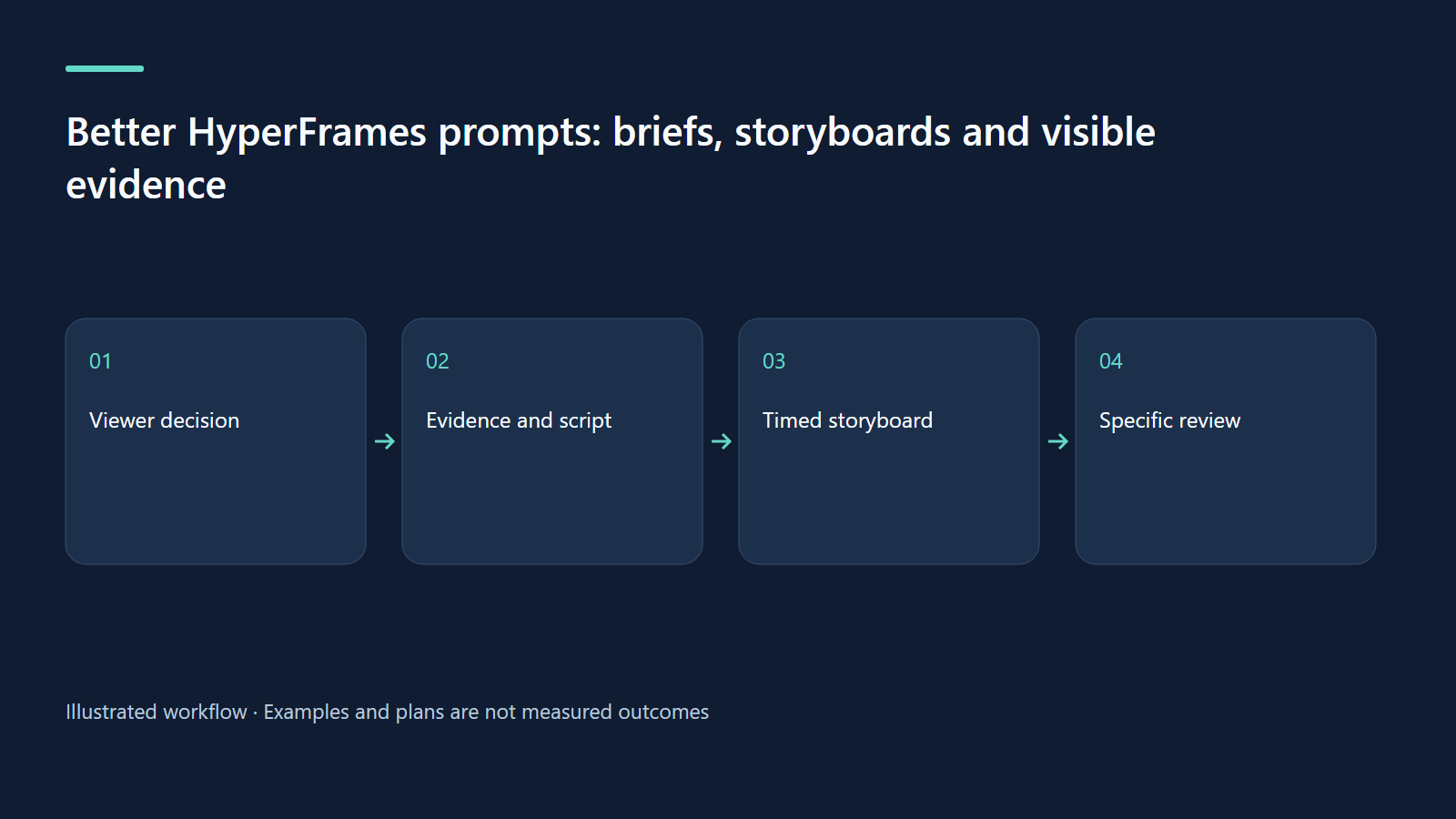
· 7 min read
HyperFrames
Better HyperFrames prompts: briefs, storyboards and visible evidence
Turn a broad idea into a precise brief, timed scenes and reviewable claims using an approval-workflow concept.
Read more
Discussion
Comments are reviewed before publication. Your email is kept private.