
JOURNAL
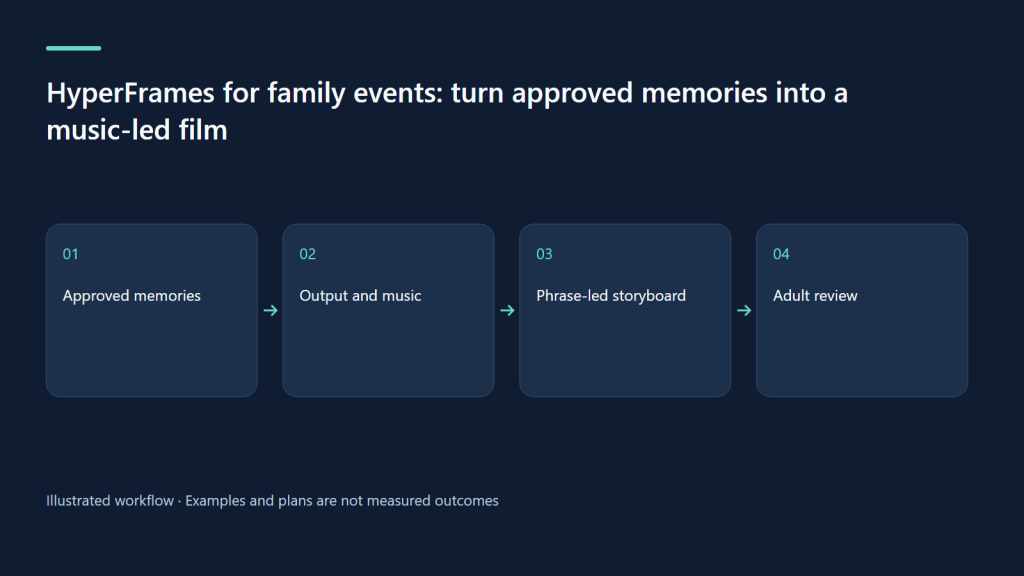
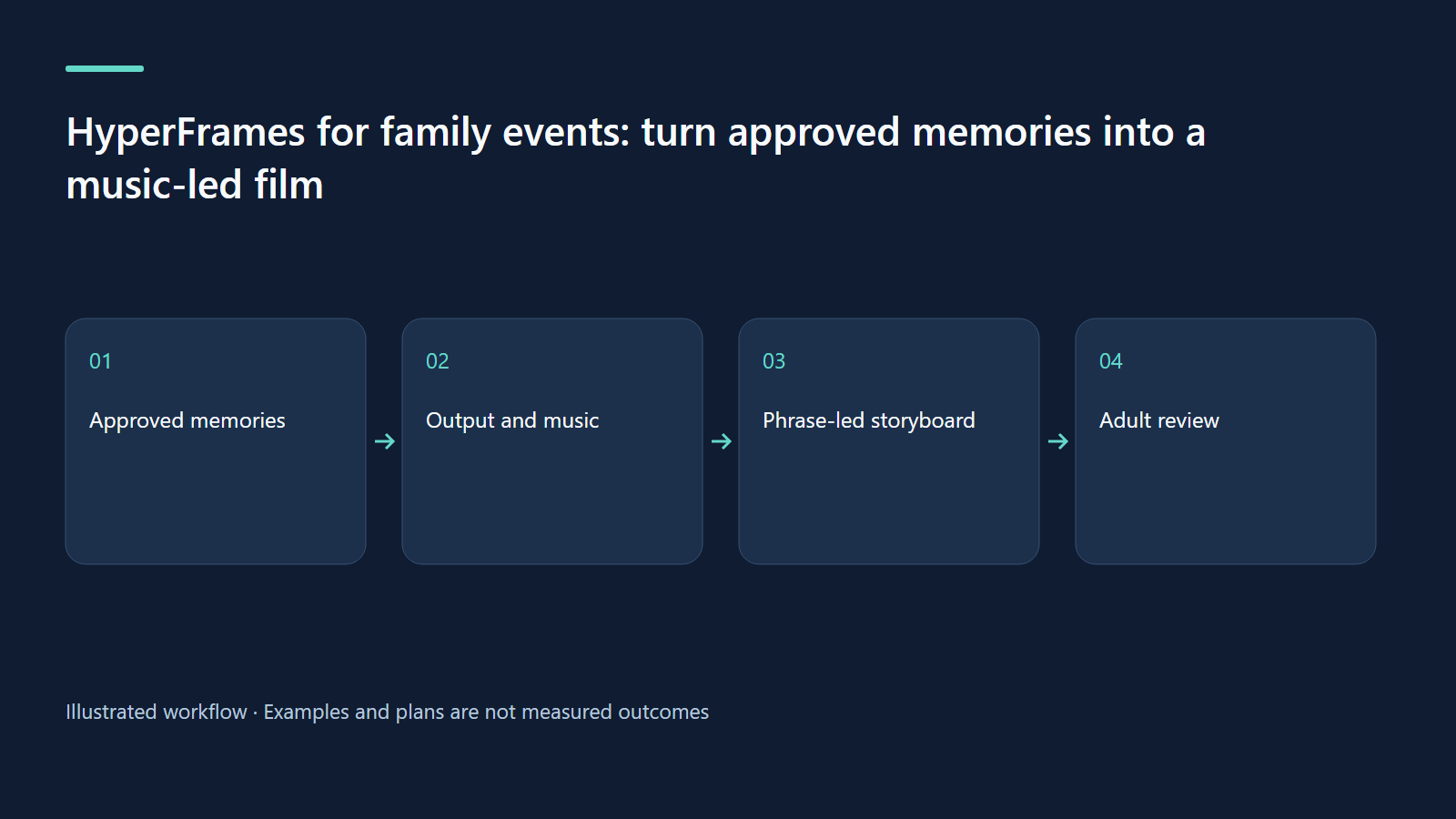
HyperFrames for family events: turn approved memories into a music-led film
Choose the right output, follow musical phrases, and keep music rights and family permissions clear.
On this page
A family film needs an audience before it needs effects
A birthday, reunion, wedding anniversary, or Tết gathering can leave a folder of pictures that nobody knows how to organise. A short film gives those memories an order. Start by deciding who will watch: relatives in a private message, guests at a celebration, or a public audience. That destination changes the permissible images, the amount of context, and whether names belong on screen.
This article proposes a 30-second reunion film built from eight approved photographs and a licensed instrumental track. It is a planned recipe, not a newly rendered event video. The purpose is to reconnect people with one shared memory, not to turn children into performers or to make a family event serve an engagement metric. Adults can assemble the piece while everyone else participates only as they wish.
Name the deliverable: music video, narrated film, or live deck
If music determines the cuts and there is no narration or website capture, choose music-to-video. If a grandparent’s spoken story must remain central, use a narrated custom general-video brief and treat music as a bed. If you want to click through photographs during a live gathering, request a slideshow deck explicitly. The official music and slideshow guide distinguishes a beat-led MP4 from a navigable deck.
Do not assume that a deck can be exported with the ordinary video render command into a complete film. Choose the final format first. A live deck suits a host who wants to pause for stories; a short MP4 suits a relative watching later on a phone. The point is to avoid building the wrong object because “slideshow” was used casually.
Select memories for an arc, not just image quality
Choose one opening photo that establishes the gathering, two or three photos that show shared activity, one emotional detail, and one closing group image. A slightly imperfect picture can be the heart of the story if everybody involved approves it. Sharpness matters, but it does not replace meaning. Leave out images that embarrass a guest or turn a private moment into a joke.
Write one sentence for the arc: “We arrived separately and left with another memory together.” That gives the agent an organising principle without inventing dialogue. For an anniversary, the arc may be past, present, and one wish for the future. Keep a long chronological archive for another project. Eight images can carry a small film; eighty often create a rushed catalogue.
A worked storyboard driven by musical phrases
The table describes musical roles rather than hard timestamps. The actual selected track determines the cut points. A rhythmic instrumental may support one image per bar; a sparse ambient track may need longer holds and phrase-based movement. The family film should breathe even when the music is lively. Keep text short enough to read before the next image arrives.
For the proposed reunion, the strongest musical phrase opens into shared activity, then a softer ending lets the last image hold. Do not demand a cut on every beat. Reserve larger transitions for meaningful structural changes, and keep faces out of aggressive distortion effects. When two similar group photographs sit next to each other, remove one rather than adding a flash.
| Musical phase | Proposed visual | Review decision |
|---|---|---|
| Opening phrase | Arrival photograph; one short title | Does it establish the event without exposing private details? |
| Energy rises | Activity photos changing on meaningful anchors | Are people and crops approved? |
| Warm central phrase | One emotional detail held longer | Is the moment respectful? |
| Musical resolution | Group image and exact family message | Can the viewer read it before the sound ends? |
A prompt for a warm, restrained event film
The prompt asks the agent to choose a musically complete passage and explain how the photos fit its phrases. It avoids exact timestamps before analysis. If your song must use a particular section for an event cue, state that constraint and review whether its beginning and ending are coherent. For the first experiment, a short instrumental with clear phrasing makes decisions easier.
Supply the end-card copy exactly, including accents in approved Vietnamese names. Request separate language versions only if needed. A wedding speech, spoken tribute, or recorded toast changes the brief and should not be slipped into a workflow designed without narration.
/music-to-video Plan a roughly 30-second 1920x1080 reunion film from eight approved photos in ./reunion-approved/ and licensed instrumental ./audio/reunion-theme.mp3. Choose a complete warm passage; let its phrases and energy determine cuts. No TTS, narration, or website capture. Arc: arrival, shared activity, warm detail, closing group photo. Restrained photo movement, soft transitions at phrase changes, readable cream/dark text. End EN: Together, another memory. VI: Bên nhau, thêm một kỷ niệm. Separate EN/VI text versions. Show storyboard before building. Flag badges, addresses, faces, and missing permissions for adult review. Keep the final message readable through musical resolution. Do not publish.Music rights and family permissions are different records
Keep the track’s licence, attribution requirement, and allowed destination alongside the audio file. Buying a song or paying for a streaming subscription does not establish all permissions needed to include it in an exported video. Use music whose terms cover the actual use, or commission a track with written permission. A platform music option may have conditions specific to that platform; do not assume they transfer to a website or downloaded MP4.
For photographs, record who supplied them and who appears in them. Agree on the audience and how removal requests will be handled. Agreement to attend an event is different from agreement to publication. An adult owns the publishing step, including the choice to keep a film within the family. Keep the approved folder separate from the raw camera roll.
Protect privacy in details as well as faces
Review invitation cards, name badges, school logos, home exteriors, vehicle plates, and location signs. A festive photo can reveal more than its main subject. Crop or replace it when an unnecessary identifier remains visible. Do not share real-time travel plans or assume that covering a face removes every identifying clue.
UNICEF’s guidance on sharing children’s images highlights privacy, audience, and respect for children’s wishes. Make thoughtful editorial choices without promising that sharing is risk-free. A child may happily join an activity and still dislike a public photo. Respect that difference without making the editing conversation pressure to participate. Consider replacing an image with an object detail when it preserves the memory with less exposure.
Check rhythm, bilingual text, and the actual export
Watch once without sound: the sequence should still be understandable. Watch again with sound: cuts should land with the musical structure. Test the final hold and end card on the destination device. A television at a reunion and a phone in a messaging app need different crops and text sizes. Keep the original aspect ratio as a master, then review a separate crop if necessary.
For EN/VI, translate naturally and check every name, date, and accent. One version may need a longer hold, so do not force identical timing when readability suffers. Follow the official rendering checks and play the exported file itself. Preview does not prove the audio ending, dimensions, or complete output are correct.
Fix one problem at a time and finish a small exercise
If the film feels frantic, reduce cut density before changing music. If static, add a restrained move within an image rather than dozens of transitions. If a caption is unreadable, shorten it or extend its hold. If the best image is low resolution, avoid heavy zoom and inspect the intended display size. Keep one review note for each issue.
Try four approved photos, a licensed instrumental passage, one opening line, and one closing line. Ask for a phrase-based storyboard and let one relative review it. The family first-film workshop offers a related starting point. Finish with a permissions ledger, readable language variants, a checked file, and an agreed audience. Publication remains an adult decision.
Continue learning
Related reading
· 6 min read
HyperFrames
HyperFrames for Training, Onboarding, and Evidence-Based Code Demos
Build a sanitized onboarding lesson with decision checkpoints, practice tasks, and a clear boundary between mock interfaces and real PR evidence.
Read more
· 7 min read
HyperFrames
HyperFrames production: audio, bilingual delivery, privacy and real costs
Build a repeatable delivery process with audible exports, honest captions and transparent hypothetical budgeting.
Read more
· 7 min read
HyperFrames
HyperFrames skills: choose a workflow and finish your first video
Install skills, choose the right route and deliver one checked video with an honest evidence boundary.
Read more
Discussion
Comments are reviewed before publication. Your email is kept private.