
JOURNAL
A child’s first AI-assisted film: a calm family workshop
A practical workshop gives children meaningful creative choices while adults own verification, spending and publication.
On this page
A practical workshop gives children meaningful creative choices while adults own verification, spending and publication.
Choose a learning experience before a tool
The first family film should be small enough to finish without exhausting its author. Begin with a familiar idea: sorting three toys, telling a short story about helping a friend, or explaining how a plant receives water. Ask the child what they want another person to understand. Turn that answer into one clear sentence. Avoid starting with subscriptions, settings or channel targets. The workshop succeeds when the child can explain a choice and enjoy seeing that choice become a scene.
Set a short working period and an easy stopping point. A family can complete story cards today and watch a draft another day. Children need permission to lose interest or change their mind. Do not promise that a finished video will become popular or earn money. Keep the initial audience within the family if that makes the activity more comfortable. The adult handles technology, facts, resource use and any later publication decision; these are not responsibilities the child must earn by behaving well.
Give the child choices that affect the story
Offer two or three concrete options rather than an open menu of every possible effect. The child might choose a fish or a bird as the character, decide which object is counted, or select the helpful action that resolves a story. Ask why they chose it. Their explanation becomes part of the script discussion. A meaningful choice changes what the viewer learns or feels. Picking a color can be fun, but it should not be the only creative contribution.
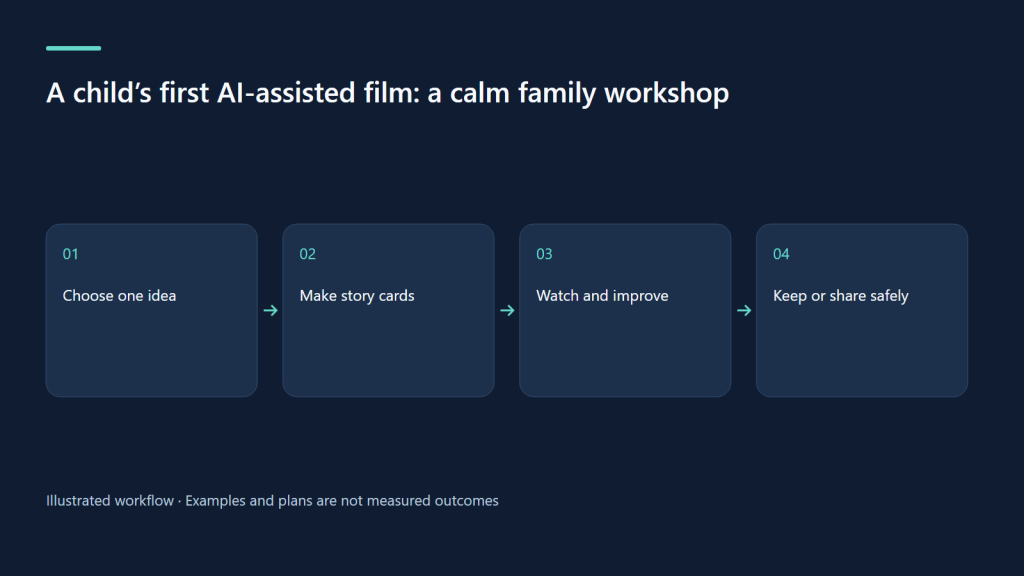
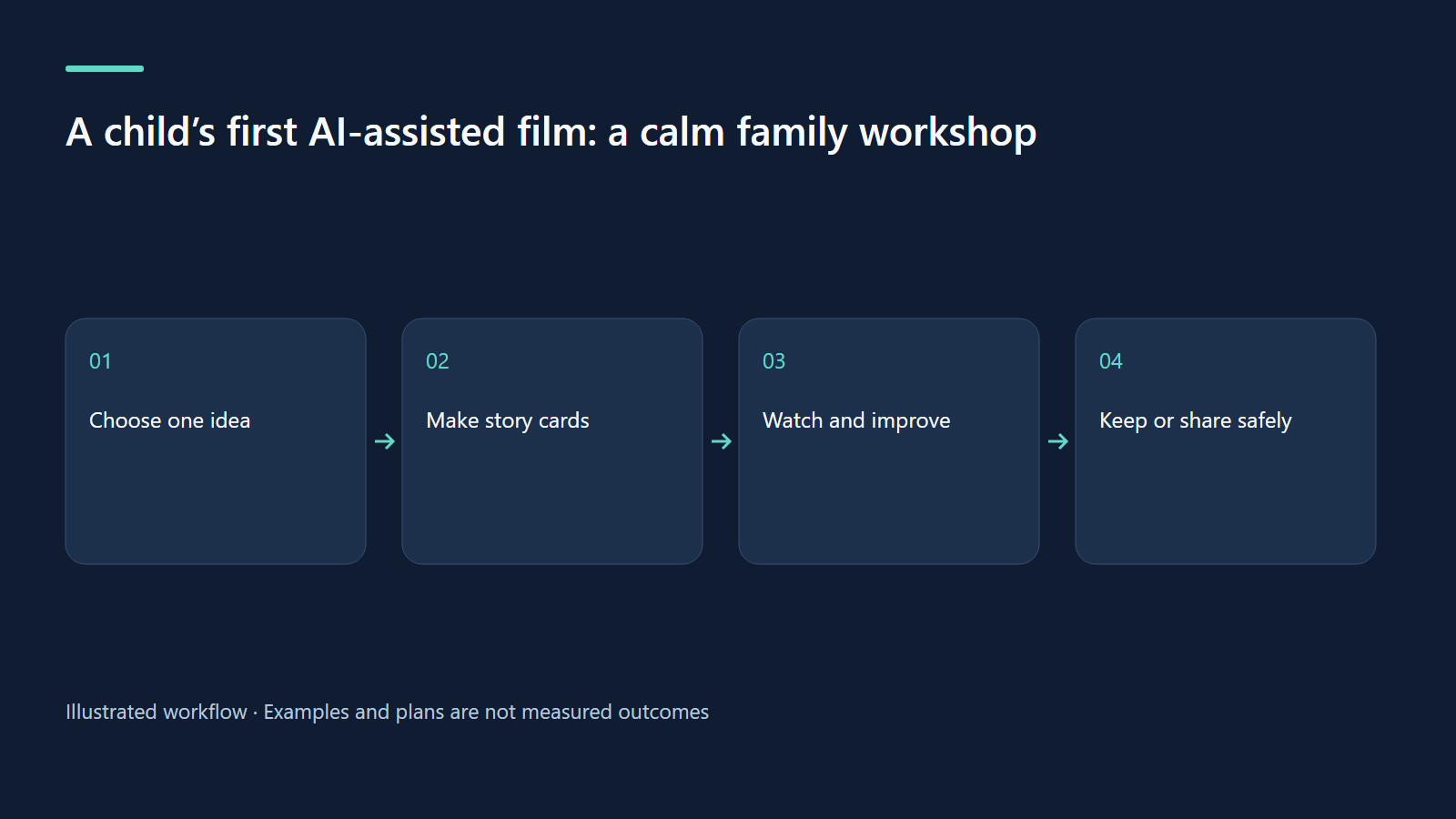
Draw four cards on paper: beginning, discovery, practice or problem, and ending. Use a simple sketch and one spoken sentence for each. Read the sequence aloud before generating anything. If a card cannot be explained, work on that idea instead of asking AI to fill it with decoration. Keep private family details out of the source: invented characters and everyday objects are usually sufficient. Children do not need to provide real faces, full names, school details or locations to make an engaging film.
Let AI propose and the family decide
An AI draft is a suggestion that the adult and child can reject. Ask the model for a short age-appropriate structure, then compare it with the paper cards. Did it preserve the child's central choice? Did it add an inaccurate fact or a confusing moral? Read the narration in a warm, ordinary voice. Replace formal or preachy language with concrete actions. For bilingual work, an adult checks that the second version preserves the same activity rather than inserting a new lesson.
Studio provides a useful division of labor. Child profiles can create, edit, duplicate, build, check, make QA material and thumbnails. The server refuses child requests for tts, all, render and upload, and the publication queue is parent-only. The “Nhờ bố mẹ” flag lets the child request review without taking over protected actions. Explain this boundary simply: the child makes creative decisions, the adult takes care of the costly and outward-facing steps. It is a collaboration, not a punishment.
Watch as curious reviewers
Preview together with one question at a time. First ask whether the child recognizes their idea. Next ask what is hard to understand. Finally ask whether the viewer has enough time to respond. A child may notice a missing object, an awkward word or an expression that sounds unfriendly. Treat that observation as useful editorial evidence. Avoid correcting every small detail in one sitting; choose the change that most improves the activity.
Praise the process specifically: “You noticed the answer appeared too soon,” or “Your new sentence tells us what the character does.” Do not praise only speed or a finished result. Adults check pronunciation, captions, safe imitation and source rights. Generated files are outputs; substantive changes belong in video.json before rebuilding. If the topic involves health, water or sports, use authoritative guidance and explicit adult supervision where appropriate. An entertaining scene is not a reason to relax factual review.
Finish with ownership and a calm choice
Give the child a chance to describe the finished film in their own words. Save the source, a reviewed export and a short note about their favorite decision. Keeping it as a family artifact is a complete outcome. If sharing is considered, the adult reviews privacy, rights, intended audience and platform settings. Do not make public posting a reward or measure the child's contribution through views. A public lesson can use invented characters while keeping the child's real identity private.
Worked example: the missing apple
A child wants a character to count apples but accidentally skip one. The four cards show three apples, a count that misses the middle apple, a pause asking what happened, and a careful recount. The adult checks that the objects remain visible and that the answer follows the pause. The child chooses to have the character say “Let's try together” instead of “You are wrong.” The final educational value comes from that kind response and the visible correction, not from a complicated animation effect.
Exercise and troubleshooting
Prepare four blank cards and two character choices. Let the child invent the scene order, then record only the agreed fictional narration. After a preview, ask them to select one improvement and explain why it matters. Write that explanation beside the saved source. If the session becomes tiring, stop after the cards. If AI overwrites the idea, restore the child's choice. If a protected button is missing, use the parent profile for that stage. If publishing feels stressful, keep the film in the family library.
| Participant | Meaningful responsibility | Completion evidence |
|---|---|---|
| Child | Idea, examples and one improvement | Can explain a creative choice |
| Adult | Accuracy, costs and publication | Reviewed source and export |
| Together | Preview and kind feedback | One agreed revision |
| Family | Keep or share decision | Comfortable final audience |
Sources and evidence boundary
Related learning paths
Related reading
08 Oct 2026 · 6 min read
AI Video
A 30-day AI video channel plan: prove a useful format before scaling
A practical month for selecting an audience, producing a small pilot, and learning without confusing output volume with audience value.
Read more
08 Oct 2026 · 6 min read
AI Video
AI video skills: build a production workflow you can inspect
A source-first workflow connects writing, bilingual narration, deterministic builds and human review.
Read more
08 Oct 2026 · 5 min read
AI Video
Publish AI video on YouTube and TikTok with a traceable review process
Match each platform, inspect the publication package, and verify the actual outcome.
Read more
Discussion
Comments are reviewed before publication. Your email is kept private.