
JOURNAL
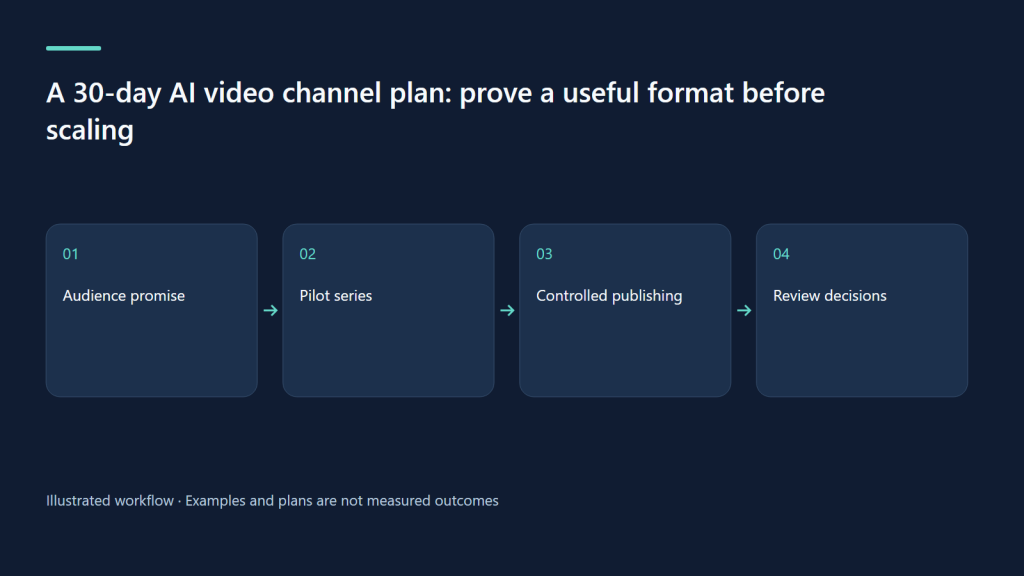
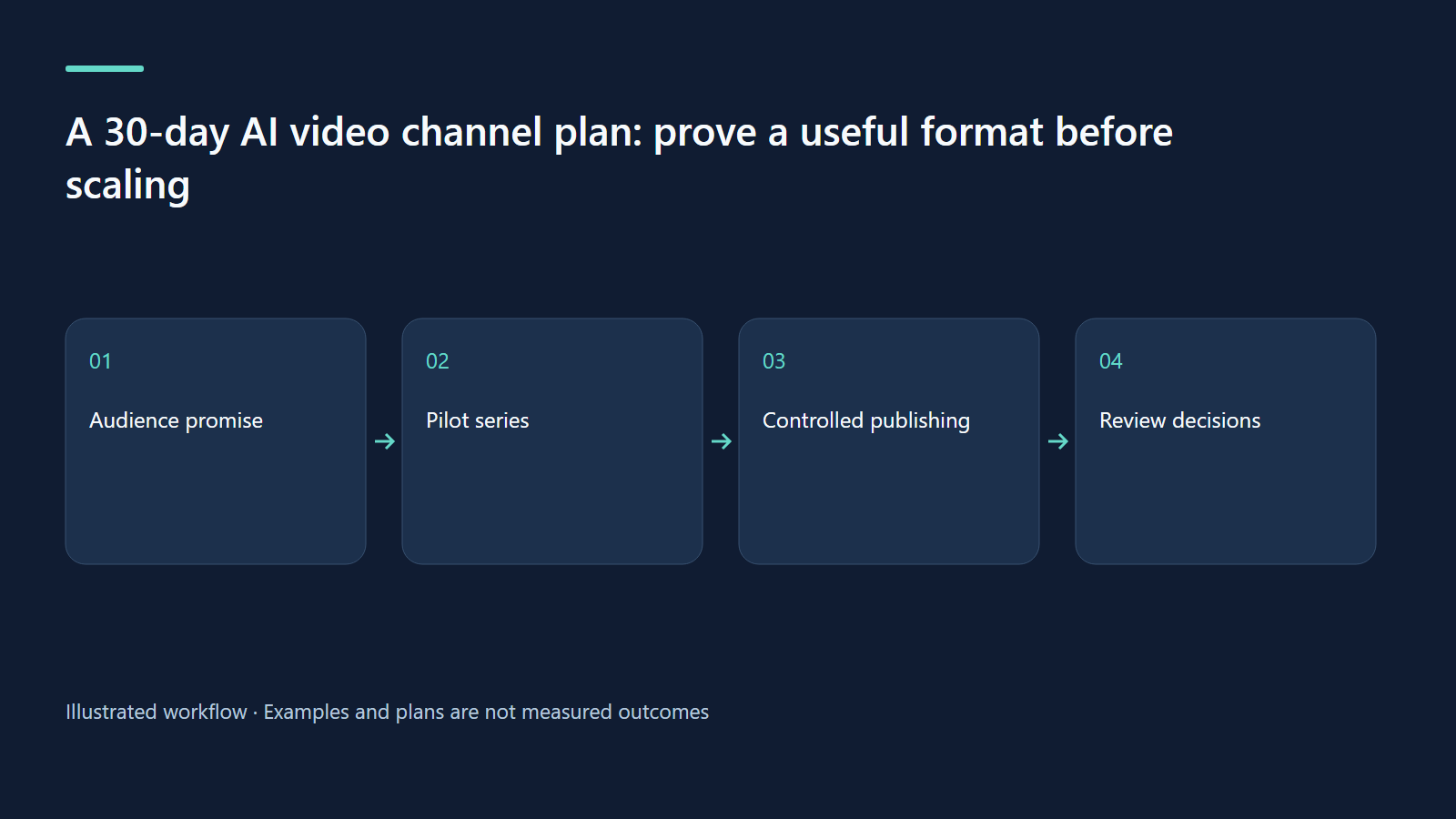
A 30-day AI video channel plan: prove a useful format before scaling
A practical month for selecting an audience, producing a small pilot, and learning without confusing output volume with audience value.
On this page
A practical month for selecting an audience, producing a small pilot, and learning without confusing output volume with audience value.
Start with a promise that can be checked
A channel begins with a recurring problem, not a model subscription. Write one sentence describing who watches, what they can do afterward, and why a short video helps. For example: parents of children aged six to eight need a calm counting activity they can repeat at home. That promise is narrower than “educational AI content,” but it gives the script, thumbnail and review process a common target. Separate the person watching from the adult choosing the lesson. Their needs overlap without being identical.
Choose a production ceiling before choosing a publishing cadence. Four thoughtful pilot videos may teach more than thirty almost identical clips. Record available adult hours, review capacity and the number of language versions. A bilingual episode is one educational idea with two complete listening experiences; it is not a free second upload. Treat the first month as a learning project. The outcome is a repeatable decision process, not a promised subscriber count or a guaranteed income milestone.
Days one to seven: make the smallest credible series
Select three candidate themes and score each against usefulness, your ability to verify facts, available visual material, and the likelihood of producing meaningfully different episodes. Counting everyday objects may fit your experience better than medical advice. Review a handful of existing videos to understand the question they answer; do not copy their narration or disguise their assets. Keep a research note explaining what your version adds, such as a clearer explanation, an original practice task or a Vietnamese family context.
Write a series outline with four episodes, each teaching a different action. For counting, use matching a number to a group, comparing two groups, finding a missing object and explaining a counting mistake. Establish a consistent title pattern and visual vocabulary. Consistency helps recognition, while the learning task creates substantive variation. Draft only the first episode in detail. Ask an adult to explain its objective after reading the outline; if they cannot, shorten the promise before you start rendering.
Days eight to fourteen: measure the production process
Complete one episode from brief to reviewed export. Track time spent writing, translating, recording or generating voice, rebuilding, inspecting and correcting. Record the reason for every retry rather than blaming the whole toolchain. A pronunciation problem needs a script or voice fix; a crowded frame needs a layout fix. Save the approved source and its output together so that a later revision does not accidentally use an older narration track.
For a family using the kids-video workflow, the durable input is video.json. Build and inspect each language separately because speech length changes timing. Listen to the beginning, one concept scene, the quiz and the ending. A useful pilot includes time for the viewer to think. Do not accelerate the voice simply to meet an arbitrary length. Your measured time per approved episode is now a planning input; it is still not evidence of market demand.
Days fifteen to twenty-one: publish a controlled test
Prepare accurate titles, descriptions and thumbnails that describe the actual activity. Publish only the versions an adult has reviewed. If the audience is children, make the appropriate audience designation and keep account ownership, scheduling and publication under adult control. Record the upload URL, language, date, privacy state and source revision. For TikTok, export and upload manually; the inspected Studio source contains no TikTok automatic publishing integration.
Choose one question to investigate per episode. You might test whether a number-first title communicates better than an activity-first title, while keeping the lesson format stable. These observations are exploratory: different topics, release times and small audiences prevent a clean causal conclusion. Look at whether viewers reach the practice scene and whether a parent can repeat the activity. A few encouraging reactions are useful qualitative input, not proof that a format will scale.
Days twenty-two to thirty: decide what deserves another month
Compare production effort with the usefulness of each episode. Group problems into content, delivery and operations. Content includes unclear explanations; delivery includes unreadable captions; operations includes repeated authentication or export failures. Fix the dominant bottleneck before increasing frequency. Archive rejected drafts with a short explanation so that the next batch does not rediscover the same mistake.
Choose between continuing the series, changing the promise or pausing it. A continuation should name the next four distinct learning tasks and the exact improvement being tested. Set a review date and a maximum time budget. Avoid using children as performance targets: their curiosity, comfort and willingness to participate matter more than views. Adult business experiments can use separate parent-facing material without turning a child's workshop into a sales obligation.
Worked example: a realistic capacity calculation
Suppose two adults can contribute six hours weekly and the first bilingual episode takes three hours including review. Reserve one hour for administration and troubleshooting. That leaves five hours, enough for one complete episode plus progress on the next, rather than a daily schedule. After four episodes, compare planned and actual time. If captions consistently consume forty minutes, improve the source text and timing checks before buying another generation tool. These numbers are planning assumptions, not measured results from Bé Vui Học.
Exercise: write the next decision before the first upload
Create a one-page experiment card containing audience, promise, four distinct episode questions, weekly time ceiling, review owner and the decision date. Add three success indicators that you can actually observe: an adult can describe the objective, exports pass the review checklist, and production stays within the agreed hours. Add one stop condition, such as a topic you cannot verify responsibly. At day thirty, annotate every indicator with evidence or “unknown.” This prevents enthusiasm from silently becoming an unsupported claim.
Troubleshooting a stalled month
If you keep changing tools, freeze one workflow for two episodes. If every episode feels the same, rewrite the learning action before changing colors. If editing never ends, define acceptance criteria and a single final reviewer. If there are few views, check discoverability and the clarity of your audience promise, then gather more observations before declaring the channel unsuccessful. A modest pilot that reveals a reliable process has fulfilled its purpose.
| Week | Deliverable | Decision |
|---|---|---|
| 1 | Audience promise and four-episode map | Can the objective be repeated clearly? |
| 2 | One reviewed bilingual pilot | What actually consumes production time? |
| 3 | Controlled uploads and observation log | Which parts help viewers practice? |
| 4 | Evidence review and next experiment | Continue, revise or pause? |
Sources and evidence boundary
Related learning paths
Related reading
08 Oct 2026 · 6 min read
AI Video
AI video skills: build a production workflow you can inspect
A source-first workflow connects writing, bilingual narration, deterministic builds and human review.
Read more
08 Oct 2026 · 5 min read
AI Video
Publish AI video on YouTube and TikTok with a traceable review process
Match each platform, inspect the publication package, and verify the actual outcome.
Read more
08 Oct 2026 · 5 min read
AI Video
AI video monetization: calculate unit economics before promising income
Count labor, retries and rights, and separate platform eligibility from real earnings.
Read more
Discussion
Comments are reviewed before publication. Your email is kept private.