
JOURNAL
AI video monetization: calculate unit economics before promising income
Count labor, retries and rights, and separate platform eligibility from real earnings.
On this page
Count labor, retries and rights, and separate platform eligibility from real earnings.
Define what the adult business offers
AI can reduce some effort, but a cheaper generation does not create demand. Describe the value being supported or sold. A channel offers original explanations; a production service delivers reviewed videos to an organization; a parent-facing product might provide activity materials. These are distinct offers with different buyers, delivery obligations and support costs. A children's learning channel should not turn attention or participation into a selling requirement. The adult owns any account, contract, publication, spending and customer relationship.
Keep the family workshop separate from the commercial ledger. Children can suggest examples and enjoy the finished lesson without becoming responsible for traffic or income. This distinction improves decisions: a family activity may be worthwhile with zero revenue, while a service needs reliable delivery and margin. Decide which experiment you are running before comparing results. A portfolio of educational work can support adult business conversations without implying the child is a performer whose job is to attract customers.
Eligibility does not predict earnings
YouTube's expanded program includes an eligible-region route at 500 subscribers, three public uploads in ninety days and either 3,000 qualified watch hours in twelve months or three million qualified Shorts views in ninety days. This earlier tier is not the advertising-share threshold. The advertising route uses 1,000 subscribers plus 4,000 qualified watch hours or ten million qualified Shorts views in the relevant periods. Consult the official pages and the channel's Earn tab for the current conditions and feature eligibility.
Thresholds do not replace policy review. AI involvement is not a blanket monetization ban. The channel policy addresses original value and inauthentic or repetitive production among its requirements. Templates can support consistent teaching, but mass-produced episodes with superficial changes do not automatically provide substance. Keep original scripts, meaningful explanations, review notes and asset records. A generated voice reading someone else's text still raises questions that a new voice file cannot solve. Review the work as a viewer would: what does this episode actually add?
Price one approved deliverable
Use the reviewed episode as the unit, not a generation attempt. Include writing, verification, translation, voice, rights, rendering, hosting, storage, failed attempts, thumbnail, publication and support. Value adult labor even if no cash leaves the account. Otherwise the spreadsheet appears profitable by hiding its largest input. Allocate shared monthly software and infrastructure costs through a stated method, such as the number of approved episodes. Use the same method for every scenario so comparisons remain meaningful.
Record retries by cause. A ten-minute correction may trigger a two-language rebuild, another render and another review. Its cost is larger than the voice fee. Rights are an economic input too: an inexpensive asset with uncertain terms can lead to costly rework. Keep source, permitted use and attribution in a ledger. Do not assume AI output eliminates rights review or makes copying another creator's identifiable work acceptable. Count the time spent managing these records rather than treating them as free overhead.
Model several adult-facing revenue routes
Advertising, affiliate arrangements, sponsorship, services and products have different economics. For ads, use several hypothetical revenue-per-thousand-view inputs and label them clearly; do not present them as a real channel RPM. Affiliate and sponsorship income depends on fit, disclosures and contractual conditions. Avoid purchase pressure aimed at children. Services depend on scope and revision count. Products need development, support and refund allowances. Each route needs its own assumptions and actual receipts before it is called earned revenue.
For children's material, confirm that the feature your plan relies on is available under its audience and program conditions. General program descriptions do not guarantee every feature to every channel. Parent-facing commercial explanations should be useful on their own and disclose business relationships where relevant. Never insert a selling segment into the child's lesson merely because a spreadsheet expects conversions. The educational review and business review can share evidence while keeping their purposes clear.
Worked example: hypothetical break-even
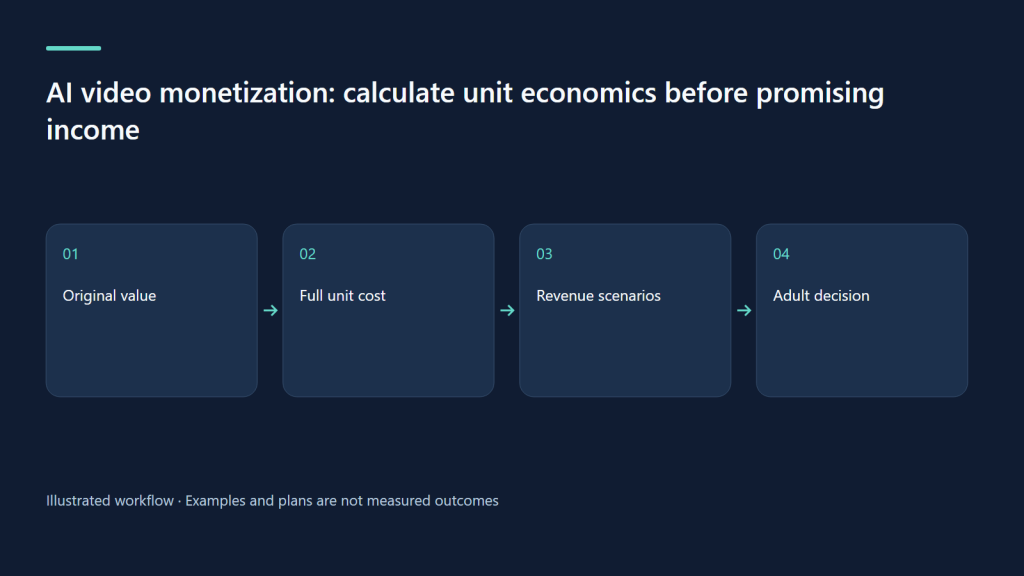
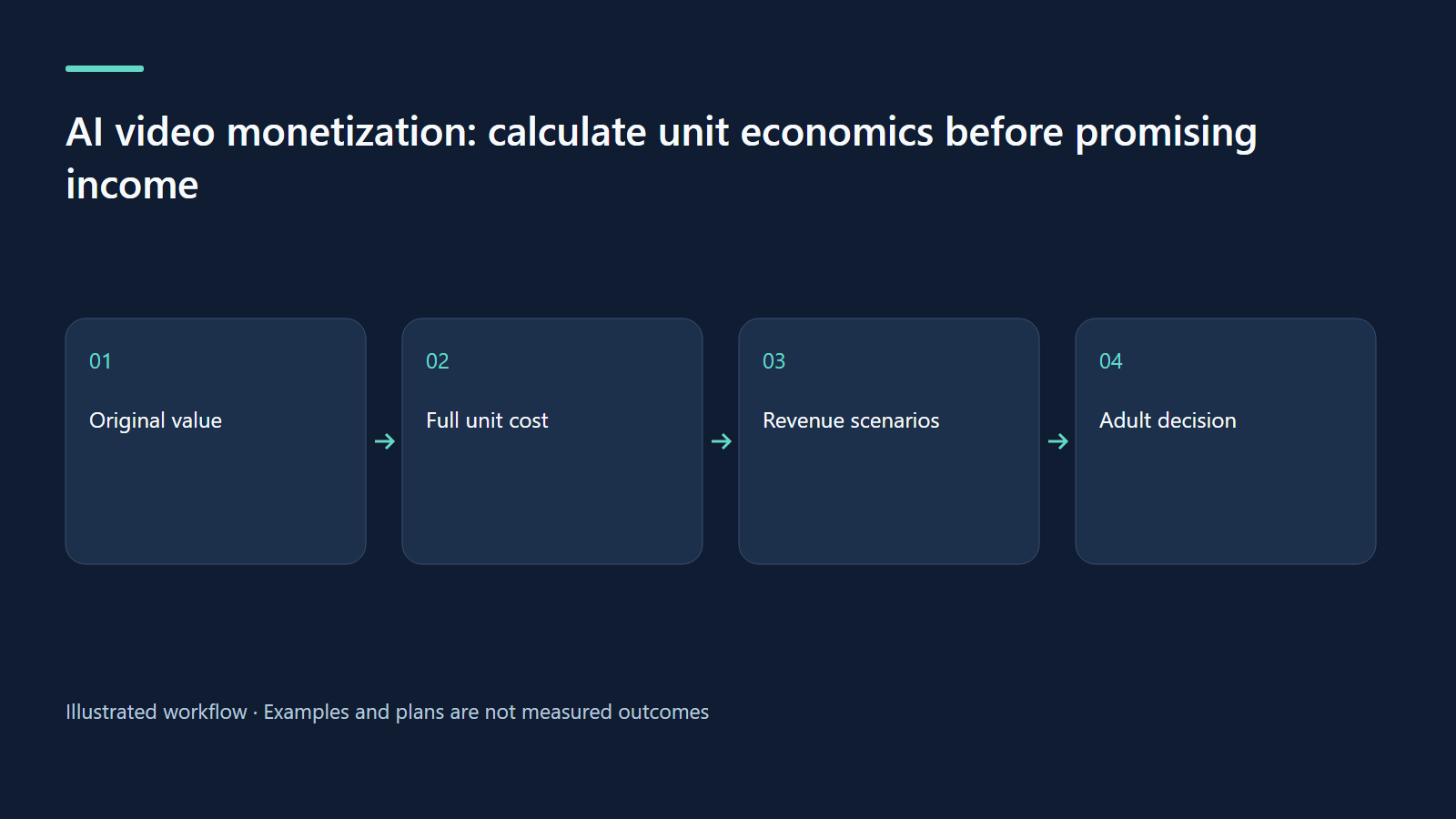
Assume a bilingual episode needs three adult hours valued at 150,000 VND each, 50,000 VND of voice and retries, and 40,000 VND of tools and hosting allocation. Full cost is 540,000 VND. At an invented net advertising input of 20,000 VND per thousand eligible views, break-even is 27,000 views. At 10,000 VND it is 54,000; at 40,000 VND it is 13,500. These are arithmetic assumptions, not measured RPM, income or outcomes from Bé Vui Học.
A commissioned service changes the calculation. If an adult customer pays an assumed 900,000 VND for that deliverable, 360,000 VND remains before acquisition, tax, extra revisions and support. Add those costs before calling the remainder profit. Specify language, formats, included revisions and acceptance criteria in the scope. A second review round can erase apparent margin, particularly when a late script change requires all audio and exports to be regenerated.
Exercise and troubleshooting
Create four pilot rows with labor minutes by stage, paid tools, rights, retries and shared overhead. Add three revenue scenarios and label every amount assumed or received. Calculate full cost and net result after overhead. Write one decision: continue as learning, test an adult offer, improve production or stop the commercial trial. If margins seem exceptional, check missing labor. If income depends on a threshold, verify the tier. If repairs dominate, simplify the objective before increasing output. No commercial results are claimed here.
| Hypothetical net per 1,000 views | Episode cost | Break-even views |
|---|---|---|
| 10,000 VND | 540,000 VND | 54,000 |
| 20,000 VND | 540,000 VND | 27,000 |
| 40,000 VND | 540,000 VND | 13,500 |
Sources and evidence boundary
Related learning paths
Related reading
08 Oct 2026 · 6 min read
AI Video
A 30-day AI video channel plan: prove a useful format before scaling
A practical month for selecting an audience, producing a small pilot, and learning without confusing output volume with audience value.
Read more
08 Oct 2026 · 6 min read
AI Video
AI video skills: build a production workflow you can inspect
A source-first workflow connects writing, bilingual narration, deterministic builds and human review.
Read more
08 Oct 2026 · 5 min read
AI Video
Publish AI video on YouTube and TikTok with a traceable review process
Match each platform, inspect the publication package, and verify the actual outcome.
Read more
Discussion
Comments are reviewed before publication. Your email is kept private.