
JOURNAL
Creator Search Insights: turn topic signals into a defensible content brief
Use search topics and content gaps as research leads, then validate audience fit and your ability to deliver a complete answer.
On this page
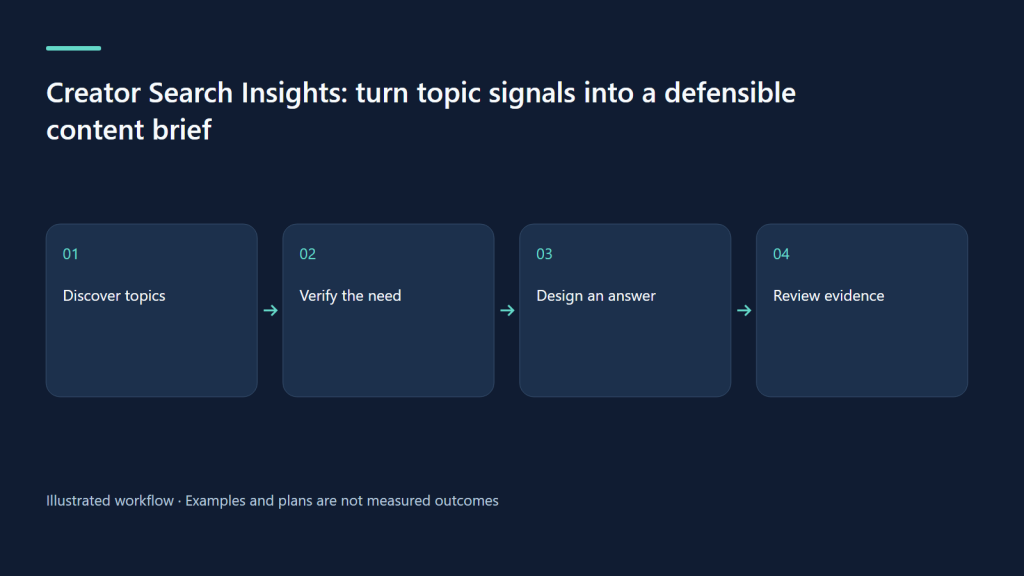
Creator Search Insights is useful when it helps a creator choose a problem they can genuinely solve. It becomes less useful when a popularity label is treated as an instruction to produce any available video. A topic signal describes an opportunity to investigate. The content brief must still establish who needs the answer, what they need to accomplish and what evidence the creator can show.
Check access before planning around the tool
TikTok introduced Creator Search Insights in selected regions, including frequently searched topics and a content-gap filter. Availability is not promised for every account. Read the official launch announcement. The current Help Center guide also describes search analytics; use only the controls your account actually provides.
Search for the tool by name in the app and verify whether its interface appears. If it does not, continue with a manual research notebook: queries you checked, the questions visible in relevant results and gaps in the explanations you personally reviewed. Do not claim that manual suggestions provide exact search volume. Do not buy access from someone promising to unlock a region-specific feature. Tool access is an operational condition, not a prerequisite for making a useful lesson.
Build a brief from three different kinds of evidence
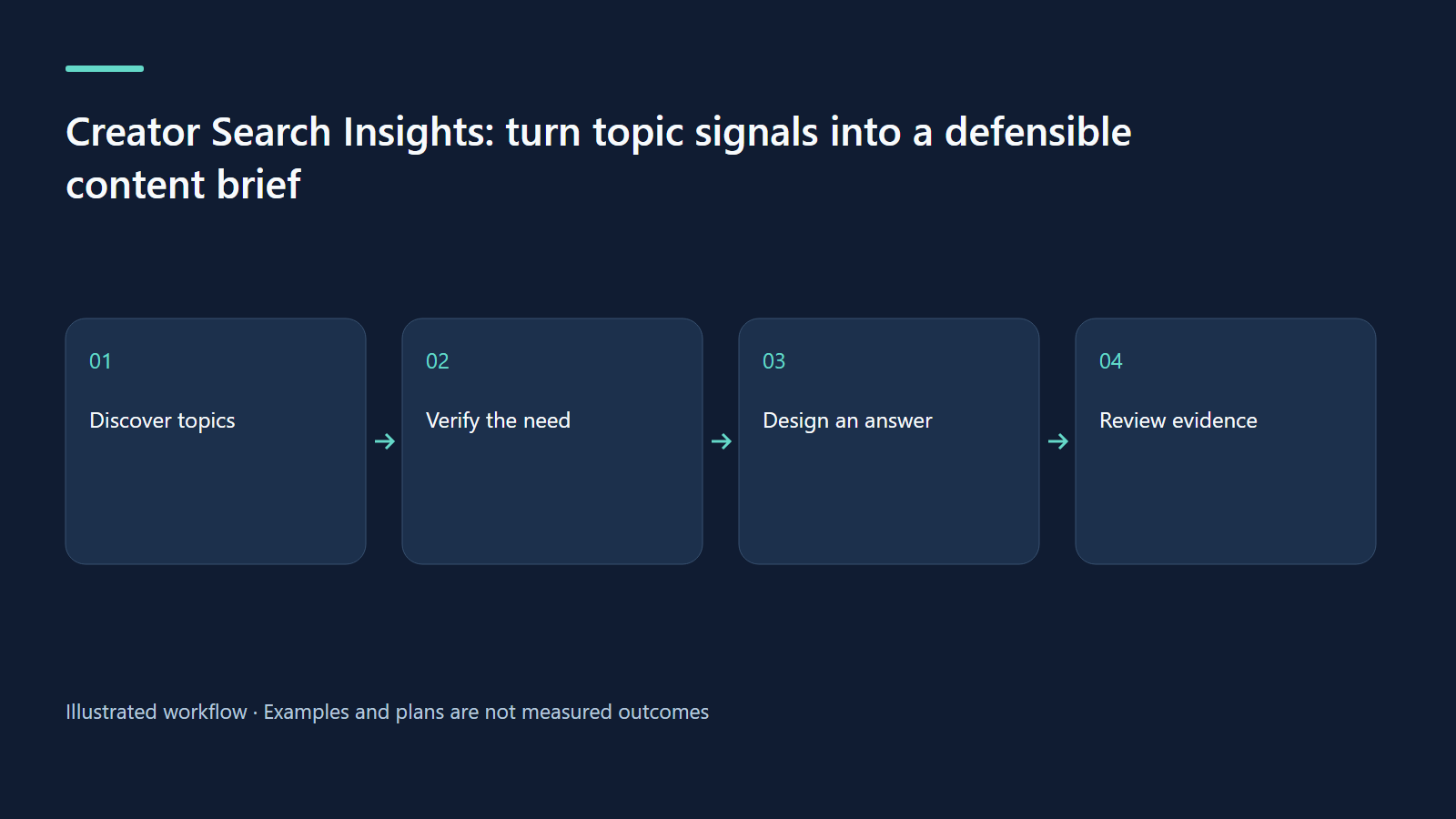
The first evidence is the topic itself. Copy its wording, note the date and distinguish an observed interface label from your own interpretation. The second evidence is the audience problem. A parent searching for home STEM activities may need an inexpensive setup, a quiet activity for an apartment or a lesson suitable for a particular age. The third evidence is the answer you can demonstrate. A classroom expert may show real preparation steps; an AI video creator may show how they verify a generated lesson before publishing it.
These evidence types should not be collapsed into a single score. A popular topic with weak production evidence can produce a shallow video. A narrower topic with a convincing demonstration may be a better fit for the account. An honest brief says “observed topic,” “inferred audience need,” and “planned proof” separately. That separation also makes later review easier: you can tell whether the research was weak, the answer was incomplete or the delivery failed to make the answer understandable.
| Field | Example entry | Decision it supports |
|---|---|---|
| Topic wording | “tạo video bài học bằng AI” | Use the audience’s task as the starting point. |
| Audience constraint | Teacher has an outline but no recorded footage. | Demonstrate a simple visual lesson. |
| Missing answer | Existing examples skip factual verification. | Show a review step before export. |
| Proof asset | Outline, corrected frame and exported sample. | Make the process inspectable. |
Read a content gap as a question, not a ranking promise
A content-gap topic is a lead for further research. Review a manageable sample of results and describe what seems missing: material costs, exact setup, language suitability or a correction step. “There are no good videos” is too broad and usually impossible to establish from a personal search. “In the five videos I reviewed, none showed how to check a generated science explanation” is a bounded observation. It may still reflect personalization or the particular day of research.
Worked example: an AI lesson without an accuracy shortcut
For the topic “create lesson videos with AI,” avoid promising that one prompt creates a publishable educational product. Open with the final short lesson, then show the outline and one error caught during review. Explain how the creator checks the learning objective, the explanation and the labels in the visual. The important distinction is between generating a draft and authoring a reliable lesson. A tool demonstration alone does not establish that the lesson is correct.
A useful video could show a paper bridge diagram that initially labels the wrong part. The creator corrects the label, simplifies the narration and exports a preview. The caption identifies the audience as adult teachers or parents preparing offline instruction. A follow-up video can explain the review checklist. This turns a broad production query into a specific answer with visible evidence and a meaningful continuation.
Practical exercise: shortlist without chasing popularity
Collect six topic candidates. For each, write one sentence describing the person who needs it, one constraint that changes the answer and one asset you already possess. Select two topics you can demonstrate accurately this week. Keep the rejected topics with a reason: missing expertise, no suitable proof, excessive preparation or a weak audience fit. Rejection is a useful research outcome because it protects production time.
Write a brief for each selected topic with an opening result, the steps required for a complete answer and a next action. Before recording, ask whether the video would still help someone if no popularity label were visible. If the answer is no, the brief is relying too heavily on the tool. A good topic signal should sharpen a useful lesson rather than substitute for one.
Troubleshooting research that does not produce useful videos
If every topic feels too broad, introduce a real constraint: available materials, teacher preparation time, language or age suitability for the offline lesson. If every result looks crowded, inspect whether competitors answer the same specific task or only mention the category. If the tool is unavailable, document that limitation and use direct observation without presenting it as measured demand. If analytics are unavailable, review comments and your own editorial execution while acknowledging that discovery performance cannot be isolated.
Review the shortlist after publishing a few comparable lessons. Preserve the original briefs so you cannot rewrite the hypothesis after seeing results. Record what the audience actually asked, which proof was clear and which question remained unresolved. The strongest outcome is not a permanent “winning keyword”; it is a better understanding of the adult audience’s task and a repeatable method for delivering answers.
Related learning paths
Related reading
08 Oct 2026 · 5 min read
TikTok SEO
TikTok hashtags and series: organize a library around real questions
Use truthful topic labels and standalone episodes to make an educational content library easier to navigate and evaluate.
Read more
08 Oct 2026 · 5 min read
TikTok SEO
TikTok search analytics and conversion: measure the answer, then the next action
Separate discovery, comprehension and meaningful adult inquiries instead of treating every view as a business result.
Read more
08 Oct 2026 · 5 min read
TikTok SEO
A 30-day TikTok search experiment with honest hypotheses and a usable review
Run a manageable editorial experiment that separates topic choice, opening design and evidence, without promising reach or income.
Read more
Discussion
Comments are reviewed before publication. Your email is kept private.