
JOURNAL
A 30-day TikTok search experiment with honest hypotheses and a usable review
Run a manageable editorial experiment that separates topic choice, opening design and evidence, without promising reach or income.
On this page
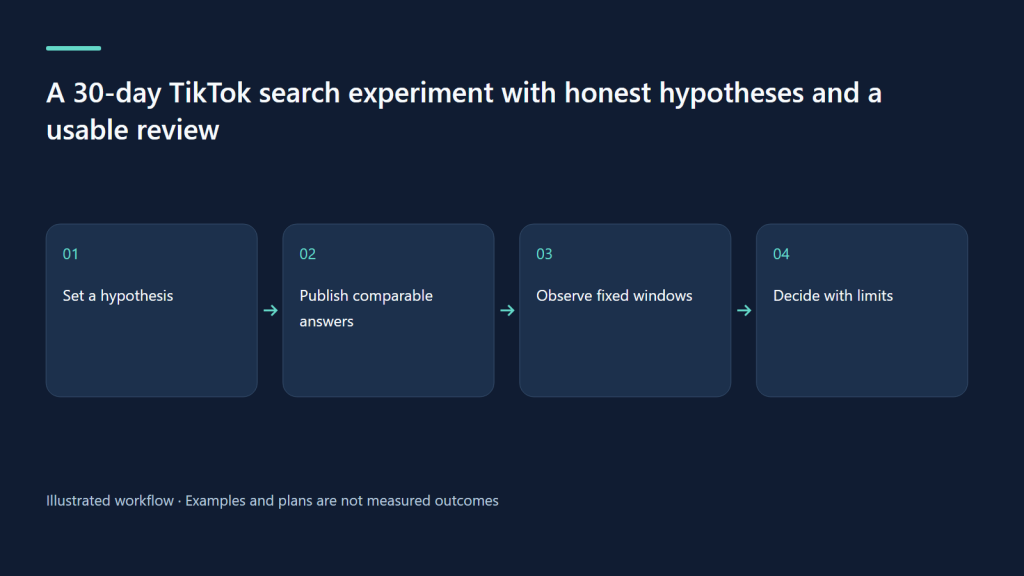
A thirty-day experiment should produce a better editorial decision, not a dramatic success narrative. The plan below is proposed work for an adult creator; it is not an account case study and contains no claimed private analytics. Its purpose is to test whether clearer, question-led lessons attract relevant adult responses and become easier to understand. Reach, ranking and income remain uncertain.
Choose a question small enough to investigate
“Can I grow on TikTok?” is too broad for a useful month of testing. A more manageable hypothesis is: “For parents planning home STEM activities, showing the finished result before the setup may improve understanding of the lesson’s purpose.” Another is: “A caption naming the adult audience and materials may reduce repeated preparation questions.” Choose one primary question and resist changing it halfway through because a different metric looks attractive.
TikTok publishes recommendation factors but no universal recipe for this experiment. Consult the official recommendation explanation. Creator Search Insights can contribute topic leads if available; its launch announcement specifies selected-region availability. Neither document turns this proposed schedule into a guaranteed growth method.
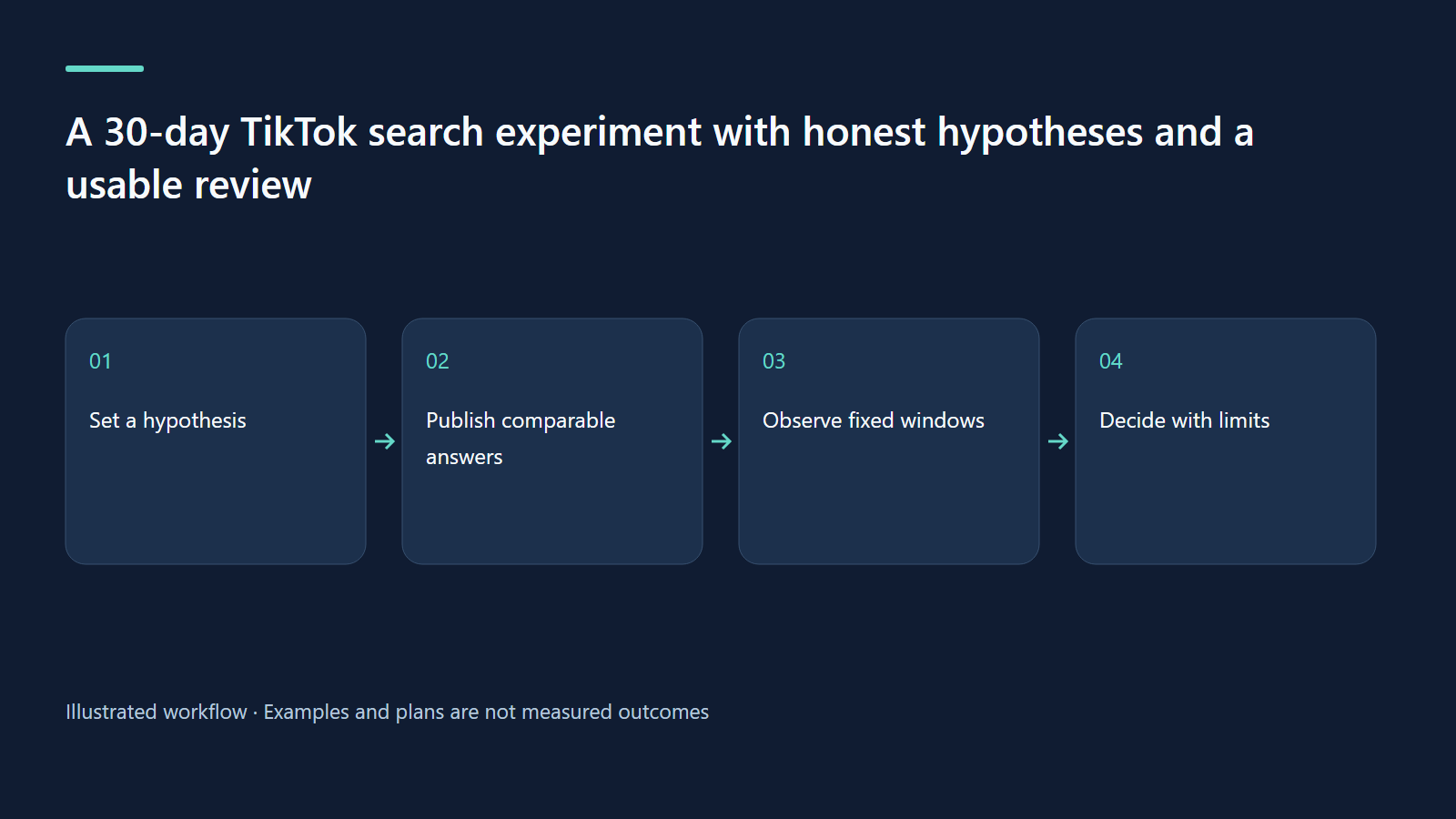
Days 1–5: define the audience, evidence and workload
Choose an adult audience with a specific task, such as parents preparing low-cost indoor activities. Select three lesson questions you can demonstrate safely and accurately: setting up a paper bridge, comparing fold shapes and keeping a comparison fair. Prepare all materials and verify each explanation before recording. If the account instead teaches AI-assisted lesson production, choose outline preparation, diagram review and export checking. Do not mix unrelated audiences in the same small experiment.
Write a brief for each video with its question, intended adult, constraint, opening and final answer. Decide a realistic publication pace based on production time. Six strong videos can be more useful for this exercise than a daily schedule that forces shallow work. Record how long preparation, filming and review take, because a format that performs well but cannot be maintained may not be the best choice.
| Period | Work | Record |
|---|---|---|
| Days 1–5 | Research, briefs and materials checks. | Hypothesis, audience and unavailable data. |
| Days 6–17 | Publish six comparable lessons at a sustainable pace. | Version, question and production time. |
| Days 18–24 | Observe fixed post-age windows and review questions. | Available metrics and comprehension issues. |
| Days 25–30 | Compare patterns and write the next decision. | Evidence, uncertainty and the next test. |
Keep the comparison understandable
If testing the opening, prepare paired formats: result first and question first. Keep the adult audience, explanation quality and intended next action comparable. The lessons can differ enough to avoid publishing duplicates, but document those differences. This is an editorial comparison rather than a randomized controlled test. Different topics, viewers, times and ordinary fluctuations can still explain differences in performance.
Days 6–17: publish complete answers
Each lesson should stand alone. A parent who sees the third upload needs the materials, the basic setup and the outcome, not an instruction to watch two earlier posts before understanding anything. Use a natural topic sentence, legible labels and a caption that states the scope. Choose truthful hashtags if used; no particular count is treated as a performance mechanism.
Before publishing, watch on a phone, check audio intelligibility and correct subtitles. Record the final script version. If an important factual or safety error appears after publication, correct it appropriately and mark the video as unsuitable for a clean comparison. Protecting accuracy takes priority over preserving experimental symmetry. Do not keep a misleading lesson online merely to avoid changing the dataset.
Days 18–24: observe without rewriting the story
Review videos at the same number of days after publication. If some uploads have not reached that age, schedule a later follow-up rather than comparing uneven windows. Capture only metrics actually present in the account. Record search-related performance separately when available, and write “unavailable” when it is not. Read relevant adult questions and classify them by topic: materials, setup, explanation or next action.
Use descriptive notes alongside totals. “Three adults asked about cup spacing” suggests a clearer setup scene. “Many comments mention the dramatic collapse, but none refer to the activity” may indicate that the hook overshadowed the lesson. These are interpretations to investigate, not proof of the audience’s private intentions. Do not infer learning success from likes alone.
Practical exercise: write the review before seeing the results
Prepare a blank review with four sentences: “We tested…,” “We observed…,” “We cannot determine…,” and “Next we will….” Fill only the first sentence before publication. Define the main success measure, such as relevant adult checklist requests or fewer repeated setup questions. A small sample may produce no clear winner; write that possibility into the plan so uncertainty is an acceptable outcome.
At the end, fill the review using the original hypothesis. Include production time and quality issues, not just reach. If one format is easier to produce and communicates equally well, that can be a useful operational finding. If one topic receives relevant questions but the opening comparison is inconclusive, continue investigating the topic without claiming the opening caused success.
Days 25–30: make a narrow next decision
Choose among continuing, revising or stopping the specific format. Continue when several comparable lessons support a useful pattern and the workload is sustainable. Revise when the audience need is evident but the explanation is confusing. Stop when you cannot demonstrate the answer reliably or when the topic does not serve the intended adult audience. None of these decisions requires a fabricated growth percentage.
If the month includes a viral outlier, report it separately and inspect whether it serves the goal. If there is no clear pattern, identify the largest uncertainty and design a smaller next test. The value of thirty days is a record of honest production and observation: reusable briefs, clearer lessons and a decision whose limits are visible.
Related learning paths
Related reading
08 Oct 2026 · 5 min read
TikTok SEO
TikTok search and For You: design for two different discovery moments
Build a useful answer for searchers without losing the visual proof that makes a recommendation worth watching.
Read more
08 Oct 2026 · 5 min read
TikTok SEO
Creator Search Insights: turn topic signals into a defensible content brief
Use search topics and content gaps as research leads, then validate audience fit and your ability to deliver a complete answer.
Read more
08 Oct 2026 · 5 min read
TikTok SEO
TikTok SEO across script, caption and screen: one promise in three forms
Coordinate the spoken explanation, post caption and visible labels so an adult viewer understands the task and can act on it.
Read more
Discussion
Comments are reviewed before publication. Your email is kept private.