
JOURNAL
TikTok SEO across script, caption and screen: one promise in three forms
Coordinate the spoken explanation, post caption and visible labels so an adult viewer understands the task and can act on it.
On this page
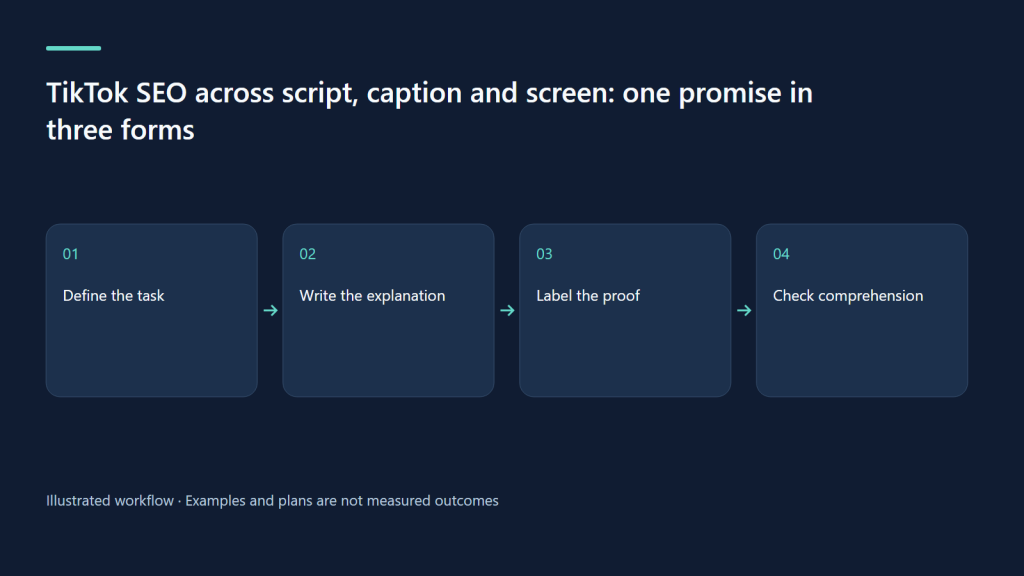
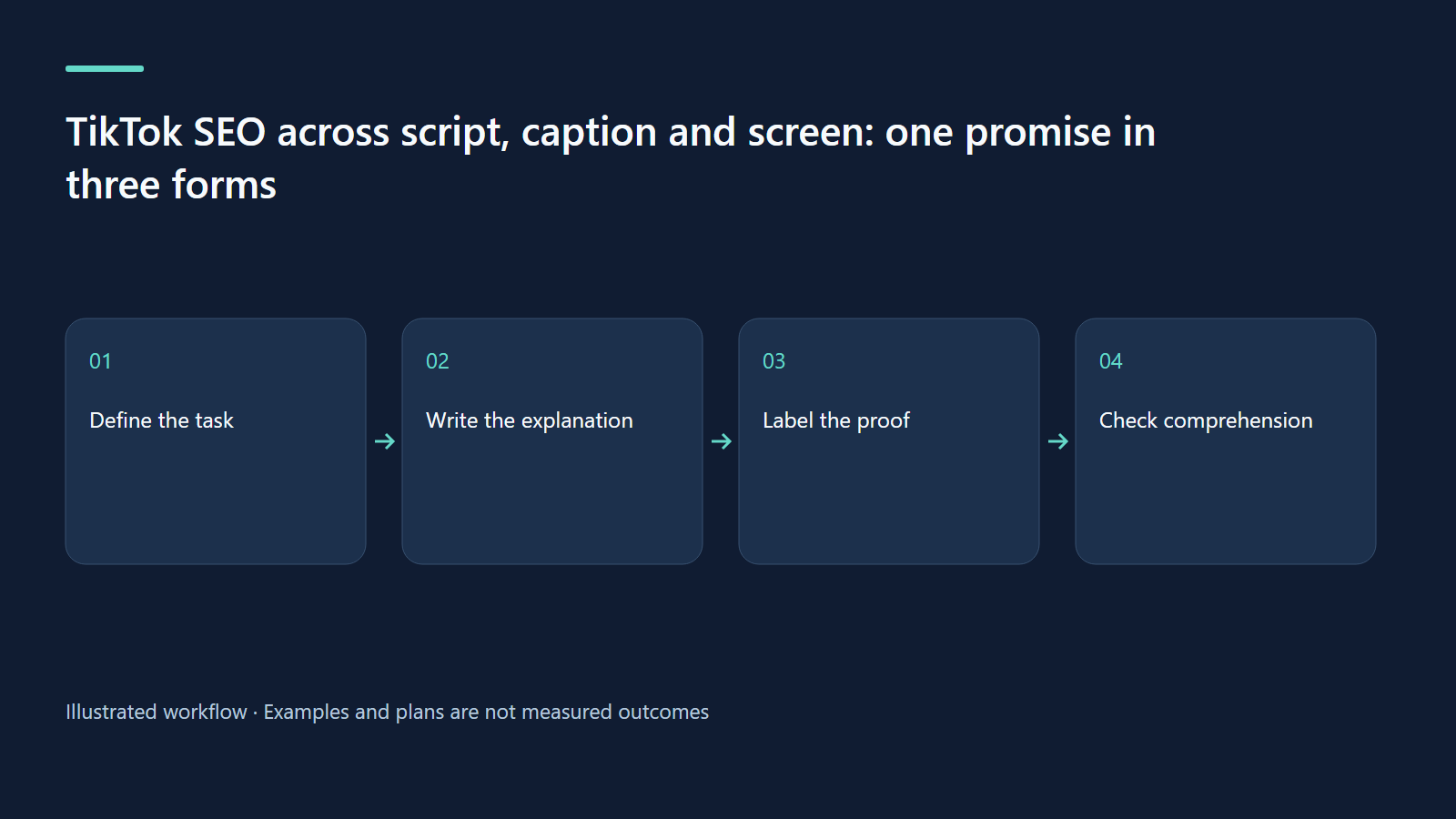
The script, post caption and on-screen text should describe the same useful outcome. They do not need to repeat an identical sentence. A script carries the explanation over time, a caption gives context around the post, and visible labels help people follow the demonstration. Treating all three as keyword containers usually creates a video that is harder to watch and less convincing.
Start with a single editorial promise
Write the promise before choosing phrases: “An adult teacher can turn a verified lesson outline into a short visual explanation.” That sentence identifies the audience, the starting material and the result. It also sets a boundary: the video is not promising that AI can replace subject knowledge or that a finished lesson will automatically attract students. Every scene should help deliver this narrower promise.
TikTok’s public recommendation documentation describes several signals, including search relevance and content information. It does not establish a fixed formula for placing a phrase in speech, screen text and captions. Refer to the official recommendation explanation. The workflow below is an editorial method for clarity, not a claim about guaranteed transcription or optical-character-recognition ranking benefits.
Write the script as an answer, not a software tour
For “tạo video bài học bằng AI,” the first scene can show the finished lesson and say: “Here is how I turn a checked outline into a short lesson video, including the review before export.” Then show the outline, one visual decision, a factual check and a preview. Interface clicks matter only when they help someone reproduce the task. A long recording of menus can consume attention without explaining why any decision was made.
A useful script names the constraint: no live footage, a limited preparation window or a bilingual audience. It explains the decision, then shows the result. For example, “This diagram needs three labels, so I simplify the frame before animating it” is more helpful than “Click generate and wait.” The viewer learns a reusable judgment rather than memorizing a button whose location may change.
| Surface | Example | Purpose |
|---|---|---|
| Spoken opening | “Create a short AI-assisted lesson from a checked outline.” | State the useful task. |
| Screen label | “Step 2: verify the diagram labels” | Locate the current decision. |
| Post caption | “For adult teachers: outline, visuals, factual review and export.” | Explain scope and audience. |
| Final prompt | “Which review step is hardest in your preparation?” | Invite a relevant adult response. |
Captions for accessibility need an accuracy pass
Subtitles and the post caption serve different purposes. Subtitles represent what is spoken; the post caption can summarize the topic and add context. Review automatic subtitles for Vietnamese diacritics, names, technical terms and numbers. A mistaken label such as “force” becoming an unrelated word can change the lesson. Correcting it is worthwhile even if no distribution benefit can be demonstrated.
Keep labels close to the objects they explain, leave enough time to read them and avoid placing essential instructions where interface controls obscure them. Preview on a real phone at ordinary size. When a diagram has too many details, simplify the scene or split the explanation. Tiny text is not rescued by being technically present in the frame. The standard is whether a person can understand it during playback.
Localize meaning rather than copying word order
An English version and a Vietnamese version can share the same demonstration while using different phrasing. “AI-assisted lesson video” might become “video bài học có hỗ trợ AI,” with the surrounding sentence making clear that a teacher reviews the result. Preserve the learning objective, constraints and caveats. Do not force an English technical phrase into every Vietnamese line if a natural explanation is clearer.
Record the voiceover against the actual scene duration. Vietnamese phrasing may need a different reading pace, so translating after the edit is locked can produce rushed narration. Allow the visual proof to remain on screen long enough for both languages. If only one version is published, avoid stuffing two full captions into the same small visual area; prioritize the intended audience’s reading experience.
Practical exercise: perform a three-surface audit
Write a short script with an opening result, two decisions and a final preview. Under it, write the post caption and every screen label. Highlight phrases that describe different promises. If the opening promises a complete lesson but the caption promises only a prompt template, choose the scope and align both. Then ask a colleague to watch without sound and explain the task; repeat with audio but without looking at the screen. Each mode should provide enough context to follow the central idea.
This is not a requirement to duplicate the whole explanation everywhere. It is a way to discover missing context. The visual version might need a “before” label; the audio might need the name of the material; the caption might need the audience and preparation constraint. Make the smallest correction that resolves the misunderstanding, then review the complete playback again.
Troubleshooting a clear topic with weak comprehension
If viewers ask which tool was used even though the lesson is about review quality, the interface may dominate the demonstration. If they understand the tool but not the output, show the finished sample earlier. If they quote a wrong fact, examine subtitles and diagram labels before blaming attention. If a keyword-rich caption accompanies an unrelated video, rewriting metadata cannot repair the missing answer; change the content brief.
Keep a record of the script version and the questions received. Use those questions to improve the next explanation. Repeating a phrase more often is a weak default because it changes language without necessarily changing understanding. Better alignment means the three surfaces support one credible answer, with a visible result and an honest account of the work required.
Related learning paths
Related reading
08 Oct 2026 · 5 min read
TikTok SEO
TikTok search and For You: design for two different discovery moments
Build a useful answer for searchers without losing the visual proof that makes a recommendation worth watching.
Read more
08 Oct 2026 · 5 min read
TikTok SEO
Creator Search Insights: turn topic signals into a defensible content brief
Use search topics and content gaps as research leads, then validate audience fit and your ability to deliver a complete answer.
Read more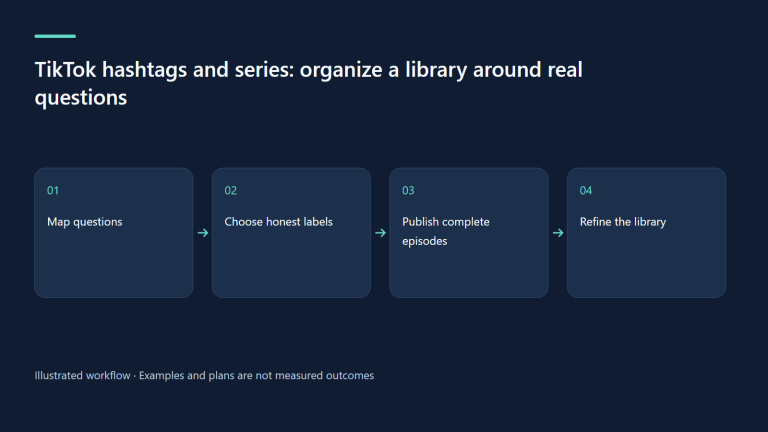
08 Oct 2026 · 5 min read
TikTok SEO
TikTok hashtags and series: organize a library around real questions
Use truthful topic labels and standalone episodes to make an educational content library easier to navigate and evaluate.
Read more
Discussion
Comments are reviewed before publication. Your email is kept private.