
JOURNAL
TikTok search and For You: design for two different discovery moments
Build a useful answer for searchers without losing the visual proof that makes a recommendation worth watching.
On this page
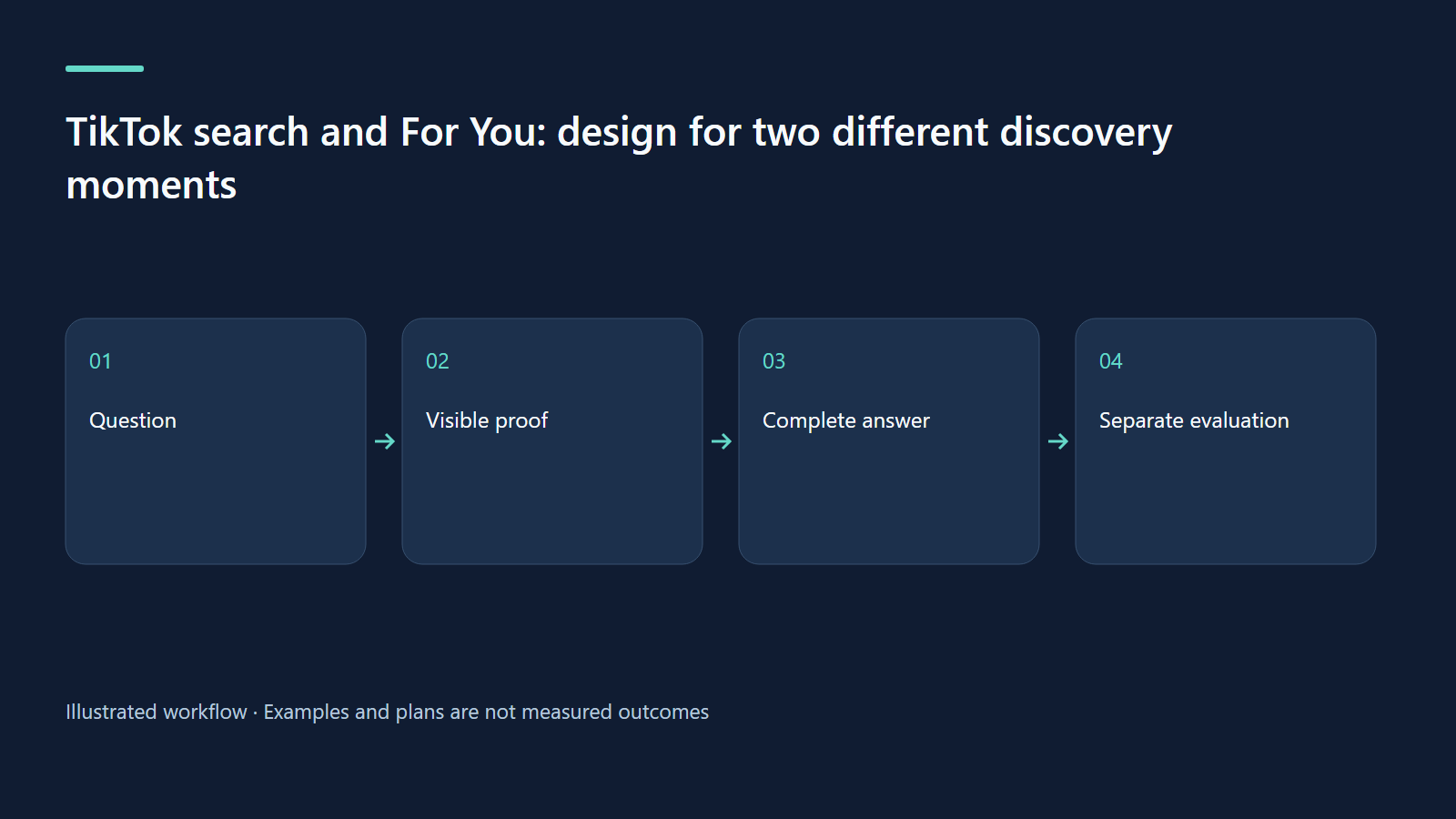
A TikTok video can meet someone who is actively asking a question and someone who has not yet decided that the topic matters. Those are different editorial situations. A parent searching for a home activity already has a practical need. A parent scrolling past a paper bridge needs to understand, almost immediately, why watching the demonstration could be useful. Planning for both moments is more productive than choosing between “SEO content” and “viral content.”
What the platform says, and what the editor must decide
TikTok describes recommendations using interactions, content information and user information. For search, matching the query is among the published considerations; For You uses a personalized recommendation process. This does not provide a universal scoring formula. See TikTok’s explanation of content recommendations.
The editorial consequence is our interpretation: a clear question gives the video a useful promise, while an observable result gives viewers a reason to stay. Neither component guarantees distribution. A demonstration that answers the wrong question may attract curiosity without helping the intended audience. A precise answer delivered through a long introduction may lose people before the useful part arrives. The job is to connect the promise and the proof.
A worked example: a paper bridge activity for parents
Consider the Vietnamese query “hoạt động STEM cho bé tại nhà.” It describes a broad category, so a single video should narrow the promise: “Paper bridge experiment for ages 6–8, using one sheet of paper and two cups.” The creator is an adult addressing parents. The demonstration can use an adult’s hands and objects rather than exposing a child’s identity. Age ranges describe the offline activity, not an invitation for children to create social accounts.
Open with the folded bridge supporting a small stack of coins. Then show the flat sheet collapsing under the same load. This is a visual comparison, not a sensational claim. Explain that folding changes the structure, identify the materials, and show where to place the cups. End with a question parents can ask offline: “Which shape do you predict will hold more?” Mention adult supervision and avoid small objects if the activity will be used around younger children.
| Moment | Viewer’s question | Editorial response |
|---|---|---|
| Search | Can I do this at home with available materials? | Name materials, age suitability and the complete setup. |
| For You | Why should I care about this bridge? | Show the load comparison before the explanation. |
| After watching | What should I do next? | Offer a materials checklist or a related experiment. |
Do not turn specificity into a keyword recital
A useful opening is a sentence a parent might actually say: “Here is a ten-minute paper bridge activity you can try at home.” Repeating “STEM,” “kids,” “education,” and “home experiment” in every line makes the explanation less clear. The topic should emerge from the task, the demonstration and the caption. Text, speech and visible objects should agree for human comprehension; this is not a claim that any particular speech or image-recognition signal has a fixed ranking weight.
Choose a success measure before recording
If the purpose is to help parents use the activity, saving a checklist or asking a setup question may be more informative than a burst of casual views. If the purpose is to introduce a teacher’s approach, profile visits and qualified inquiries may matter. Define “qualified” in advance, such as an adult asking about age suitability or lesson preparation, rather than treating every comment as buying intent.
Compare discovery sources only when the account’s analytics actually exposes them. Record unavailable fields as unavailable. A search-oriented video can receive For You exposure, and a visually strong video can later answer a search. The categories describe how people arrive, not permanent labels for the content. Evaluate videos at the same age after publication so a week-old lesson is not compared with one uploaded an hour ago.
Practical exercise: rewrite a broad idea into an answer
Start with “fun science for children.” Write the specific adult problem underneath it: “I need an inexpensive indoor activity for a rainy afternoon.” Draft a title that names the activity and the constraint. Then write the opening visual, the materials sentence, the two most important instructions and the final result. Ask another adult to explain what they can do after watching. If they cannot name the setup, improve the explanation before experimenting with metadata.
For a second version, change only the opening: start with the failed bridge, then reveal the stronger version. Keep the materials, caption scope and intended next step comparable. This is a proposed creative test, not a controlled platform experiment. Different viewers, timing and ordinary variation can influence the outcome.
Troubleshooting conflicting results
If views rise but practical questions do not, the opening may entertain a broader audience than the lesson serves. Examine whether the first scene promises a spectacle while the rest promises teaching. If useful comments arrive despite modest reach, do not discard the topic automatically; it may deserve clearer framing or a second, more accessible demonstration. If people repeatedly ask for information already in the video, the information may be too brief, too small or buried behind an unrelated introduction.
Do not infer suppression from one disappointing upload or success from one unusually strong result. Look for repeated patterns across a small group of comparable lessons. TikTok states that accounts generally require users to be at least 13, subject to its terms and local rules; these examples are for adult creators and parents, with children learning offline. Consult TikTok’s teen privacy and age guidance. The useful long-term asset is a library of answers people can understand and apply, with a process that separates evidence from guesses about the platform.
Related learning paths
Related reading
08 Oct 2026 · 5 min read
TikTok SEO
Creator Search Insights: turn topic signals into a defensible content brief
Use search topics and content gaps as research leads, then validate audience fit and your ability to deliver a complete answer.
Read more
08 Oct 2026 · 5 min read
TikTok SEO
TikTok SEO across script, caption and screen: one promise in three forms
Coordinate the spoken explanation, post caption and visible labels so an adult viewer understands the task and can act on it.
Read more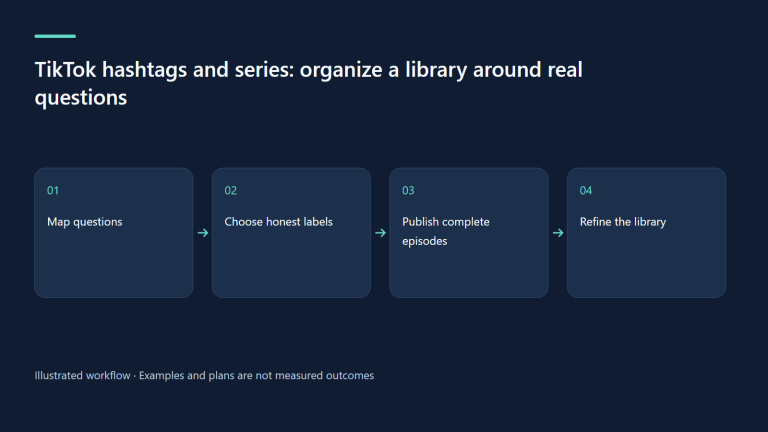
08 Oct 2026 · 5 min read
TikTok SEO
TikTok hashtags and series: organize a library around real questions
Use truthful topic labels and standalone episodes to make an educational content library easier to navigate and evaluate.
Read more
Discussion
Comments are reviewed before publication. Your email is kept private.