
JOURNAL
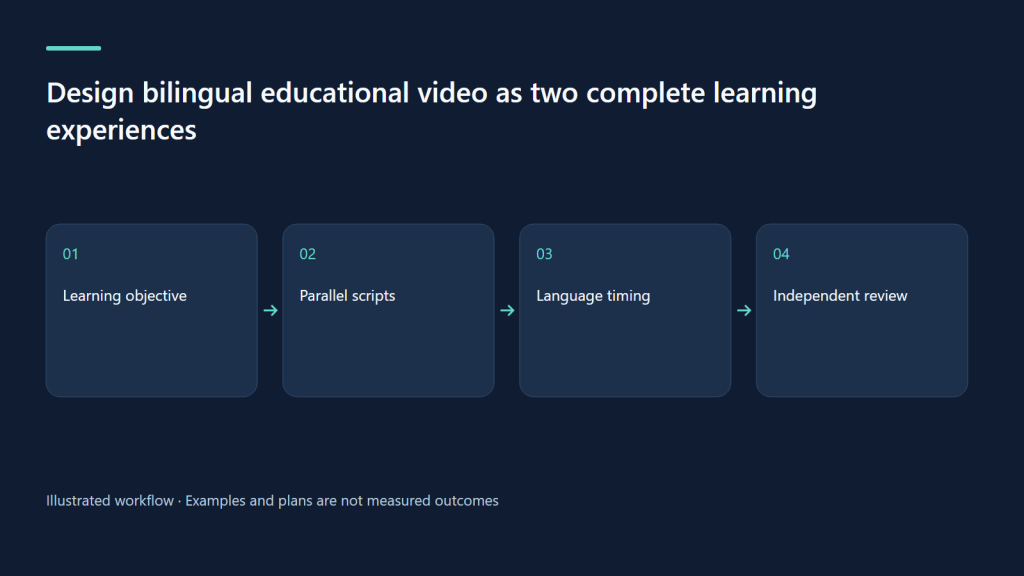
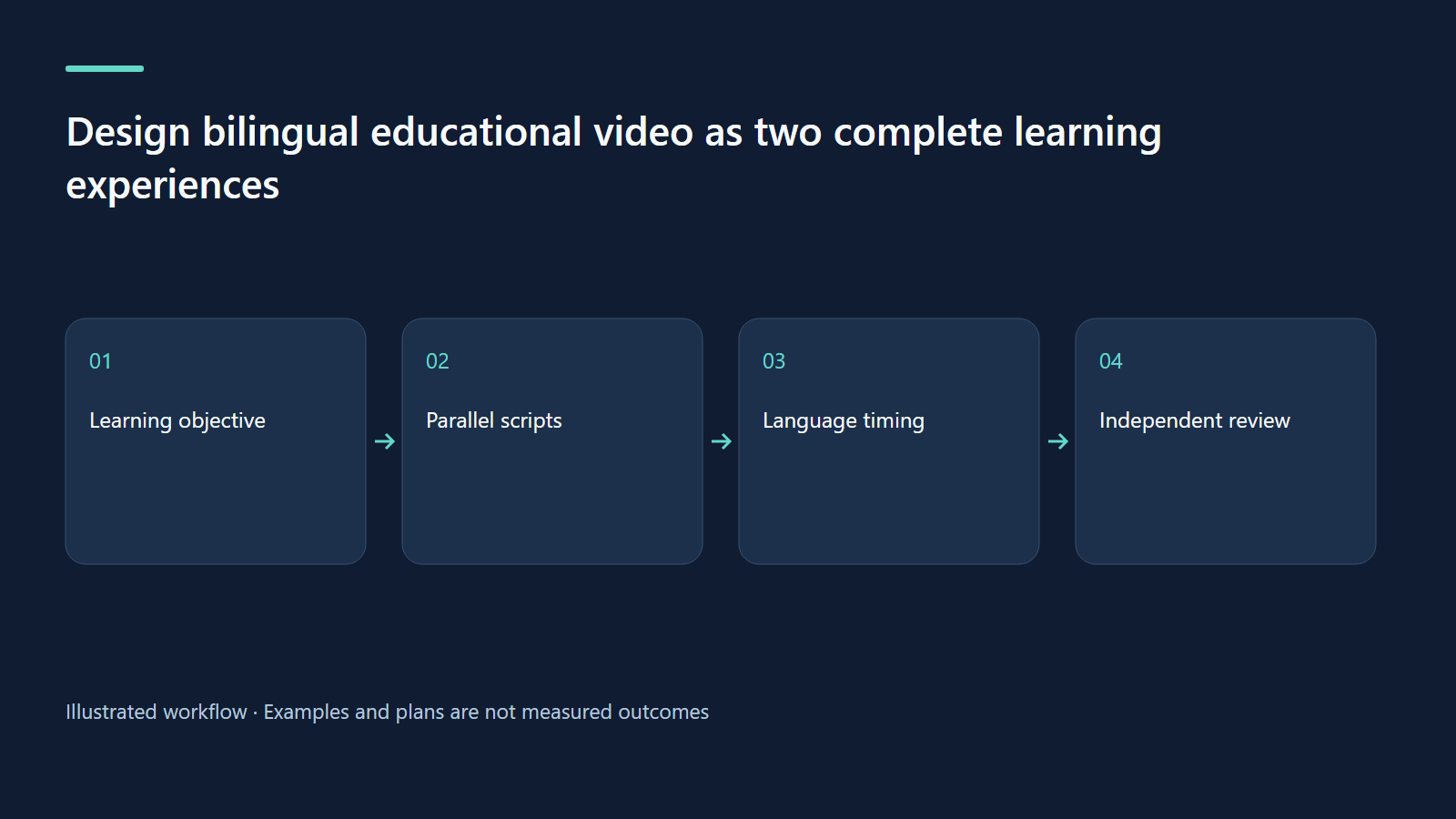
Design bilingual educational video as two complete learning experiences
Translation must preserve the learning action while voice, cues, captions and pacing are reviewed separately.
On this page
Translation must preserve the learning action while voice, cues, captions and pacing are reviewed separately.
Define an observable objective
A bilingual lesson needs one clear learning action before translation starts. The viewer might match a number to a group, identify a shape or explain why a character should ask for help. “Learn English and Vietnamese” is too broad for one short video. Write what the viewer should be able to do, what visual evidence supports it, and how the quiz will reveal understanding. The language versions should preserve that action even when the sentences differ.
Choose an age band and the assumed language familiarity. A six-year-old hearing English for the first time needs a different vocabulary load from a bilingual ten-year-old. Avoid confusing translation with immersion: a translated narration may be understandable only when the viewer already knows the language. Decide whether the video teaches a concept in each language or explicitly teaches words across languages. Those are different instructional goals, and the opening should tell the adult selecting the lesson which one they are getting.
Use parallel meaning rather than identical sentence shapes
Draft the stronger language first, then create a second script that preserves the same concept, question and answer. A literal translation can sound formal or unnatural. Vietnamese may use a warm final particle while English uses a short invitation. Both can communicate reassurance without matching word for word. Compare scene by scene rather than checking only the title. Ask whether each version names the same object, gives the same instruction and explains the same correct response.
In video.json, text can use vi and en objects. Narration fields need both languages, including answerSay in quiz scenes. Numbers spoken aloud should be written to produce the intended pronunciation, while the visual can keep a digit. Symbols that genuinely remain unchanged may use a shared string. Do not put decorative emoji inside narration text; use the icon or emoji fields designed for graphics. This keeps spoken content, subtitles and visual assets easier to review independently.
Plan one reveal per understandable sentence
The lesson builder uses sentence cues for card and object reveals. Write the visible progression and spoken progression together. If three objects appear, the viewer should hear the relevant count while that object becomes available. A long sentence listing everything can destroy this connection. After generating speech, inspect cue files and preview the scene. A warning that reveals are being spread evenly is a reason to revisit the wording, especially for a beginner audience.
Do not require Vietnamese and English to have the same runtime. Voice speed, sentence length and pronunciation differ. Review each build as a complete listening experience and allow natural breathing space. If the English version is too long, shorten an introduction or remove redundant explanation before accelerating it. The educational requirement is time to understand and respond. Matching a spreadsheet's duration is less important than an answer that arrives only after the viewer has had a fair chance to think.
Design a quiz that tests the concept
Use one question with plausible choices rather than trick answers. In a count lesson, neighboring numbers can reveal whether the viewer actually counted. A quiz needs its question narration, a thinking interval and answer narration. In the lesson schema, answer is zero-based, so the second choice has index one. Check the resulting highlight visually; an apparently sensible JSON file can still encode the wrong option. The answer should state the result and a simple reason, then offer kind encouragement.
For Vietnamese letters narrated with an English voice, avoid relying on pronunciation that the voice cannot reliably produce. Keep the letter visible and use a clear positional or descriptive instruction where appropriate, such as the letter with a hook. Listen to the actual generated audio rather than imagining how the text should sound. A bilingual adult or knowledgeable reviewer should inspect language-specific examples, because a culturally familiar object or mnemonic may not transfer cleanly.
Keep visuals calm and captions useful
Give the main object room, keep text short and reserve clear space for captions. Test phone readability rather than assuming a large desktop preview represents the viewing context. One scene should advance one idea. Use motion to show sequence or emphasis, not to fill every pause. A thinking interval is productive time, so avoid revealing the answer through an animation while the countdown is still running. Consistent icons help recognition, but verify that the object is unambiguous in both language contexts.
Worked example: finding three fish
The objective is to choose the group containing three fish. The Vietnamese version invites the child to count slowly; the English version says “Let's count the fish.” Both display the same three choices and preserve the same correct answer. The adult listens to the counting cues, verifies that the fish do not disappear under captions, and checks that the answer begins after the thinking interval. If English needs a longer opening, its scene timing changes independently. The shared educational structure remains intact.
Exercise and troubleshooting
Make a comparison sheet with one row per scene and columns for objective, Vietnamese narration, English narration, visible object and review note. Include one quiz and explain why each wrong choice is plausible. Ask reviewers to summarize the lesson independently in both languages. If the summaries differ, fix meaning before timing. If cues are missing, split or rephrase sentences and regenerate speech. If captions crowd the frame, simplify visible text. If pronunciation is unclear, adjust the script or voice and review again. Never assume a successful build proves a successful lesson.
| Design layer | Shared between languages | Reviewed independently |
|---|---|---|
| Objective | Action and correct answer | Age and language familiarity |
| Script | Meaning and visual referent | Natural phrasing and pronunciation |
| Timing | Reveal intention | Audio length and cues |
| Quiz | Concept and plausible choices | Pause and spoken explanation |
Sources and evidence boundary
Watch the source-backed local demo
These HyperFrames clips use the actual Studio UI at source commit 238bba2, with repository fixtures. Narration is English; caption tracks provide an English transcript and Vietnamese summary. Cue timing is authored at sentence level. AI, embedding and YouTube services are simulated; no family data or real channel uploads are shown.
Review both languages together
MP4 · English transcript · Tóm tắt tiếng Việt
What was actually verified
We authenticated a fixture parent profile, opened creation, script, SEO and queue screens, edited paired titles, saved and read the saved source through the local API. Seven UI captures completed without page errors. The videos illustrate this limited workflow; the Studio render pipeline, child workflow and live YouTube upload were not exercised in this capture.
Try the same review exercise
Choose “count three apples” as the objective. Compare both titles and every scene against that objective. Save, reopen, and verify the pair. Before publication, separately check narration, the number of visible objects, quiz answers, audience settings and the final rendered file. A high internal SEO score cannot replace these checks or guarantee discovery.
Related learning paths
Related reading
08 Oct 2026 · 5 min read
AI Video
A child’s first AI-assisted film: a calm family workshop
A practical workshop gives children meaningful creative choices while adults own verification, spending and publication.
Read more
08 Oct 2026 · 6 min read
AI Video
Bé Vui Học Studio architecture: a private production app with a public learning front door
A source-based case study of role boundaries, file-backed production, jobs, semantic search and host-separated publication.
Read more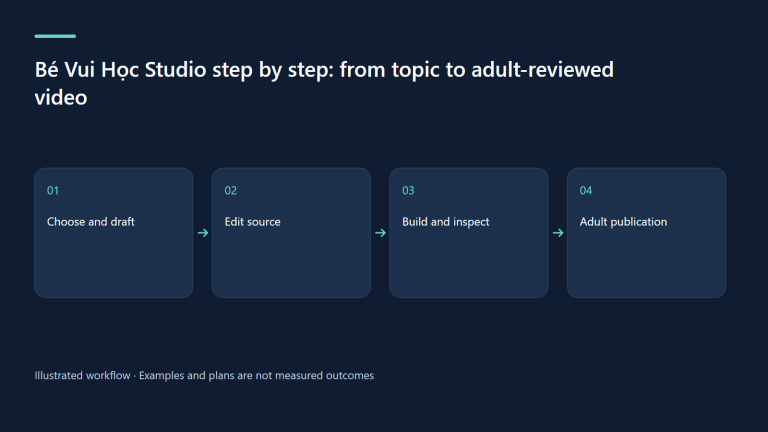
08 Oct 2026 · 7 min read
AI Video
Bé Vui Học Studio step by step: from topic to adult-reviewed video
Follow source, voice, build and review while respecting child and parent roles.
Read more
Discussion
Comments are reviewed before publication. Your email is kept private.