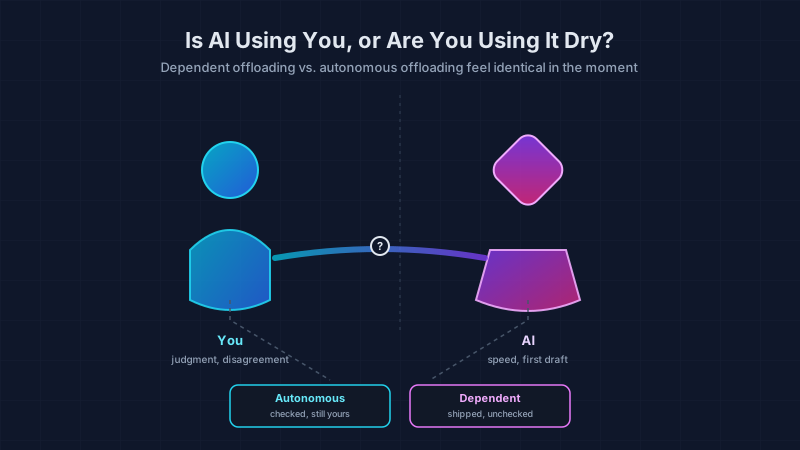
My friend watched me juggle three tabs and said it flat: “I don’t know if AI is controlling you, or if you’re using it until you squeeze it dry.” Then he laughed. I laughed too. Then I sat there for a few seconds not laughing.
Not because the line was clever. Because it was true and I didn’t have an answer ready.
It was around 9pm, a coffee shop near my place. Four tabs open: Claude running a refactor task, ChatGPT open for an old API lookup, Notion AI summarizing a meeting I’d half-listened to, my phone counting down to the Max quota reset. He wasn’t being sarcastic. He was just describing what he saw.
Last month I joked here about running a one-person company with sixteen employees, fourteen of them AI, one subscription each. Funny at the time. Reading it back, the joke was actually a real question wearing a costume.
There’s a study out this year that maps this better than I can from memory. 589 people, students and early-career workers, tracked across three waves two weeks apart. It splits AI use into two modes. “Dependent offloading”: take the AI’s answer, barely check it, ship it as final. “Autonomous offloading”: use the AI’s output as a starting point, argue with it against your own judgment, keep the final call.
Short term, both modes feel identical. Same speed, same relief, same “done.” The gap only shows up later. Dependent offloading tracks with lower motivation to do the work yourself and a measurable drop in independent judgment. Autonomous offloading tracks the opposite: higher motivation, more confidence doing original work. A separate study with 666 people found the same shape from another angle. Heavier AI use correlated with weaker critical thinking, and cognitive offloading was the mechanism connecting the two.
Here’s the part that actually worries me. The researchers found people can’t tell which mode they’re in just from how it feels in the moment. Both feel like “great, that’s handled.” So sitting around asking yourself whether you’re being controlled gets you nothing. The feeling answers “no, you’re fine” either way.
So I checked one evening instead of guessing. Building a client’s site that night, I overruled Claude twice on architecture calls it proposed. That’s autonomous, I did the work of disagreeing. The post I put up last month is a different story. I took a full draft from Grok, didn’t read it closely, published it. Found out three weeks later it wasn’t my voice. That one’s dependent. No excuse for it.
So the line my friend threw out isn’t a yes or no question. It’s two tracks running through the same person on the same day. Morning: arguing with a model about a database schema. Afternoon: rubber-stamping a draft it handed me. There’s no clean version of “using AI correctly.” There’s just each task, and whether you actually checked it or not.
That night I went back and reread the old draft line by line, hunting for the parts that sounded fake. Found a handful. Fixed most of them. Texted my friend: “Just squeezed it one more round. Done.” He saw it. No reply.
That’s an answer too.
References
- Frontiers in Psychology (2026): “Not all cognitive offloading is equal: distinguishing dependent and autonomous offloading to generative AI”
- Gerlich, M. (2025). AI usage and critical thinking: study on 666 participants examining cognitive offloading as the mediating mechanism between generative AI use and critical thinking decline.