
JOURNAL
When AI makes code cheap: why the billable-hour model of software outsourcing is being torn down and rebuilt
AI makes an hour of coding worth more but makes billing by the hour worth less. The shift from T&M to outcome-based pricing, seen by CEOs, engineers, clients and investors.
On this page
For more than twenty years, software outsourcing companies have run on a formula so simple that everyone in the industry knows it by heart:
Revenue = Headcount × Hours worked × Hourly rate
Overseas clients accepted paying by the hour, the Time & Materials (T&M) model, because they understood that writing and testing a given volume of code took a given number of people a given amount of time. Hours were the closest proxy for the amount of work, so they became the unit of billing.
Claude, Copilot, Cursor and the new generation of coding agents have knocked that proxy out of alignment. When a job that used to take two people a week can be finished by one person in a few days, the question is no longer “how many hours did your team work?” but “what exactly am I paying for?”
This article covers four things: how much AI really raises developer productivity, why the billable-hour model contradicts itself in the age of AI, how risk moves when vendors sell outcomes instead of time, and how each role in the value chain, including the client and the investor, sees the shift. It ends with a few counterpoints, because the story is not as simple as “the billable hour is dead”.
1. AI does raise productivity, but far less evenly than people think
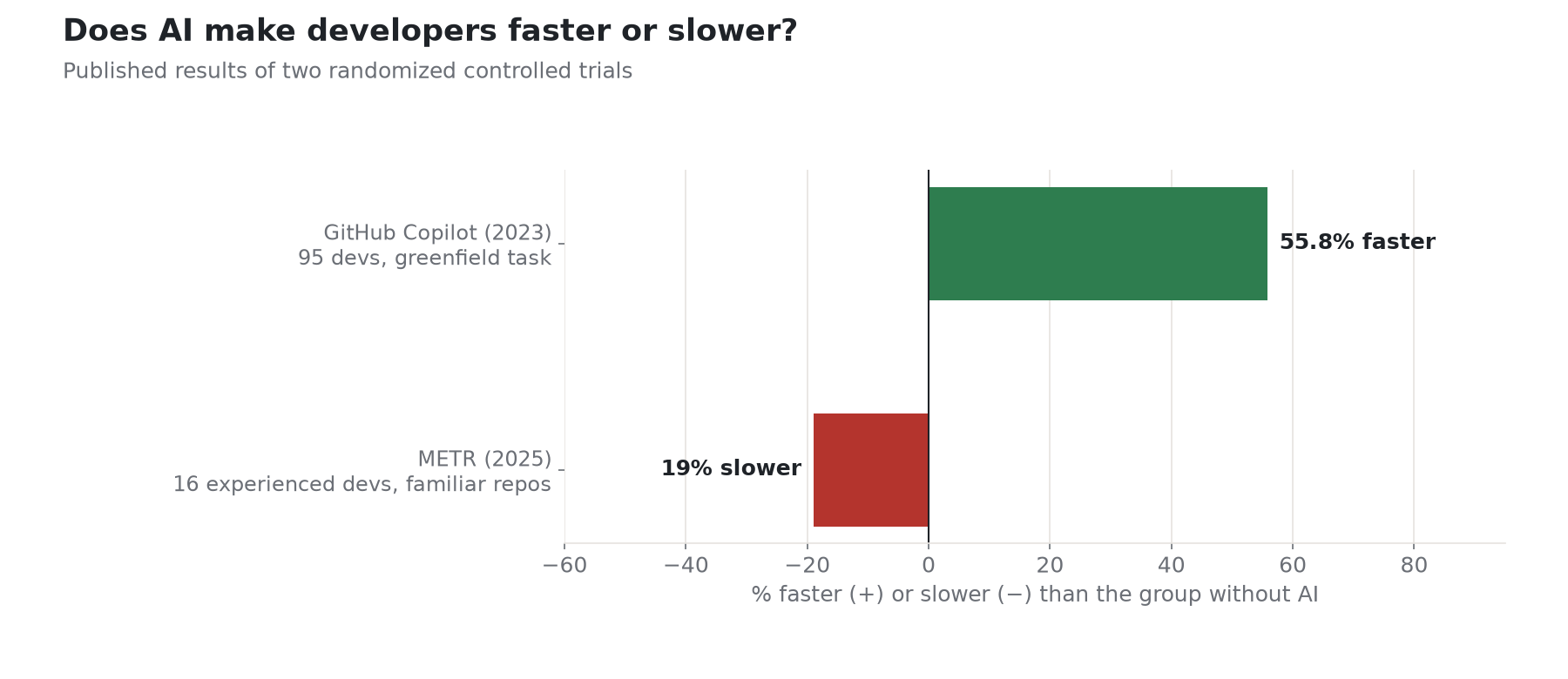
The most quoted figure comes from a 2023 controlled experiment by GitHub and MIT researchers. Ninety-five professional developers were randomly split into two groups and asked to build the same HTTP server in JavaScript. The group with Copilot finished 55.8% faster: about 1 hour 11 minutes against 2 hours 41 minutes for the control group (Peng et al., arXiv 2302.06590; GitHub Blog).
That was a small greenfield exercise on an empty codebase. When METR ran a different randomized trial in mid-2025, with 16 experienced open-source maintainers working on 246 real tasks in repositories they knew well, the result went the other way: with AI tools they were 19% slower. The most striking detail is that before starting they expected AI to make them 24% faster, and after finishing they still believed it had made them about 20% faster (The Register; DX newsletter).
Google’s 2025 DORA report, based on nearly 5,000 technology professionals, offers a useful frame: AI is an amplifier. Teams with strong engineering practices see throughput rise clearly. Weaker teams see delivery instability go up, because code is generated faster than they can review, test and operate it (DORA 2025 report; InfoQ).
Putting the three sources together, the realistic picture is:
- For new, well-specified, loosely constrained work (prototypes, CRUD, scripts, test cases, repetitive migrations), a 1.5× to 2× speed-up is real.
- For legacy systems, complex domain logic and heavy dependencies, the gain is much smaller and sometimes negative.
- The most time-consuming parts of a project (clarifying requirements, design, integration, regression testing, operations) have not shrunk in proportion.
Here is the key point, though: commercially, the client’s perception matters more than the average. Clients already believe AI has made code cheaper, and they are negotiating on that belief. Reuters (August 2026) quotes Persistent Systems CEO Sandeep Kalra saying clients want the same work for 25% to 30% less, delivered faster. Wipro CEO Srini Pallia has likewise estimated that AI-assisted software development will cost about 25% less (The Star / Reuters; The Star / Reuters, January 2026).
2. The billable-hour paradox: the better you use AI, the less you earn
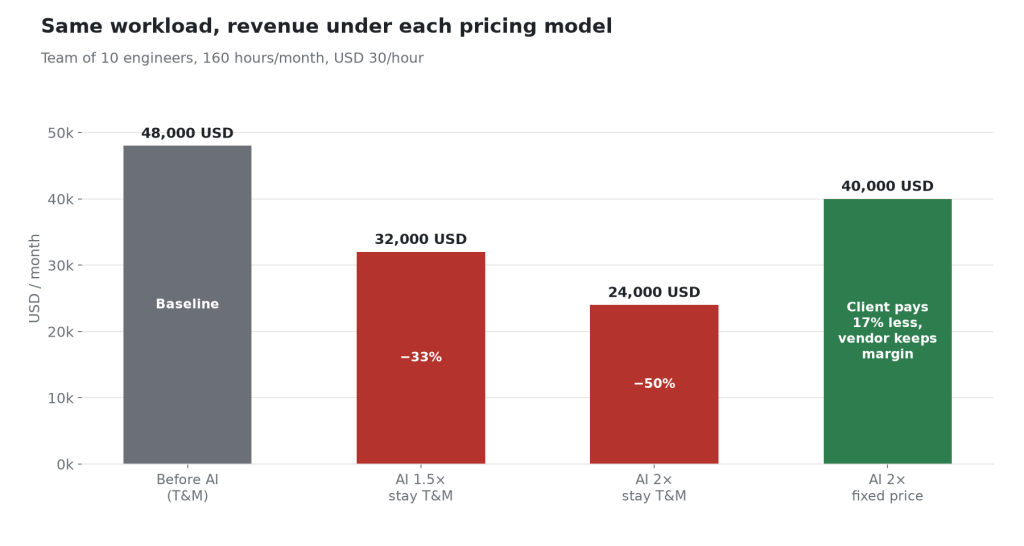
Take a simple example. A team of 10 engineers, 160 hours a month each, billed at USD 30 an hour:
| Scenario | Hours billed / month | Revenue / month | Note |
|---|---|---|---|
| Before AI | 1,600 | USD 48,000 | Baseline |
| AI 1.5× faster, still T&M | ~1,070 | ~USD 32,000 | ~33% revenue lost for the same work |
| AI 2× faster, still T&M | 800 | USD 24,000 | 50% lost |
| AI 2× faster, sold at a fixed USD 40,000 | 800 (internal cost) | USD 40,000 | Client pays 17% less, vendor keeps its margin |
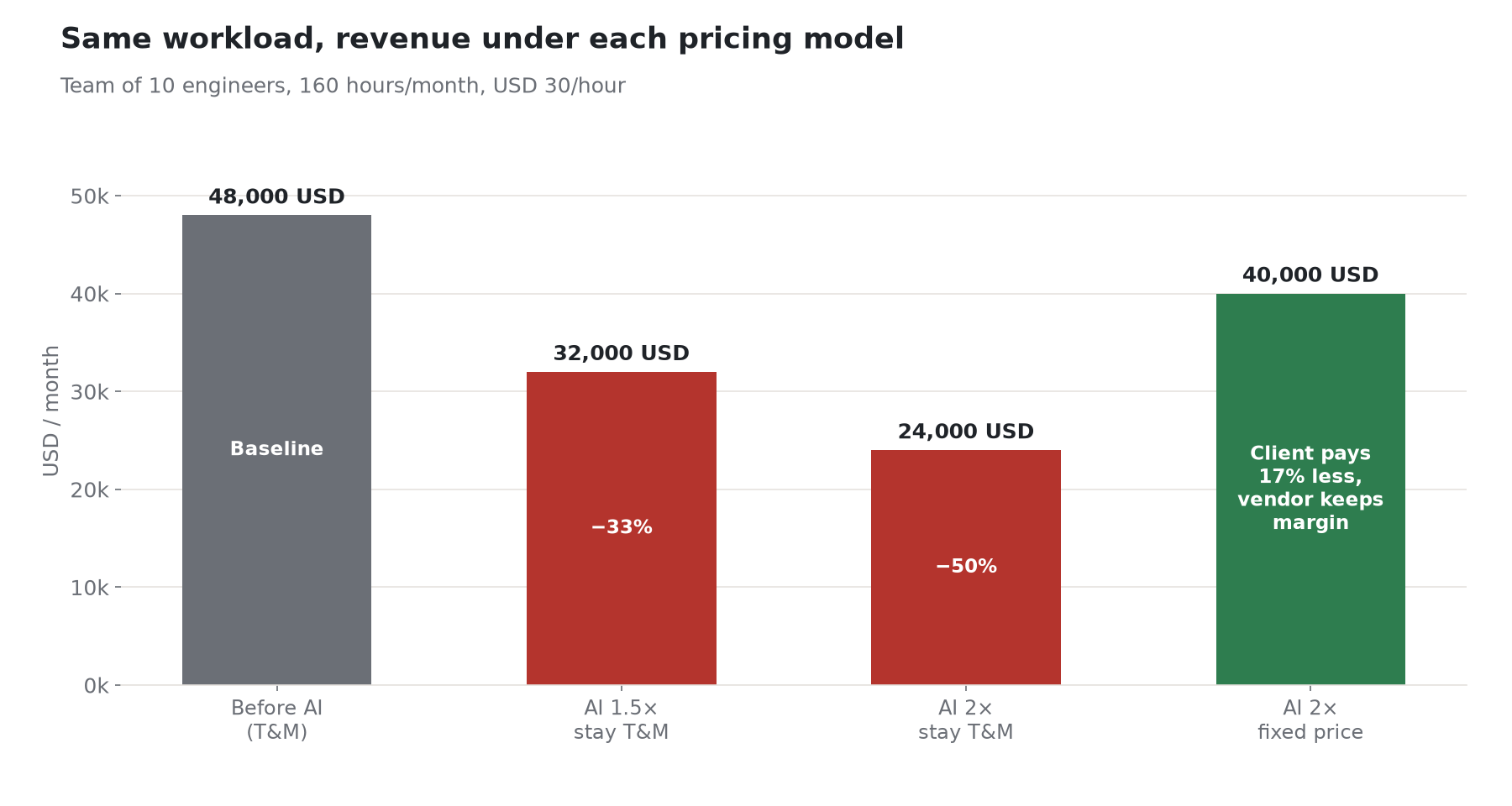
Rows two and three are the trap: the more a company invests in AI to work faster, the more its hourly revenue falls. The technology strangles the business model of the very firms that adopt it. The last row is why the whole industry is changing direction: when you sell outcomes, the productivity AI creates is shared between client and vendor instead of flowing entirely to the client.
Clients are not naive. They know how much faster AI makes engineers, and their question is blunt: “Why should I pay for eight hours of your time when, with AI, the job takes you three?” Even when the honest answer is “because the other five hours go into reviewing, testing and fixing what the AI produced”, the hour has lost its credibility as a measure.
3. The industry is moving to selling outcomes: evidence from the majors
This is no longer theory. Some notable data points from 2026:
- TCS: CEO K. Krithivasan told Reuters that about 80% of contracts in TCS’s finance, HR and business-services segment are now tied to outcome measures. The figure applies to that segment, not the whole company (Zawya / Reuters).
- Accenture: according to a summary of its fiscal Q4 2026 earnings call, more than 65% of bookings are now fixed-price (including outcome-based) contracts, pricing was lower “in many areas”, and the company acknowledged it is “giving more productivity due to AI” (MatterFact).
- Infosys: its 20-F filing warns that competitors may offer higher productivity commitments on the back of their AI investments, leading to significant pricing pressure (SEC 20-F FY2026).
- On the buyer side: an HFS Research and EY survey of 304 Global 2000 executives found that about 39% of enterprises already use outcome-based pricing for AI services, 72% are comfortable with it, and 82% prefer hybrid structures. HFS also expects AI to trigger IT contract renegotiations within 24 months, especially for contracts above USD 50 million a year (HFS Research).
The direction is clear, but the 82% preference for hybrid models also shows the market has not jumped straight to pure fixed price. Section 6 returns to this.
4. Risk flips 180 degrees
When you switch from selling time to selling results, the biggest change is not on the price list. It is who carries the risk.
| Time & Materials | Fixed price / Outcome-based | |
|---|---|---|
| Who pays for a bad estimate | The client | The vendor |
| Client changes requirements mid-project | Client pays for extra hours | Needs a change request, or the vendor absorbs the loss |
| Who keeps the AI productivity gain | The client (fewer hours billed) | The vendor (if it holds the price) |
| Vendor’s incentive | Stretch the work, add people | Finish fast, automate, reduce defects |
| Margin | Stable, modest | Volatile: high when delivery goes well, negative when the estimate is wrong |
The estimation risk is not small. The well-known McKinsey and University of Oxford study of more than 5,400 large IT projects found they ran on average 45% over budget and 7% over time, while delivering 56% less value than predicted (McKinsey). Under T&M, that 45% overrun is paid by the client. Under a fixed price, it comes straight out of the software company’s profit.
The AI era adds risks of its own: code is generated quickly but can contain subtle defects, technical debt builds up faster, and, as DORA shows, delivery instability rises in teams that are not ready. A company that signs fixed-price deals without matching quality control is betting its margin.
5. Every role sees a different story
5.1. CEO and founder of an outsourcing company
The strategic question is no longer “how many more people should we hire?” but “what are we selling?” Revenue stops scaling with headcount, so familiar metrics such as utilization, bench ratio and hiring velocity lose their meaning. The new numbers to watch are revenue and gross profit per engineer, the share of fixed-price projects that make money, and the value of reusable assets (accelerators, templates, test suites, internal agents).
The hardest choice is whether to cannibalize your own revenue before a competitor does it for you. Infosys has said it walked away from contracts that were no longer economically viable; Tech Mahindra cut more than 12,000 jobs; TCS’s headcount fell to 584,519 by the end of fiscal 2026 (Tuoi Tre News / Reuters). None of the options is comfortable.
5.2. Sales and presales
Sales used to sell “a team of ten at rate X”. Now they have to sell a measurable result: “a payment system running in production, handling load Y, delivered in 12 weeks, at price Z”. That requires presales to understand the client’s business more deeply, to write a clear definition of done and acceptance criteria, and to know when to decline a project whose requirements are too vague to price.
One new skill becomes essential: value-based pricing rather than cost-plus. If a system saves the client USD 500,000 a year, a USD 150,000 price is reasonable however many hours the team spends.
5.3. Project and delivery managers
Under T&M, a good PM keeps the team busy and reports hours accurately. Under fixed price, a good PM controls scope. Every “while you’re at it, could you also…” costs real money. The change-request process, the assumptions written into the contract and the rhythm of milestone acceptance matter more than the burndown chart.
PMs also have to plan around a new variable: AI speed is uneven. One module might be done in two days while the next is stuck for two weeks because the AI generated code that gets the business logic wrong. Estimates need an explicit risk buffer; you cannot simply multiply every task by a productivity factor.
5.4. Solution architects and tech leads
This is the role that gains the most. As writing code gets cheaper, value moves to the decisions AI cannot yet make: how to split the system, where to draw integration boundaries, which technical debt to accept, how to enforce security. A wrong architectural decision in a fixed-price contract can wipe out the project’s entire profit.
Tech leads also build the internal “factory”: prompt conventions, rules for agents, automated review pipelines and regression suites. That is what turns individual AI productivity into productivity the whole company can repeat.
5.5. Developers
For engineers the shift is both an opportunity and a pressure. Pure typing work shrinks; reading, verifying, debugging and owning code (including code the AI wrote) grows. The METR result is a candid reminder that feeling faster is not the same as being faster. The valuable engineer in the new model knows when to hand work to AI, when to do it by hand, and how to measure the real result.
One consequence gets less attention: the junior career path is narrowing. The tasks that used to train newcomers (small bug fixes, CRUD screens, unit tests) are exactly the tasks AI does best. Hiring data from Pave shows companies leaning towards senior engineers (Pave). Companies without a new path for juniors will be short of seniors in five years.
5.6. QA and testing
Under a fixed price, every defect that reaches production after acceptance is the vendor’s cost, not the client’s. As AI speeds up code generation, the pressure lands on testing. QA moves from “running test cases” to “designing the quality strategy”: automated tests, contract tests between services, security testing, and monitoring the quality of AI-generated code.
5.7. HR and people management
Evaluation frameworks based on hours, lines of code or tickets closed become meaningless and even counterproductive. HR needs new competency frameworks that measure delivered results, quality and reuse. Team shape changes too: fewer people, each with broader ownership, and AI tooling becomes a per-head budget line.
5.8. Finance (the CFO)
T&M revenue is easy to forecast: people times hours. Fixed-price revenue is recognized by percentage of completion, cash flow follows milestones, and margin swings project by project. CFOs need new capabilities: risk provisions for fixed-price contracts, near-real-time margin tracking per project, and treating AI costs (tokens, licences) as a new component of cost of delivery.
The paradox is that total revenue can fall while gross profit rises, if the company holds its fixed prices and delivers faster with AI. Whether capital markets read that signal correctly is another matter (see 5.10).
5.9. The client
There is no single “client”, so it helps to separate them:
- A startup CTO or founder wants speed and flexibility. Requirements are usually unclear and the product changes weekly. For them, pure fixed price is a trap: every pivot means renegotiation. A better fit is a small team on a subscription or capacity basis with commitments on delivery pace.
- Procurement in a large enterprise likes fixed prices because they are easy to approve and move risk away. But the price for that is writing much more detailed specifications, and the vendor will add a risk premium. Fixed price is not always cheaper.
- The client-side product owner loses something important: the freedom to re-prioritize every sprint. Under T&M they can say “do something else this week”. Under fixed price, every change goes through a change request.
- A shared client worry: once the vendor optimizes for margin, it has an incentive to do just enough to pass acceptance, using AI to generate code that works today but is hard to maintain. Clients need acceptance criteria on quality (test coverage, performance, security, documentation), not just “it runs”.
Some work is disappearing from the outsourcing market altogether: Reuters reports that many clients are bringing in-house tasks that AI has made simple enough to do themselves, and contracts are getting shorter.
5.10. The investor
Investors do not price this quarter’s profit; they price cash flows years ahead. The “rent people by the hour” model used to command high valuations because growth was almost linear and easy to forecast. Once that model is in question, valuation multiples (P/E) compress before profits have a chance to fall. India’s Nifty IT index has dropped by about a fifth this year (Tuoi Tre News / Reuters).
FPT, Vietnam’s largest IT services group, is a close-to-home example. In the first nine months of 2026, FPT’s pre-tax profit reached VND 8,770 billion (up 17%) on revenue of VND 40,023 billion (up 12.4%). Its overseas IT services segment grew 11.6% to VND 28,538 billion, slower than the group as a whole, while new signed revenue in that segment still rose 23.1% (CafeF; Tuoi Tre). At the same time, foreign investors were net sellers of about 240 million FPT shares, worth nearly VND 17,957 billion, from the start of the year to 17 November 2026, and the share price fell to a three-year low (CafeF).
Interpret this with care: foreign net selling has many causes (outflows from emerging markets, currency, a previously high valuation, portfolio rebalancing). No source claims funds sold FPT only because of AI. But IT services stocks in both India and Vietnam being re-rated while profits still grow suggests the market is discounting the risk to the billable-hour model, not current results.
6. Some counterpoints, so we don’t overshoot
“You pay for a bowl of noodles, not for the minutes the cook spent at the stove” is only half true. A bowl of pho is a defined product: everyone knows what a good one looks like. Software is different. On most projects, clients only understand what they need after they see a first version. T&M exists not because clients like paying by the hour but because requirements cannot be fully specified in advance. AI does not remove that ambiguity; if anything, it makes clients change their minds faster because experiments are cheaper.
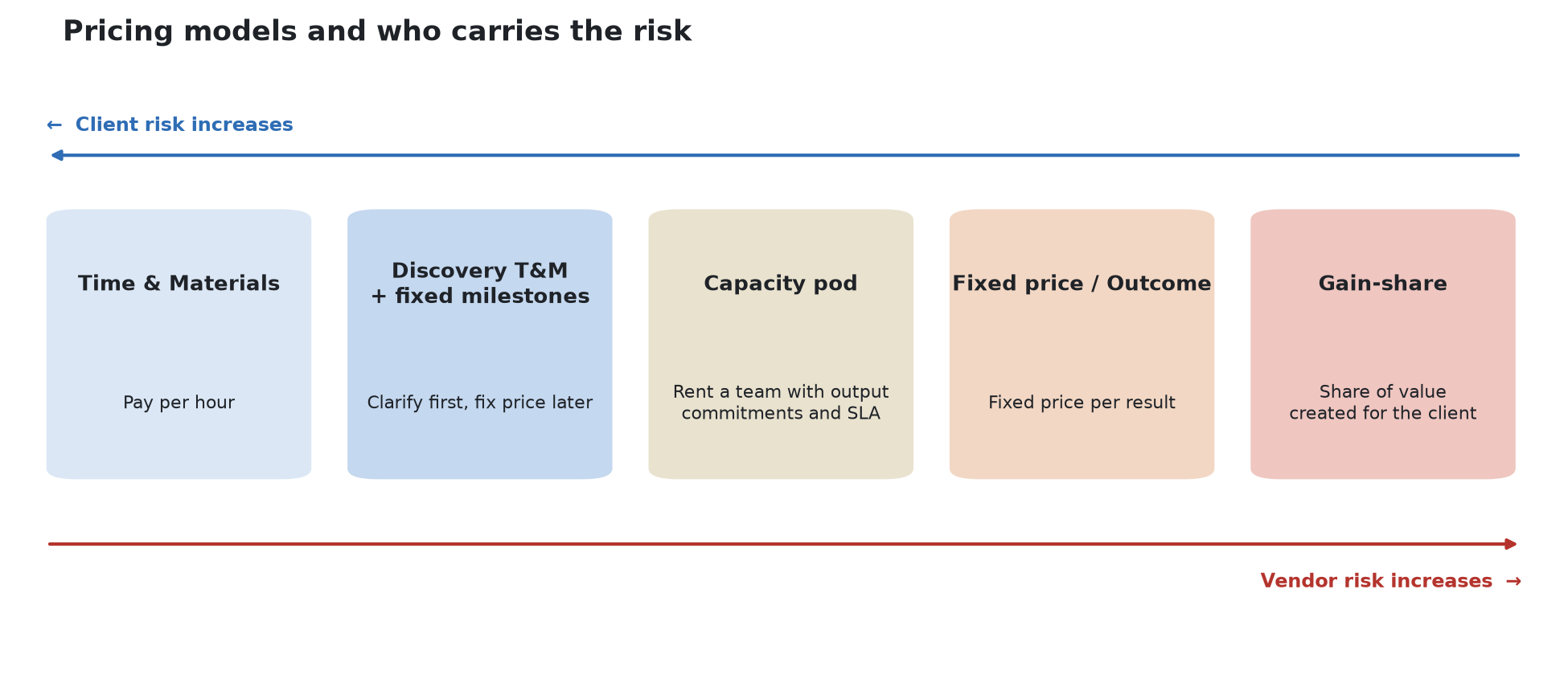
Pure fixed price does not win; hybrid models do. 82% of executives in the HFS/EY survey prefer hybrid structures. The arrangements gaining ground are:
- Discovery on T&M, build on fixed milestones: clarify requirements first, then lock the price.
- Capacity-based pods: the client rents a “delivery unit” with output commitments (for example features or story points per month, plus quality SLAs), not hours.
- Gain-share: the vendor takes a share of the savings or extra revenue the system delivers for the client.
- Unit-priced managed services: billing per resolved ticket, transaction or user, common in operations and maintenance.
AI may make the market bigger, not smaller. Under the Jevons paradox, when something gets cheaper people use more of it. Wipro’s CEO argues that cheaper software will create “new and more projects”, so IT budgets will not shrink in the long run. FPT’s new signed revenue still grew 23%. The real question is not whether demand falls but who captures the new demand: firms that sell hours or firms that sell outcomes.
7. Practical advice for outsourcing companies
- Measure AI productivity on your own projects, not with marketing numbers. Compare like-for-like tasks, with a control group where possible. The METR lesson: engineers’ own sense of speed is not reliable.
- Start fixed-price work where it is safest: repetitive work with clear outputs (migrations, framework upgrades, test writing, data conversion, SLA-based bug fixing). Do not take a fixed price on a new product with vague requirements.
- Invest in reusable assets: project skeletons, domain libraries, internal agents and test suites. They are where fixed-price margin comes from.
- Rewrite your contract templates: definition of done, quality acceptance criteria, change-request process, assumptions about the client’s data and infrastructure, and risk-sharing clauses.
- Build project finance capability: track margin per project weekly, provision for fixed-price risk, and put AI costs into cost of delivery.
- Change internal KPIs: phase out utilization and billed hours in favour of gross profit per engineer, on-time delivery and post-delivery quality.
- Keep a training path for juniors: redesign how newcomers learn the craft alongside AI, or in five years there will be no seniors.
Conclusion
The “headcount × hours × rate” formula will not die tomorrow. It still makes sense for projects whose requirements cannot yet be specified. But it has lost its place as the default. AI makes an hour of work worth more, and, paradoxically, that is exactly what makes billing by the hour worth less.
Outsourcing companies will split into two groups. One keeps selling people, competes on price and watches its margin shrink with every round of negotiation. The other learns to sell outcomes: it takes on risk but, in return, keeps a share of the productivity AI creates. Clients, engineers, managers and investors alike need to know which side of this shift they are standing on.
References
- Peng, Kalliamvakou, Cihon, Demirer (2023). The Impact of AI on Developer Productivity: Evidence from GitHub Copilot. arXiv 2302.06590
- GitHub Blog. Research: quantifying GitHub Copilot’s impact on developer productivity and happiness
- METR (2025), via The Register and DX
- Google Cloud DORA. 2025 State of AI-assisted Software Development; InfoQ
- Reuters (August 2026). AI reshapes India’s IT services sector contracts as clients demand more for less, via Zawya, The Star, Tuoi Tre News
- Reuters (January 2026). Wipro CEO sees growing demand for India’s IT services from AI
- HFS Research. AI drives IT contract renegotiations within 24 months as pricing models shift
- Newsweek. AI Is Forcing IT Services to Rethink How They Get Paid
- MatterFact. Accenture Beats and Keeps Hiring While Admitting AI Pricing Pressure
- Infosys. Form 20-F FY2026
- McKinsey & Company. Delivering large-scale IT projects on time, on budget, and on value
- Pave. Are software engineers being replaced by AI?
- CafeF. FPT nine-month 2026 results (Vietnamese); Foreign ownership at FPT as the share price hits a three-year low (Vietnamese)
- Tuoi Tre. FPT reports nine-month pre-tax profit above VND 8,700 billion (Vietnamese)
Related reading

· 9 min read
agentic coding
Going Several Times Faster With AI Agents Without Losing Control of Quality
Agents made doing cheap, but saying what you want and checking the result did not get cheaper. Five principles, picking models by role, and a sample workflow for moving faster in software and beyond while keeping control of the details and the quality.
Read more· 9 min read
agentic coding
Prompt Injection Is the Vulnerability Class Actually Breaking AI Agents in 2026
Part 3 of the AI agent safety series: why prompt injection, not jailbreaking, is the real vulnerability behind CamoLeak, Comment and Control, CometJacking, and the Claude Code CVE chain — plus the CaMeL defense architecture and OS-level sandboxing.
Read more
· 4 min read
ai
AI News From My Muse Feed — October 17, 2026
Five AI items that showed up in my personal Muse (muse.ai) feed today — voice mode expansion, longer AI video clips, director-style AI voiceover, and AI creeping into ordinary converter tools — read with a technical lead's eye.
Read more
Discussion
Comments are reviewed before publication. Your email is kept private.