
JOURNAL
Laid Off Tomorrow? Treat the Job Search Like a Project, Not a Panic Attack
A former Tableau senior engineer breaks the post-layoff job search into a six-step, measurable process instead of a spiral of applications and silence.

On this page
The video runs 6 minutes 47 seconds. About 8,800 views two months in — not viral numbers, but the guy talking is worth listening to. Bogdan Pshonyak graduated from Green River College, joined Tableau Software as a Software Engineer in 2017, got promoted to Senior Software Engineer in 2020, then left at the end of 2021 to build his own YouTube channel, a Rust-focused channel called Let’s Get Rusty — it now sits around 176,000 subscribers. So this isn’t some career coach who’s never signed an employment contract. This is someone who sat inside a large tech company, got promoted there, and chose to leave on his own terms rather than being laid off — but his video, “What I’d do if I got laid off as a senior engineer,” is his own answer to the question: if it happened to him, what would he actually do first?
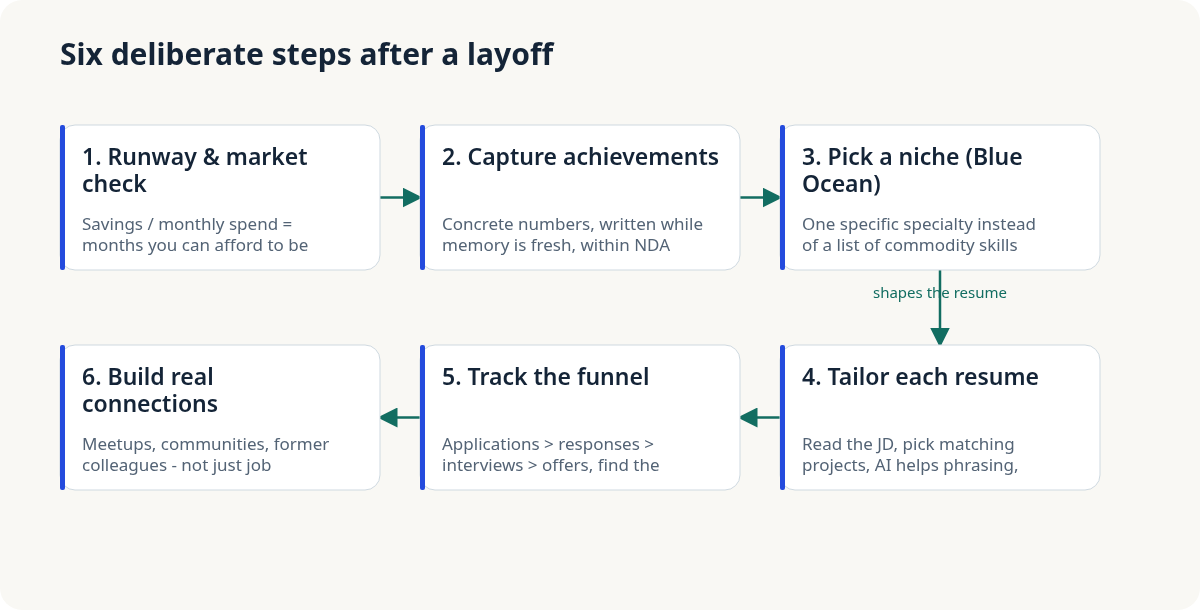
I watched it a few times, and the part that stuck with me wasn’t the layoff itself. It’s the blank space right after — when nobody tells you what to do first, which advice to trust, and why “just apply everywhere, fast” is some of the worst advice you can follow at that moment. Bogdan packs his framework into six steps. I kept the order, but I’m rewriting it with more detail — concrete number examples, a self-check for each step, and two diagrams so you can see the whole process at once instead of as a flat list.
1. Don’t apply that same night — do the runway math first
Most people’s first move after the layoff email is to open LinkedIn and start applying. Bogdan says do the opposite: sit down first and work out your financial runway — how many months you can live on savings before you absolutely need income again. The formula is simple: savings divided by monthly spend. An illustrative example, not anyone’s real numbers: if you have $30,000 saved and spend $1,500 a month, that’s roughly 20 months of runway. With $6,000 saved, it drops to 4 months.
That number isn’t just for peace of mind. It changes the quality of every decision you’ll make in the coming weeks. Long runway means you can afford to be picky — turn down a mediocre offer and wait for the right niche fit. Short runway means you’ll need to widen your criteria sooner, and knowing that up front stops you from beating yourself up later for taking a “good enough” job to keep cash flowing. Alongside the runway number, look at the market: is the whole industry cutting, or just your company restructuring; are your current skills still in demand on the job boards you’d actually use; does your experience transfer to a different kind of company (big tech to startup, or the reverse). Those two questions — how much time do I have, what does the market actually want — are inputs for every decision that follows, not a feel-good warmup exercise.
2. Write down your achievements before you forget — and before you’re legally boxed in
Memory of a project fades fast. Six months after leaving, you won’t remember the exact number you once knew cold. So the second move, done in the first week: list every meaningful project using problem — approach — measured impact. Compare these two ways of writing the same thing:
Vague: “Improved backend performance.”
Specific: “Optimized database queries and indexing, reducing p95 API latency from 480ms to 140ms, which cut timeout-related incidents the following quarter.”
The second version answers the question any decent interviewer will ask next: where did that number come from, how was it measured. But there’s a line to hold while doing this: your confidentiality obligations to your former employer don’t disappear when you leave. Writing down the type of problem you solved and the scale of impact is fine; copying source code, unpublished internal metrics, or customer documentation is not. If a number feels sensitive, expressing it as a percentage or a range (“cut by more than 50%”) usually still carries the weight without breaching what you signed.
3. Stop trying to know everything — pick a niche, Blue Ocean style
This is the part I find most counterintuitive, and the one Bogdan leans on hardest. The natural instinct when job hunting is to list as many skills as possible — Go, Java, Python, SQL, Docker, Kubernetes — so you don’t miss an opportunity. The problem is every other candidate is listing the exact same list. The “Blue Ocean” move is the opposite: instead of competing in a red ocean where everyone looks alike, pick a segment narrow and specific enough that you’re one of the few people who actually have real experience in it. Examples: embedded Rust, large-scale data processing, database performance tuning, or observability for distributed systems.
There’s a real tradeoff here, and the video doesn’t hide it: a narrow niche has fewer total job postings than “Backend Engineer” in general. But among that smaller set, you’re competing against far fewer people, and recruiters actually remember you instead of skimming past. In a market like Vietnam’s, where truly specialized roles are still limited in number, this tradeoff is sharper: you might wait longer for the right posting to show up, but when it does, your odds of landing an interview are much higher than from applying broadly.
4. Tailor the resume for every role — and use AI in the right place
One resume used for every application is the fastest way to get filtered out by an ATS or skimmed past by the first human reader. The suggested process: read the job description closely, circle the 3-4 requirements that matter most, then go back to your step-2 achievement list and pull the ones that match directly — move them to the top, reorder bullets, rewrite the summary to echo the JD’s own language.
AI has a legitimate place here, but the line is clear: use it to rephrase a real achievement more concisely, suggest keywords that match the JD, or check grammar — fine. Use it to invent a number you never measured, or inflate a role you only touched peripherally — not fine. A good interviewer will probe exactly the line you wrote, and an answer that doesn’t match the resume does more damage than an ordinary but honest one ever would.
5. Job search is a funnel — measure it, don’t just apply
This is the part of Bogdan’s framework I think works best, because it borrows the exact conversion-funnel thinking product people use to find a bottleneck. He doesn’t hand out a “correct” target percentage for each stage — the video doesn’t claim one, and anyone who gives you a single universal benchmark across every niche and every market is making it up. What’s actually useful is the structure: three stages, each measured as a conversion rate from the one before it.
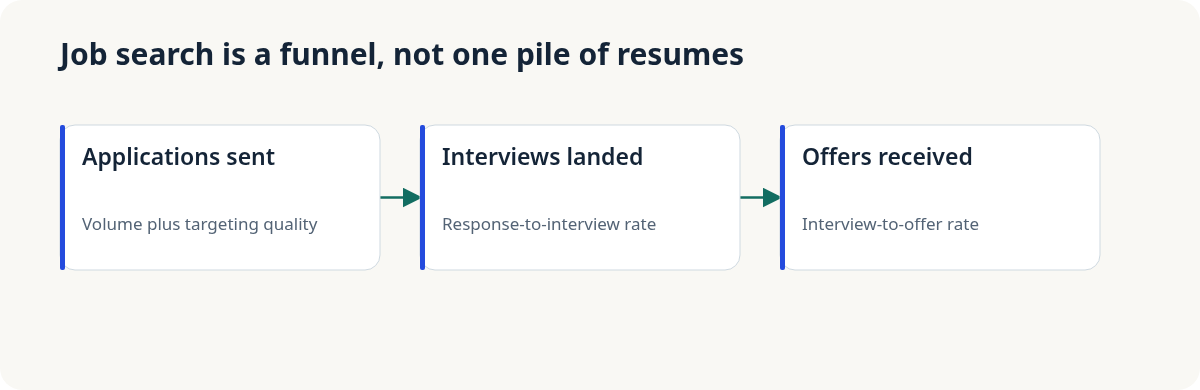
What’s left is keeping a tracker — company, role, date applied, source (job board, referral, networking), current status, outcome per round. No fancy tooling needed, a spreadsheet is enough. The point of this table isn’t to feel organized — it shows you the real numbers: if your application-to-response rate is too low, the problem is the resume or you’re targeting the wrong kind of company or role; if your interview-to-offer rate is low despite good response rates, the problem is interview skill, not the resume. These are two completely different problems needing two completely different fixes, and without measuring, you’ll fix the wrong one.
6. Job boards aren’t the only channel
The last step in the video, and the easiest to skip because it doesn’t measure as neatly as the funnel above: go to meetups, conferences, hackathons, communities built around the exact niche you picked in step 3; reach out to former colleagues and classmates — not just to ask for a referral, but to build a real, lasting connection. Most good roles never hit a public job board; they’re filled through internal referrals before the posting goes live. This channel is slower and harder to measure than applying online, and that’s exactly why it needs to start early, running alongside the funnel — not after the funnel stalls.
These six steps aren’t six independent chores. Runway tells you how much time you have to be selective. Niche shapes the resume. The resume feeds the funnel. The funnel points to the bottleneck. And when the bottleneck is “job boards aren’t enough,” networking is the channel you expand into — not something you bolt on from day one for appearances. Bogdan says it plainly in the video: the best time to build this process is before you get laid off, not after. I don’t have my own runway or funnel story to tell here — I read this video closely because my own work depends on constantly producing evidence of value, not waiting for someone to ask. If that email lands tomorrow morning, the first move isn’t opening LinkedIn. It’s opening a spreadsheet, and running the numbers, not the feelings.
Related reading

· 5 min read
ai-agents
Inside OpenAI's Performance Factory: Codex Hunting Its Own Regressions
OpenAI built a Codex-powered pipeline that investigates ChatGPT performance regressions, argues with itself, and ships fixes with a human still holding the merge button.
Read more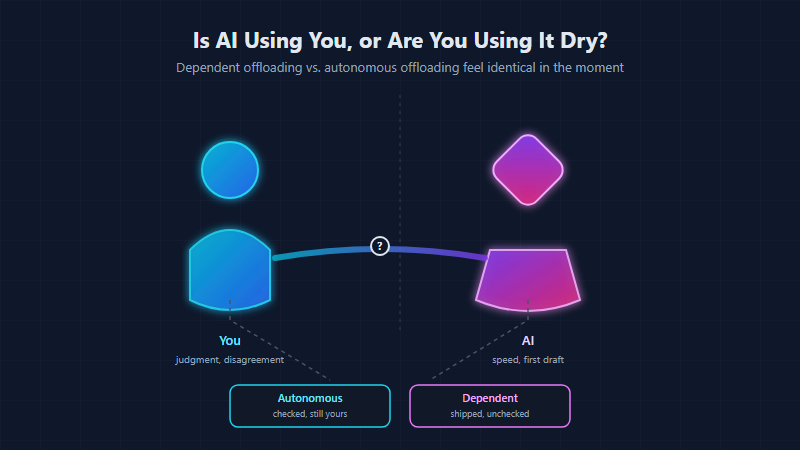
· 3 min read
ai
Is AI Using You, or Are You Using It Dry?
A friend's offhand comment sent me back to check my own AI habits against a new study on dependent vs. autonomous cognitive offloading. The two feel identical in the moment. They aren't.
Read more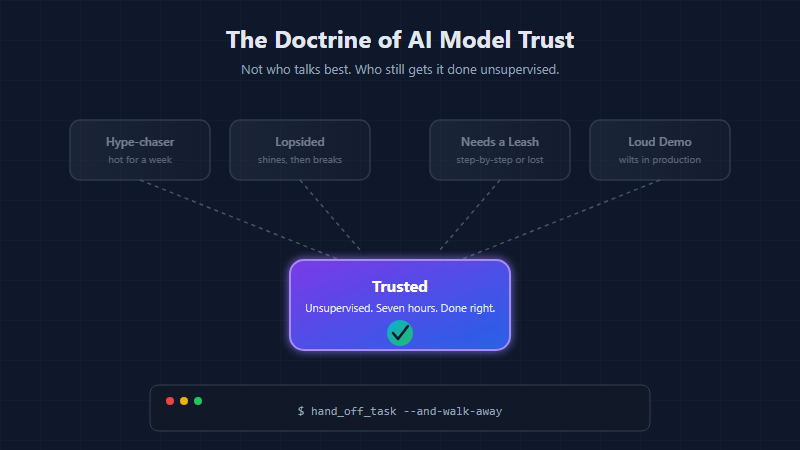
· 7 min read
ai
The Doctrine of AI Model Trust
It's not about which model scores higher. It's about which one still gets the job done when you're not sitting next to it. Notes from a year of switching, paying, and betting real client work on Claude.
Read more
Discussion
Comments are reviewed before publication. Your email is kept private.