
JOURNAL
Inside OpenAI’s Performance Factory: Codex Hunting Its Own Regressions
OpenAI built a Codex-powered pipeline that investigates ChatGPT performance regressions, argues with itself, and ships fixes with a human still holding the merge button.

On this page
On November 19, 2026, OpenAI described a system it calls the Performance Factory: a pipeline where Codex investigates ChatGPT slowdowns before an engineer ever opens a ticket. Over three months, it ran more than 1,700 investigations. Six hundred of those landed on a confirmed root cause. Four hundred turned into an actual proposed fix. That’s a steep drop-off, and it’s the interesting part.
Most “AI finds bugs” stories stop at the investigation. This one keeps going. About fifty shipped fixes trace back to agent suggestions that engineers adopted or matched. Roughly fifteen of those were Codex-authored pull requests, merged close to as-is. Seventeen investigations happen on an average day. None of that sounds dramatic until you picture the alternative: an on-call engineer at 2am, grepping through traces, trying to figure out why median latency crept up 4% since Tuesday.
The workflow, and why the second agent matters
The pipeline runs in five stages: an alert fires, Codex investigates and proposes a root cause, it drafts a code change, an engineer reviews and decides whether to merge, and the system checks the result after deployment. None of that is new in shape. Plenty of shops have auto-triage bots. What’s different here is the step wedged in the middle: adversarial review.
Before a diagnosis goes to a human, a second Codex session — fresh context, no memory of how the first one reasoned — gets explicit instructions to try to break it. Find the gap. Check the evidence. Try an alternative explanation and see if it fits better. OpenAI says this adversarial pass currently catches and reverses about 25% of diagnoses.
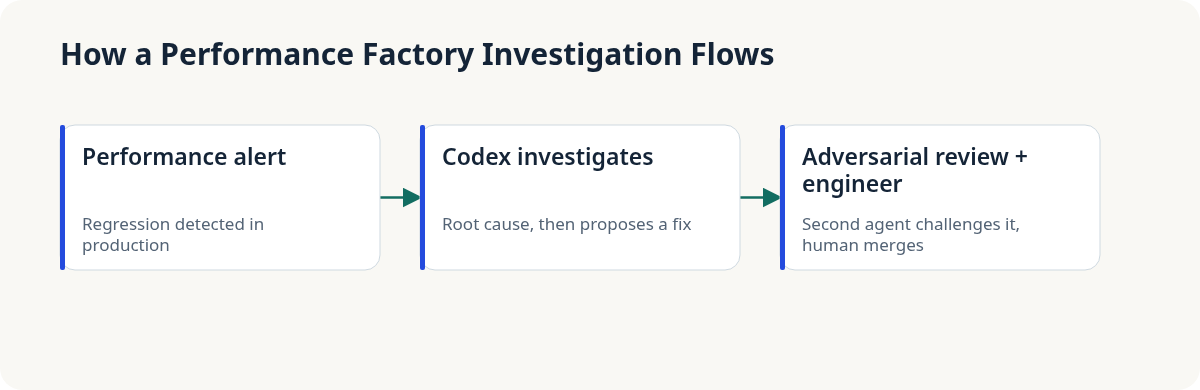
OpenAI’s own example is the kind of thing that’s easy to miss if you’re not looking for it: an image-download error that the first pass blamed on a broken file-locating service. The adversarial reviewer noticed the service had already recovered by the time failures kept happening, which meant the real cause was somewhere else. A quarter of the time, this is exactly the save. Three-quarters of the time, the original diagnosis holds, and the system moves on without wasting a reviewer’s afternoon on a dead end.
Where the human still sits
Every fix still needs a person. “An engineer reviews the code and decides whether to merge it,” is how OpenAI puts it, flatly, no further ceremony. That line is doing more work than it looks like. It means the fifteen Codex-authored merges weren’t rubber-stamped; they were read by someone whose name is on the deploy. It also means the ~50 influenced fixes are engineers taking a suggestion seriously enough to act on it, not agents quietly pushing to production on their own authority.
I’d push back gently on how this gets framed in some of the coverage, which leans hard on the “AI fixes its own bugs” angle. The more accurate read: Codex got good at a specific, bounded kind of forensic work — correlating a regression with a recent change, narrowing down which service actually misbehaved — and OpenAI built a second agent whose entire job is distrust. That combination is the actual engineering contribution here, not the fact that a model wrote some diffs.
Seventeen investigations a day, spread across a product the size of ChatGPT, isn’t a small number, but it’s not a replacement for an SRE team either. It’s a filter that catches the boring, well-trodden cases — a 25% rejection rate on its own diagnoses suggests the system knows it’s wrong a meaningful chunk of the time, and is built to catch itself before it costs anyone an afternoon.
The stage everyone skips past: post-deployment verification
The fifth stage of the pipeline barely gets mentioned in the coverage, and it’s arguably the one that keeps the whole thing honest. After a fix ships, the system checks whether the regression actually went away. That sounds obvious. It isn’t, in practice — plenty of teams ship a fix, watch the dashboard calm down for an hour, and call it closed, only to find the same symptom back a week later under a different trigger. Closing the loop automatically means a bad fix gets flagged instead of quietly living in the codebase until the next incident rediscovers it.
It also changes what “fifty shipped fixes” means. That number isn’t fifty patches someone glanced at and forgot. Each one got checked against the thing it was supposed to solve, after the fact, with production data. That’s a different bar than most code review clears, agent-written or not.
What this doesn’t do
It’s worth being blunt about the limits, because the framing in some coverage oversells this. Four hundred proposed fixes out of 1,700 investigations is a 24% conversion rate from “we found something” to “here’s a patch.” Of those four hundred, around fifty influenced what shipped. That’s roughly 3% of all investigations turning into a production change, agent-authored or otherwise. The other 97% either dead-ended, got rejected by the adversarial reviewer, or needed a human to solve it from scratch.
That ratio isn’t a knock on the system. It’s exactly what you’d want from a tool built for a specific, narrow job: catching the regressions that look like ones Codex has seen before, where the failure pattern is legible from logs and traces. A genuinely novel architectural problem — a new caching layer behaving badly under a load pattern nobody’s modeled — is still going to need someone who understands the system at a level no amount of trace-reading substitutes for. The Performance Factory isn’t claiming otherwise. It’s just taking the repetitive 3am grep-through-logs work off an engineer’s plate, seventeen times a day, so the harder 97% gets more attention instead of less.
Source: VentureBeat, “OpenAI reveals Performance Factory” (Nov 19, 2026).
Related reading

· 4 min read
AI models
GPT-6.2 Astra and Sol: A Cheaper Model Family, With One Catch
OpenAI's GPT-6.2 release cuts prices and nudges intelligence scores up, but the coding benchmarks tell a messier story than the headline numbers suggest.
Read more
· 4 min read
ai-governance
OpenAI Is Letting Outsiders Inside Its Training Pipeline. Just Not as Far as It Promised.
OpenAI signed Apollo Research, METR, Transluce, and Goodfire for its first phase of embedded safety assessments, giving them scoped access to training data and model checkpoints. A Redwood researcher says it falls short of the employee-like access OpenAI originally promised.
Read more
· 18 min read
agentic coding
Part 7: Applying the agent workflow to a real project
I brought the series workflow into LingoLive AI, a live product repo, with the agent-repo-setup tool: audit, apply and verify in six steps. Two surprises: every merge to main deploys production, and a security review found three holes in the hooks themselves.
Read more
Discussion
Comments are reviewed before publication. Your email is kept private.