
JOURNAL
GPT-6.2 Astra and Sol: A Cheaper Model Family, With One Catch
OpenAI's GPT-6.2 release cuts prices and nudges intelligence scores up, but the coding benchmarks tell a messier story than the headline numbers suggest.

On this page
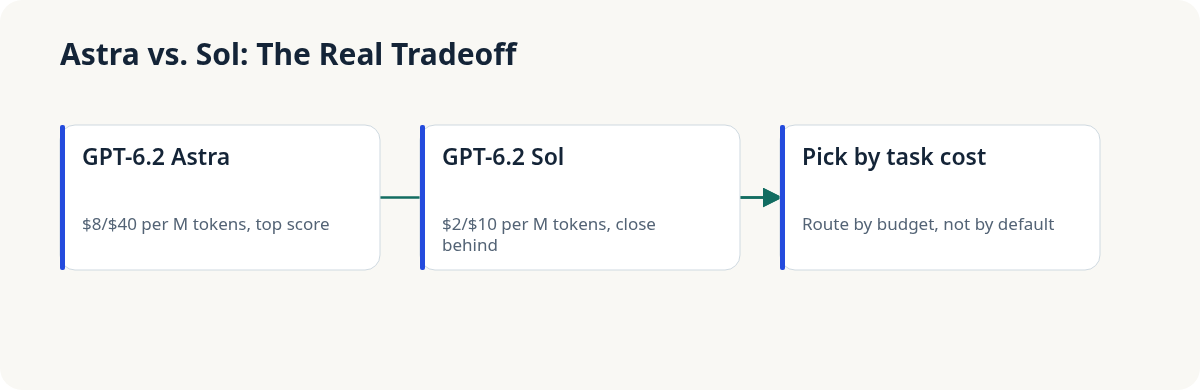
OpenAI shipped GPT-6.2 Astra and GPT-6.2 Sol on November 17, 2026. The pitch is the usual one — smarter, cheaper — and for once the cheaper part is the easier claim to check. Astra runs $8 per million input tokens, $0.40 for cached input, $40 per million output. Sol comes in at $2 input, $0.10 cached, $10 output. For context, the prior GPT-6 Astra cost roughly 20% more for input/output at the same tiers.
Run the math on something concrete: 1,000 requests, 10K input tokens and 2K output tokens each. GPT-6.2 Astra comes out to about $160 total. The older GPT-6 Astra would have cost around $200 for the same workload. That’s a real, checkable 20% savings, not a marketing rounding trick.
The intelligence numbers move, but not evenly
On the Artificial Analysis Intelligence Index, Astra scored 62, a five-point gain over GPT-6 Astra. Sol scored 57, up two points from GPT-6.1 Sol. Both are real gains. Neither catches Claude Fable 5.2, which sits at 65 on the same index. If raw general intelligence is the metric you care about, GPT-6.2 narrows the gap with the field leader without closing it.
Here’s where it gets more interesting, and where the press releases tend to go quiet: on coding-specific benchmarks, the picture flips. Reported Coding Agent Index results show Astra essentially flat against its predecessor, and Sol down — a three-point drop overall. A model that costs less and scores a little higher on a general intelligence index, while getting measurably worse at a chunk of coding tasks, is not a strictly-better release. It’s a different release, aimed at a different buyer.
A closer look at two specific benchmarks
Two narrower benchmarks make the tradeoff concrete. On AA-Robotics v0.1, a test suite built around robotics-flavored reasoning tasks, Astra scores 79 and Sol scores 78 — close enough that the cheaper model is the obvious pick for that category, full stop. On FrontierCode 2.0, a harder coding benchmark, Sol hits 43.8% at an effective cost of $1.29 per run, while Astra hits 44.2% at $5.97 per run. A 0.4-point accuracy gain for 4.6x the cost is not a good trade for most teams, and it’s the kind of number that doesn’t show up anywhere near a release-day headline.
Put those two together and a pattern emerges: Astra’s premium buys you very little on tasks where Sol already does fine, and buys you a real but expensive edge only on the hardest reasoning work. There’s no single “better model” here — there’s a cost curve, and where your workload sits on it determines which number actually matters.
Long-context pricing has a trap worth knowing about
Push a request past 272,000 input tokens and the pricing changes for the whole request, not just the overflow: input doubles, output goes up 1.5x. That’s not unusual as a long-context pricing model, but it’s easy to miss if you’re estimating costs off the headline $8/$40 or $2/$10 numbers and your workload occasionally spikes past that threshold. A document-heavy pipeline that normally sits at 50K tokens but hits 300K once in a while will see its cost profile swing hard on exactly those runs, and the bill won’t look like a rounding error.
So which one do you actually use?
Not Astra by default, and not Sol by default either — that’s the honest answer, even though it’s an unsatisfying one to put in a release-day headline. Sol at $2/$10 is the obvious pick for high-volume, lower-stakes work: classification, summarization, drafting where a human reviews anyway. Astra’s five-point intelligence gain and top-tier general reasoning make sense when the task is genuinely hard and the token volume is low enough that $40 output pricing doesn’t blow the budget.
Where I’d actually push back on OpenAI’s framing: if your workload leans toward coding agents specifically, this release is not an obvious upgrade. A flat score plus a three-point drop on Sol means teams running agentic coding pipelines should benchmark their own workload before migrating wholesale, not assume the new version number means strictly better. Cheaper, yes. Smarter on paper, yes. Better at writing code — not demonstrated, and the numbers published so far say the opposite for one of the two models.
Source: Requesty, “GPT-6.2 Sol and Astra: Pricing and Benchmarks” (Nov 2026).
One practical note for anyone running an existing GPT-6 or GPT-6.1 integration: the pricing drop alone is not a reason to swap models in a production pipeline without rerunning your own eval set first. A five-point gain on a general intelligence index says nothing about your specific prompt templates, your retrieval setup, or the exact shape of your coding tasks. The AA-Robotics and FrontierCode numbers above move in opposite directions for a reason — different task shapes reward different models — and your workload is its own task shape, not a point on someone else’s benchmark.
Related reading

· 5 min read
ai-agents
Inside OpenAI's Performance Factory: Codex Hunting Its Own Regressions
OpenAI built a Codex-powered pipeline that investigates ChatGPT performance regressions, argues with itself, and ships fixes with a human still holding the merge button.
Read more
· 4 min read
ai-governance
OpenAI Is Letting Outsiders Inside Its Training Pipeline. Just Not as Far as It Promised.
OpenAI signed Apollo Research, METR, Transluce, and Goodfire for its first phase of embedded safety assessments, giving them scoped access to training data and model checkpoints. A Redwood researcher says it falls short of the employee-like access OpenAI originally promised.
Read more· 4 min read
ai-security
Gemini 4 Carbon's Security Benchmarks Come With an Asterisk
Google's new Gemini 4 Carbon scores 88.2% on SEC-bench Pro and 71% on CWE-bench for finding and fixing real vulnerabilities. Google itself says those numbers came without guardrails, and access is limited to vetted defenders for now.
Read more
Discussion
Comments are reviewed before publication. Your email is kept private.