
JOURNAL
The AI Team Model: Every Software Role Reimagined (Part 1 of 12)
Part 1 of 12 — A panoramic view of how AI agents transform every role in a modern software delivery team: BA, PO, PM, SA, Tech Lead, Dev, QA, TA, Security, and DevOps — and what it means for how teams collaborate, decide, and ship.
On this page
Every role on a software team is changing. Not disappearing — changing. The Business Analyst who used to spend three days synthesising stakeholder interviews can now do it in three hours. The QA Engineer who manually explored edge cases now directs an AI agent to do it and reviews the findings. The Tech Lead who dreaded sprint planning now has an AI that pre-populates estimates from historical velocity.
This 12-part series maps every role in a modern software delivery team — BA, PO, PM, SA, Tech Lead, Dev, QA, TA, Security Engineer, and DevOps Engineer — through the lens of AI transformation. For each role, we cover what changes, what stays human, the new workflows, and the tools that make it real.
This first post sets the frame: the AI Team Model.
The Core Shift: Amplifiers, Not Replacements
AI agents in a software team function as cognitive amplifiers. They accelerate the low-signal, high-volume work — processing requirements, writing boilerplate, generating test cases, scanning for vulnerabilities — so humans can focus on the high-signal, high-judgment work: stakeholder relationships, architectural taste, ethical trade-offs, team culture.
The team still needs every role. But each role now has a different leverage point:
| Role | Old bottleneck | New leverage with AI |
|---|---|---|
| BA | Interview synthesis, story writing | Rapid synthesis + structured outputs |
| PO | Backlog grooming, prioritisation | AI-assisted impact scoring, release notes |
| PM | Status reporting, risk tracking | Automated dashboards, risk flags |
| SA | Architecture diagrams, ADR writing | AI-drafted options + trade-off analysis |
| Tech Lead | PR reviews, standards enforcement | AI pre-review + auto-linting |
| Dev | Boilerplate, documentation | AI pair, test generation, refactoring |
| QA | Manual test cases, regression | AI exploratory testing, smart coverage |
| TA | IaC, infra sizing, cost modelling | AI-assisted IaC generation + cost forecast |
| Security | Manual threat modelling, code review | AI SAST, dependency scanning, threat maps |
| DevOps | Pipeline config, runbook authoring | AI-generated IaC, incident summarisation |
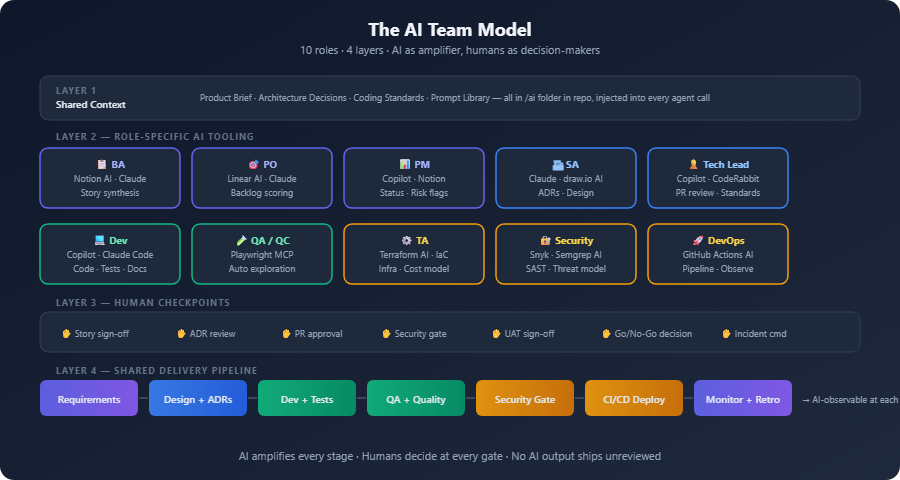
The AI Team Topology
A well-functioning AI-augmented team is not a team where everyone just uses ChatGPT individually. It is a structured system with shared context, shared prompts, and agreed human checkpoints.
The model has four layers:
1. Shared Context Layer
- A shared product brief, architecture decision log, and coding standards — kept as living Markdown documents in the repo
- AI agents are given this context on every prompt; they don’t hallucinate in a vacuum
2. Role-Specific AI Tooling
- Each role uses AI tools optimised for their domain (see table above)
- Prompt libraries are maintained per role — not ad-hoc prompts invented each time
3. Human Checkpoints
- Every AI output passes through a human before it becomes a decision, a commit, or a deliverable
- Checkpoints are agreed in advance: PR review, ADR sign-off, UAT approval, security gate
4. Shared Delivery Pipeline
- The pipeline is AI-observable: CI/CD surfaces AI-generated quality and security signals
- No AI output bypasses the pipeline (no “LGTM, ship it without tests”)
What Doesn’t Change: The Human Irreducibles
For each role, there is a set of responsibilities that AI cannot and should not own:
- BA: Building stakeholder trust, navigating organisational politics, reading the room in workshops
- PO: Making the call on “what we’re NOT building” — AI can score, humans must decide
- PM: Escalating risk to executives, managing people through uncertainty
- SA/TA: Architectural taste — knowing which technically-correct solution is actually right for this team, this budget, this timeline
- Tech Lead: Setting engineering culture, mentoring junior developers, making the hard call on tech debt
- Dev: Judging whether AI-generated code is actually correct, readable, and maintainable — not just syntactically valid
- QA: Deciding when the product is good enough to ship — AI can flag, humans must judge
- Security: Explaining risk to non-technical stakeholders, owning the breach response, making the “acceptable risk” call
- DevOps: Incident command during production outages — AI helps diagnose, humans drive recovery
AI Team Anti-Patterns to Avoid
These are the failure modes we see most often:
1. The “Prompt Dump” Anti-Pattern Everyone uses AI individually with no shared context. Each role reinvents the prompts, misses the shared constraints, and produces inconsistent outputs that don’t connect.
Fix: Maintain a shared /ai folder in the repo with role-specific prompt templates and a shared context document.
2. The “AI Says So” Anti-Pattern AI output is treated as ground truth. ADRs written by AI are signed off without challenge. Test cases generated by AI are assumed to cover the right scenarios.
Fix: Establish a “human must review” rule at every checkpoint. AI outputs are proposals, not decisions.
3. The “Only Devs Use AI” Anti-Pattern AI adoption is siloed to the development team. BA writes requirements manually, PM tracks status manually, QA tests manually — while devs fly ahead with AI assistance.
Fix: AI tooling is a team-wide initiative. Every role gets training, tooling, and a prompt library.
4. The “AI Replaced the Junior” Anti-Pattern Junior roles are eliminated because AI can do the work. The team loses its pipeline for growing the next generation of tech leads and architects.
Fix: Junior roles shift to AI review, quality checking, and prompt engineering — not elimination.
The 12-Part Map
Here’s where each post in this series takes you:
| Part | Role(s) | Key question |
|---|---|---|
| Part 2 | BA | How does AI change requirements discovery? |
| Part 3 | PO, PM | How do AI tools reshape backlog and delivery? |
| Part 4 | SA | How does AI assist system design and ADRs? |
| Part 5 | Tech Lead | How does AI change code governance? |
| Part 6 | Dev | What is the AI developer’s daily workflow? |
| Part 7 | QA/QC | How does AI transform the testing pyramid? |
| Part 8 | TA | How does AI help with infrastructure and non-functionals? |
| Part 9 | Security | How does AI reshape the secure SDLC? |
| Part 10 | DevOps | How does AI change CI/CD and platform engineering? |
| Part 11 | All | How do team ceremonies change in the AI era? |
| Part 12 | All | What does the full AI delivery playbook look like? |
Getting Started: The First Week
If you want to introduce this model to your team without a big-bang transformation:
Day 1–2: Audit which roles currently use AI, which tools they use, and how. No judgement — just baseline.
Day 3–4: Run a half-day workshop: “What is the most painful, repetitive task in your role right now?” Map those to AI tools.
Day 5: Create the /ai folder in the repo. Add one shared context document (a one-page product brief AI can use as context). Each role adds one prompt template.
Week 2: Run one sprint with those prompts. Retrospect on what worked, what hallucinated, what saved time.
The series that follows gives you the depth for each role. Start with whoever is most willing — momentum matters more than completeness.
Next: Part 2 — The AI Business Analyst: Requirements, User Stories & Discovery →
This is Part 1 of the AI-Powered Software Teams series.
Related reading
07 Oct 2026 · 4 min read
ai
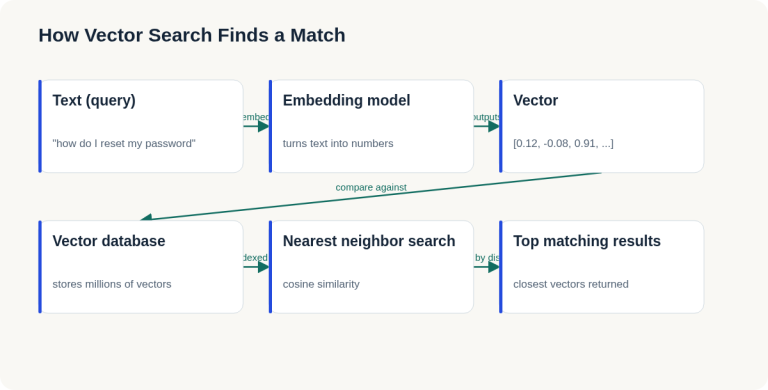
English Lesson — Tuesday Morning: Embeddings & Vector Search Vocabulary
Daily English practice for tech professionals: embed, vector database, and nearest neighbor search vocabulary with pronunciation and exercises.
Read more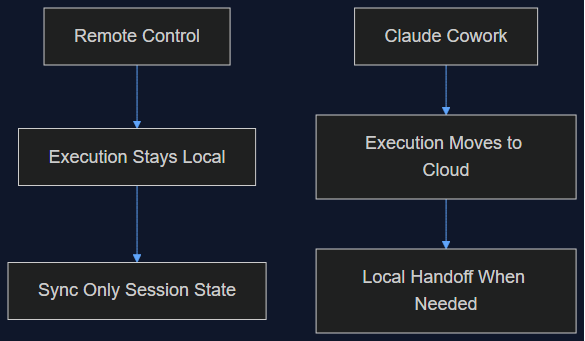
06 Oct 2026 · 5 min read
agentic coding
Claude Cowork Just Did the Thing I Said Remote Control Wasn't Doing
In August I wrote that Claude Code's Remote Control was a sync layer, not a cloud migration, and that keeping execution local was the point. This week Anthropic moved Cowork's execution to the cloud by default. Here's why both were the right call — for different products.
Read more
03 Oct 2026 · 4 min read
agents
SIFT: What It Actually Costs to Make a Coding Agent Improve Itself
MIT and Sakana AI's SIFT framework beat the prior self-improving-agent SOTA by using a Bradley-Terry judge instead of more patches. I ran the real cost numbers — $150 and under 5 hours wall-clock for a 4.4-point jump on Polyglot.
Read more
Discussion
Comments are reviewed before publication. Your email is kept private.