
JOURNAL
The Full AI Team Playbook: Tools, Processes & Delivery Excellence (Part 12 of 12)
Part 12 of 12 — The complete AI-Powered Software Teams playbook: the full delivery pipeline, team configuration principles, toolstack recommendations, the 5 non-negotiable human checkpoints, and what it means to lead and work in an AI-augmented software team.
On this page
This is the final post in the AI-Powered Software Teams series. In the eleven posts preceding this one, we examined each role in detail: how AI agents transform what each person does, which tools accelerate which workflows, and where human judgment remains irreplaceable. This post brings everything together into a complete delivery playbook.
If you have read the entire series, this will serve as a reference. If you are starting here, this is your map.
The AI-Powered Delivery Pipeline: End to End
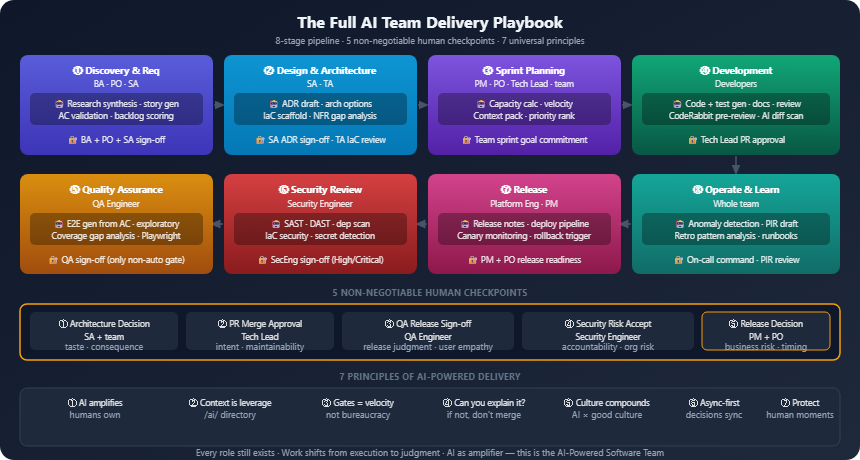
Every piece of software that leaves a high-performing AI-augmented team passes through the same pipeline. The specific tools vary; the stages do not.
Stage 1: Discovery & Requirements
Who: BA + PO + SA
AI Role: Synthesis of research, user story generation, AC validation, prioritisation scoring
Human Gate: BA signs off requirements; PO approves backlog priority; SA signs off feasibility
Output: Sprint-ready stories with testable AC, design context in /ai/context.md
Stage 2: Design & Architecture
Who: SA + TA
AI Role: Architecture option generation, ADR drafting, IaC scaffolding, NFR gap analysis
Human Gate: SA team sign-off on ADR; TA reviews IaC before merge
Output: ADR committed to repo; IaC reviewed and merged; NFR targets documented
Stage 3: Sprint Planning
Who: PM + PO + Tech Lead + team
AI Role: Capacity calculation, velocity trend, context pack generation
Human Gate: Team commits to sprint goal
Output: Sprint board loaded; sprint goal agreed; team aligned
Stage 4: Development
Who: Developers (with AI pair)
AI Role: Ticket analysis, code generation (boilerplate), test scaffolding, documentation
Human Gate: Developer self-review; CodeRabbit automated review; Tech Lead PR approval
Output: Reviewed, tested, documented code merged to main
Stage 5: Quality Assurance
Who: QA Engineer
AI Role: E2E test generation from AC, exploratory testing agent, coverage gap analysis
Human Gate: QA sign-off (the only non-automated gate before staging release)
Output: All quality gates passed; QA signed off
Stage 6: Security Review
Who: Security Engineer
AI Role: SAST (Semgrep/CodeQL), dependency scan, DAST (ZAP), IaC security scan (Checkov)
Human Gate: Security Engineer reviews all High/Critical findings; explicit sign-off
Output: Security report clean; release cleared
Stage 7: Release
Who: Platform Engineer + PM
AI Role: Release notes generation, deployment pipeline execution, monitoring during rollout
Human Gate: PM and PO confirm release readiness; Platform Engineer confirms deployment
Output: Production deployment; stakeholder notification sent
Stage 8: Operate & Learn
Who: Whole team
AI Role: Ongoing monitoring, anomaly detection, post-incident summary drafting, retro pattern analysis
Human Gate: Incident command (on-call engineer), post-incident blameless review
Output: Runbook updated; action items in backlog; metrics reviewed at sprint review
The 5 Non-Negotiable Human Checkpoints
No matter how much AI accelerates the pipeline, these five human decisions cannot be delegated:
| # | Checkpoint | Who | Why human |
|---|---|---|---|
| 1 | Architecture Decision | SA + team | Architectural taste, long-term consequence, context AI lacks |
| 2 | PR Merge Approval | Tech Lead | Maintainability, intent, team mentoring |
| 3 | QA Release Sign-off | QA Engineer | Release judgment, user empathy, severity weighting |
| 4 | Security Risk Acceptance | Security Engineer | Regulatory accountability, org-specific threat context |
| 5 | Production Release Decision | PM + PO | Business risk, stakeholder accountability, timing judgment |
Rule: These five decisions can be informed by AI. They cannot be made by AI.
The AI Team Configuration
Shared Context (the /ai/ directory)
Every AI-augmented team maintains a shared context repository that all agents use:
/ai/
  context.md           — product brief, tech stack, team norms
  prompts/
    ba-story.md        — BA's standard story generation prompt
    sa-adr.md          — SA's standard ADR generation prompt
    dev-review.md      — Developer's self-review prompt template
    qa-testgen.md      — QA's test generation prompt template
  decisions/           — ADRs committed here
  runbooks/            — Operational runbooks (AI-maintained)
All AI prompts reference /ai/context.md as their first line. No AI output is produced without the team’s shared context.
Git Branch Strategy
main                   — always deployable
├── feature/[ticket]   — all feature development
├── fix/[ticket]       — bug fixes
└── release/[version]  — release candidates
- Every PR targets
main - Every PR trigger: full CI pipeline (build, test, SAST, deps scan)
- Merges to main trigger: staging deployment + integration tests
- Release tags trigger: production workflow with manual approval gate
The AI Team Toolstack (Recommended Starting Point)
| Layer | Tool | Purpose |
|---|---|---|
| AI Assistant | Claude + GitHub Copilot | Code assistance, reasoning, content generation |
| Code Review | CodeRabbit | Automated PR pre-review |
| Version Control | GitHub / GitLab | Source of truth |
| Issue Tracking | Linear / Jira | AI-enriched tickets and boards |
| CI/CD | GitHub Actions / Azure DevOps | Automated pipeline |
| IaC | Terraform + Infracost | Infrastructure + cost estimation |
| Testing | Playwright MCP + Vitest | AI-directed E2E + unit tests |
| SAST | Semgrep + CodeQL | Security scanning |
| Observability | Prometheus + Grafana | Metrics + dashboards |
| Docs | Notion AI / Confluence AI | Living documentation |
This is a baseline. Every team will adapt based on their technology stack, cloud provider, and existing tooling.
The 7 Principles of AI-Powered Delivery
After twelve posts examining this topic from every angle, seven principles emerge as universal:
1. AI amplifies; humans own.
AI agents make existing roles more powerful. They do not create teams of self-directing agents. Every AI output has a human accountable for it.
2. Context is leverage.
The quality of AI output is directly proportional to the quality of context provided. Teams that invest in maintaining shared context files, prompt libraries, and ADR repositories get vastly better AI results than those who treat each prompt as ad-hoc.
3. Quality gates are the backbone.
AI-accelerated teams produce more code faster. Without automated quality gates and human checkpoints, they also produce defects faster. Gates are not bureaucracy — they are velocity sustainers.
4. The “can I explain this?” test.
For every line of AI-generated code: can the developer who owns it explain exactly what it does and why? If not, it should not be merged. This is the anti-debt principle for AI-assisted development.
5. Culture compounds.
AI makes good engineers more effective. It also makes bad engineering processes faster and worse. Teams that invest in engineering culture — psychological safety, blameless postmortems, mentoring, standards — get compounding returns from AI adoption. Teams that don’t pay for it later.
6. Async-first, human-facing.
Information exchange is async (AI handles it). Decisions, trust, and alignment are synchronous (human conversations and ceremonies). Structure your meetings accordingly.
7. The irreducible human.
In every role, in every process stage, there is a decision point where human judgment — formed by experience, context, accountability, and values — is irreplaceable. Know where your irreducible human moments are. Protect them.
What Changes When You Adopt This Playbook
Developer experience improves significantly. Engineers spend more time on interesting problems and less on boilerplate, administrative tasks, and mechanical review. This measurably improves retention.
Output quality increases, not decreases. Counter-intuitively, more AI involvement — implemented correctly — increases quality because automated gates catch more issues than humans manually testing can. The key is “implemented correctly”: gates must be non-negotiable.
Velocity is sustainable. Technical debt accumulation slows temporarily in AI-accelerated teams because defect detection happens earlier (when fixes are cheapest). Long-term velocity remains high.
Roles shift, not disappear. Every role in this series still exists. What shifts is where each role’s time goes: less mechanical execution, more judgment, mentoring, and stakeholder alignment.
The Series Summary
| Part | Role | Transformation theme |
|---|---|---|
| 1 | Overview | The 4-layer AI team model |
| 2 | BA | AI-synthesised requirements, story generation |
| 3 | PO/PM | Backlog scoring, sprint planning, release notes |
| 4 | SA | ADR generation, architecture canvas |
| 5 | Tech Lead | AI PR review, standards enforcement, mentoring |
| 6 | Developer | Inner loop: ticket to PR in AI-augmented workflow |
| 7 | QA | AI testing pyramid, 6-gate quality assurance |
| 8 | TA | IaC generation, NFR analysis, cost modelling |
| 9 | Security | Secure SDLC pipeline, SAST/DAST, threat modelling |
| 10 | DevOps | CI/CD generation, incident diagnosis, GitOps |
| 11 | Rituals | Async-first ceremonies, AI-prepared agile meetings |
| 12 | Playbook | Full pipeline, 5 human checkpoints, 7 principles |
Start from the beginning: Part 1 — The AI Team Model →
Browse all posts in the AI-Powered Software Teams series.
Related reading
07 Oct 2026 · 4 min read
ai
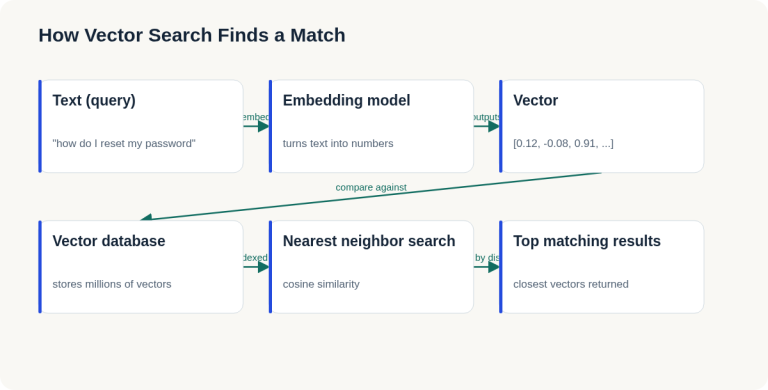
English Lesson — Tuesday Morning: Embeddings & Vector Search Vocabulary
Daily English practice for tech professionals: embed, vector database, and nearest neighbor search vocabulary with pronunciation and exercises.
Read more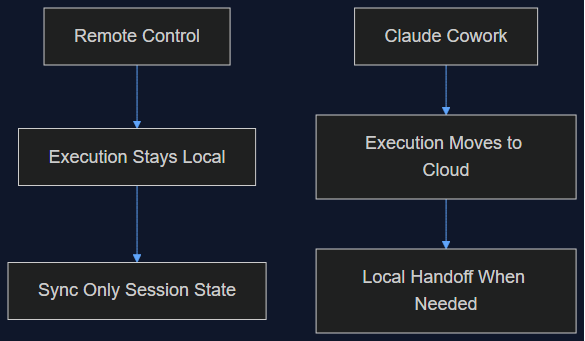
06 Oct 2026 · 5 min read
agentic coding
Claude Cowork Just Did the Thing I Said Remote Control Wasn't Doing
In August I wrote that Claude Code's Remote Control was a sync layer, not a cloud migration, and that keeping execution local was the point. This week Anthropic moved Cowork's execution to the cloud by default. Here's why both were the right call — for different products.
Read more
03 Oct 2026 · 4 min read
agents
SIFT: What It Actually Costs to Make a Coding Agent Improve Itself
MIT and Sakana AI's SIFT framework beat the prior self-improving-agent SOTA by using a Bradley-Terry judge instead of more patches. I ran the real cost numbers — $150 and under 5 hours wall-clock for a 4.4-point jump on Polyglot.
Read more
Discussion
Comments are reviewed before publication. Your email is kept private.