
JOURNAL
The FBI Just Warned That an Open-Source AI Agent Can Breach a Network in Under Three Hours
The FBI's November 13 FLASH advisory says ARTEX, an open-source multi-agent pentesting framework, is being weaponized to go from initial targeting to privileged access in under three hours, with 1,600+ exposed consoles found in the wild.
On this page
On November 13, 2026, the FBI’s Internet Crime Complaint Center released a TLP:CLEAR FLASH advisory, FLASH-20261113-001, with a title that doesn’t leave much room for interpretation: a threat overview of the ARTEX autonomous penetration testing framework. ARTEX isn’t a secret government tool or a leaked nation-state exploit kit. It’s an open-source project, built for legitimate red-team work, that threat actors have been running against real companies since at least August 2026. The FBI’s advisory is essentially a public admission that a tool anyone can download is now showing up on the attacker side of actual breaches.
What ARTEX actually does
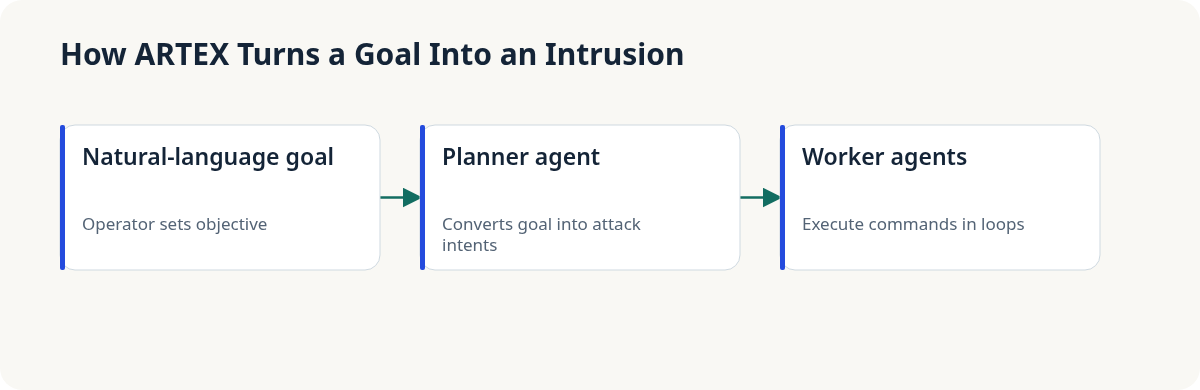
ARTEX is written in Go and structured as a multi-agent system, not a single model making decisions. A planner agent takes a natural-language goal — something as plain as “get domain admin on this network” — and breaks it into attack intents. Specialized worker agents then execute those intents as machine commands, looping until the objective is met, with minimal human involvement beyond setting the initial goal. The framework has no model of its own; it’s a harness that plugs into external LLM providers, including frontier models from Anthropic and OpenAI as well as open-source and Chinese-origin models like DeepSeek, GLM, Grok, and Kimi. The advisory notes that DeepSeek’s cheaper models dominate among observed attacker instances, for a reason worth sitting with: a stated “lack of observable guardrails,” combined with lower cost, makes them the practical choice for someone running this at scale against targets that don’t fight back the way a safety-tuned frontier model’s refusals would.
The number that should worry you
The advisory cites Microsoft data showing ARTEX-driven intrusions moving from initial targeting to privileged access in under three hours. For context, the industry’s own benchmark for “breakout time” — how fast an attacker pivots from initial access to lateral movement — has historically been measured in hours for the fastest human-operated intrusions and often in days for most. Under three hours, end to end, with minimal human steering, changes the math for every defender whose incident response plan assumes there’s a window to detect and contain before privileged access is lost. There usually was one. ARTEX is built to close it.
Researchers identified more than 1,600 publicly exposed ARTEX console instances as of early November 2026, which tells you two things at once. First, this isn’t a handful of sophisticated actors carefully hiding their tooling — it’s widespread enough that a large population of operators left their own control panels facing the internet. Second, the framework has escaped its original red-team niche and is circulating through forks, localized variants, archived copies, and a commercial offshoot called ARTEX PRO. Once a tool exists in that many parallel versions, taking down the original repository does essentially nothing. The FBI’s advisory lists victims across financial services, government, technology, defense, semiconductors, energy, healthcare, manufacturing, telecommunications, and legal — which is less a target list than a confirmation that there isn’t a target list. If your organization has anything worth stealing or disrupting, you’re in scope.
Why the six-sub-agent architecture matters for defenders
The advisory describes ARTEX as abstracting the attack lifecycle across specialized sub-agents rather than a single model doing reconnaissance, exploitation, and privilege escalation sequentially. That architectural choice is what makes the speed numbers plausible instead of marketing. A single LLM working through a multi-stage intrusion the way a human operator would — read, reason, act, observe, repeat — is bottlenecked by context limits and the time each reasoning step takes. Splitting the work across a planner and multiple workers running in parallel loops is the same scaling trick that made agentic coding tools fast enough to be useful for software development, applied to intrusion instead. The defensive implication is specific: signature-based detection tuned to catch a human operator’s pacing and tool sequencing will miss an ARTEX-driven intrusion, because the attack doesn’t pace itself like a person. It paces itself like a pipeline.
This is also where the “minimal technical expertise” line in the advisory earns its weight. ARTEX collapses what used to require a skilled operator chaining tools by hand into a single natural-language prompt. That’s the same democratization effect every agentic AI product markets as a feature — lower the skill floor, let more people do the work — except the work here is compromising networks, and the people it’s lowering the floor for are the ones currently running 1,600 exposed consoles without apparently knowing or caring that their own infrastructure is visible.
What this means if you run infrastructure
None of ARTEX’s individual techniques are new — it’s not exploiting some undiscovered class of vulnerability. What’s new is the speed and the low barrier to entry, and those two things together mean the old assumption that you have hours to detect and respond before privileged access is lost no longer holds for a meaningful share of attackers. If your detection stack still relies primarily on behavioral baselines tuned for human-paced intrusions, or if your incident response runbook assumes a multi-hour window between initial compromise and serious damage, this advisory is a direct argument for re-testing that assumption against a machine-speed adversary rather than a hypothetical one. The FBI publishing a FLASH advisory about a specific named open-source framework, rather than a generic warning about “AI-enabled threats,” is itself a signal worth taking at face value: this is already happening, not a future risk.
Source: OODA Loop, “FBI FLASH on ARTEX: Agentic AI Hacking Frameworks Move From Pen Testing Tool to Mainstream Threat”, November 13, 2026 (summarizing FBI/IC3 FLASH-20261113-001).
Related reading

· 4 min read
agentic-ai
LangChain Raised $300M. The Interesting Part Isn't the Valuation.
LangChain's $300M Series C at a $3B valuation is the headline, but the money is going into LangSmith's observability, evaluation, and governance layer for agents already running at Toyota, Rippling, and NVIDIA. Here's what that actually buys a team shipping agents.
Read more
· 4 min read
agentic-ai
Cursor Projects Just Learned to Let Your Agents Talk to Each Other
Cursor's Projects feature went multiplayer on November 10, adding a shared task board and shared context so a team's coding agents can spot conflicts before they turn into merge hell. Here's what actually changed and who should care.
Read more
· 5 min read
agentic-ai
Gemini 4 Hydrogen Is Google's Bet That Most Agent Work Doesn't Need the Flagship
Google's new mid-tier model runs 2.5x faster than Gemini 3.8 Flash and triples its Terminal-Bench score, while Antigravity Orchestrator hands it most of the actual agent work. Here's what the numbers mean for teams building on Gemini.
Read more
Discussion
Comments are reviewed before publication. Your email is kept private.