
JOURNAL
LangChain Raised $300M. The Interesting Part Isn’t the Valuation.
LangChain's $300M Series C at a $3B valuation is the headline, but the money is going into LangSmith's observability, evaluation, and governance layer for agents already running at Toyota, Rippling, and NVIDIA. Here's what that actually buys a team shipping agents.

On this page
On November 13, 2026, LangChain announced a $300 million Series C at a $3 billion post-money valuation, led by CapitalG with new money from GIC and DFJ Growth, and continued participation from IVP, Sapphire Ventures, Salesforce Ventures, Insight Venture Partners, QuantumLight, and MongoDB Ventures. That brings LangChain’s total raised to roughly $460 million. Funding rounds are easy to skim past — a number, a logo wall of investors, a quote about the future of AI. The part worth actually reading is what CEO Harrison Chase said the money is for, because it’s a narrower and more specific bet than “grow the company.”
What the money is actually funding
Chase’s framing is that “every company will need to own its intelligence” to compete in an agent-driven economy, and that companies “should be free to choose the best models for their needs, control their data and infrastructure, and continuously improve their agents.” Stripped of the pitch-deck phrasing, that’s an argument against renting a black-box agent product from a single model vendor and for owning the pipeline that builds, watches, and fixes your own agents. The round is going primarily into LangSmith, LangChain’s observability, evaluation, and deployment platform, not into the open-source LangChain or LangGraph frameworks themselves.
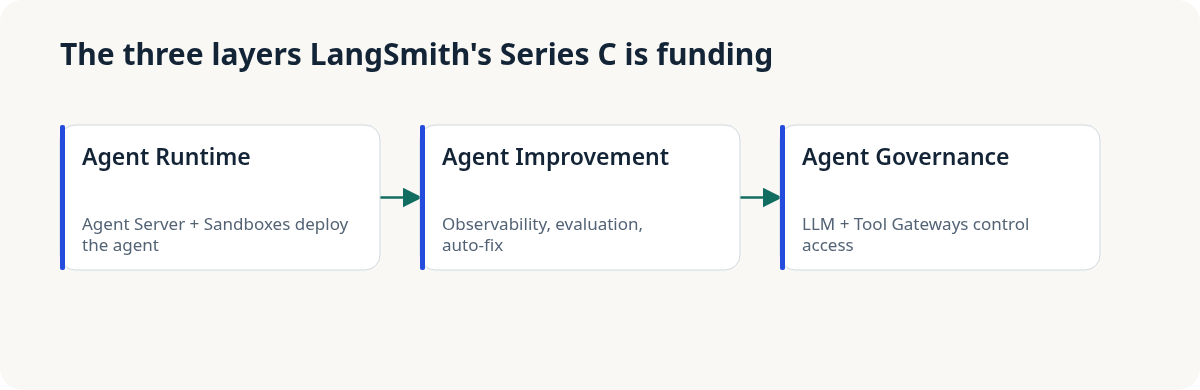
LangSmith’s pitch breaks into three pieces that map to three different failure modes teams hit once an agent is in production. Agent Runtime — the Agent Server and Sandboxes — handles deploying agents reliably across LangGraph, Deep Agents, or plain LangChain code, in the cloud or on-prem. Agent Improvement is the observability and evaluation layer: watching what an agent actually did, scoring it, and feeding failures back in. The detail that stands out here is LangSmith Engine, which Chase’s team describes as automating improvement by detecting errors and writing fixes itself, and a fine-tuning path that converts agent traces into training data. Agent Governance is the LLM and Tool Gateways: controlling which models an agent can call, what budget it can burn, and which tools it’s allowed to touch, enforced across a whole team rather than per developer.
The usage numbers are the real signal
LangChain says LangSmith now serves more than 7,000 organizations, spanning startups like Harvey, Rippling, and Listen Labs and enterprises including NVIDIA, Toyota, and Salesforce. Two specific data points are worth more than the customer-logo list: Clay monitors hundreds of millions of monthly agent runs through the platform, and Workday says LangSmith cut its agent deployment time from five months to under a day. If both numbers hold up under scrutiny, they say something more concrete than “enterprises are adopting AI” — they say the gap between a working agent demo and a governed, observable agent in production was, until recently, measured in months, and the market is paying to close it. That gap is the actual product LangChain is selling. Anyone can wire a LangGraph agent together in an afternoon. Getting a team’s leadership comfortable putting that agent in front of customers, with budget controls and an audit trail, is the part that used to take five months.
Why this matters even if you don’t use LangChain
A $3 billion valuation on an open-source-adjacent framework company is itself a signal about where the money in agentic AI is flowing in late 2026: not toward better base models, which is a game only a handful of labs with enough capital can play, but toward the operational layer that sits between a model API and a production agent — observability, evaluation, governance, deployment. That’s the same layer Datadog built a business on for traditional software, applied to a category of software that fails in ways traditional APM tooling was never built to catch, like an agent quietly drifting into bad tool calls that no exception ever gets thrown for.
The one claim in this announcement that deserves more scrutiny before anyone repeats it as fact is LangSmith Engine’s automated fix-writing. “Detects errors and writes fixes” is the kind of capability that sounds great in a funding announcement and needs to be judged against real failure cases, not a demo, before a team trusts it on anything that touches customers. The governance half of the pitch — model gateways, tool access control, budget enforcement — is a more boring, more provable claim: those are policy enforcement points, not model behavior, and they’re exactly the kind of guardrail most teams running agents in production are currently missing. If you’re running agents without any version of that governance layer today, the $300 million says you’re not alone, and that someone just bet real money on the idea that you’ll want to buy it rather than build it yourself.
Source: LangChain, “Series C”, November 13, 2026.
Related reading

· 4 min read
agentic-ai
Cursor Projects Just Learned to Let Your Agents Talk to Each Other
Cursor's Projects feature went multiplayer on November 10, adding a shared task board and shared context so a team's coding agents can spot conflicts before they turn into merge hell. Here's what actually changed and who should care.
Read more
· 5 min read
agentic-ai
Gemini 4 Hydrogen Is Google's Bet That Most Agent Work Doesn't Need the Flagship
Google's new mid-tier model runs 2.5x faster than Gemini 3.8 Flash and triples its Terminal-Bench score, while Antigravity Orchestrator hands it most of the actual agent work. Here's what the numbers mean for teams building on Gemini.
Read more
· 4 min read
agentic-ai
DeepMind Got AI Agents to Write 6.5 Million Lines of Proof for Signal's Crypto Code
DeepMind's AlphaProof Code formally verified Signal's cryptographic code in four weeks instead of years, with AI agents writing every line of the proof. Here's what it actually checked, and what it didn't.
Read more
Discussion
Comments are reviewed before publication. Your email is kept private.