
JOURNAL
Cursor Projects Just Learned to Let Your Agents Talk to Each Other
Cursor's Projects feature went multiplayer on November 10, adding a shared task board and shared context so a team's coding agents can spot conflicts before they turn into merge hell. Here's what actually changed and who should care.

On this page
On November 10, 2026, Cursor announced that Projects — the workspace it shipped a little over two months earlier — is now multiplayer. The pitch is simple: invite teammates into a Project, and every person’s coding agent can see what everyone else’s agent is doing, instead of each engineer running Cursor in their own isolated bubble and finding out about conflicts at merge time.
What actually shipped
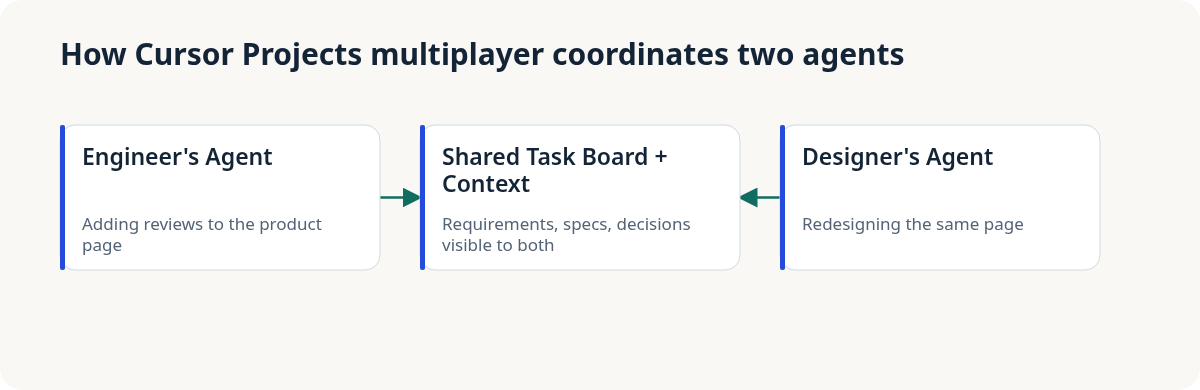
Two pieces matter here. The first is a shared task board: everyone on the team can see who’s doing what, which agent is working on which task, and the pull request tied to each one. That’s not a new idea — Jira and Linear have done this for humans for years — but putting it in front of the agents themselves, not just the people, is the actual change. The second piece is shared context: a team-wide pool of requirements docs, diagrams, tech specs, and mockups that every agent in the Project can read. Cursor’s own framing is direct about why that matters: “A decision made in one chat is accessible to every agent in the Project.” Before this, if you clarified a requirement with your own agent in a one-on-one chat, that clarification lived in your chat and nowhere else. A teammate’s agent working on an adjacent piece of the same feature had no way to know it happened.
The part worth paying attention to is agent-to-agent communication. Cursor describes it as opening up coordination between teammates’ agents in real time, and gives a concrete scenario: an engineer is adding reviews to a product page while a designer is redesigning that same page. Under the old, single-player model, neither agent would know about the other’s work until someone opened a PR and the diffs collided. With shared context and a shared task board, the two agents can, in Cursor’s words, “plan around and unblock each other” before that collision happens.
The real problem this is aimed at
Anyone who’s run two or three agents against the same codebase at once already knows the failure mode: each agent is individually competent and collectively unaware. One agent renames a function the other one is mid-edit on. One agent assumes an API shape that another agent just changed an hour ago in a different chat. The agents aren’t wrong, exactly — they’re working from the context they were given, and that context stopped at the edge of a single conversation. Scale that across a five- or six-person team each running their own agent sessions, and the coordination tax isn’t theoretical. It shows up as duplicated work, conflicting assumptions baked into separate branches, and PRs that fight each other on review day. Cursor is betting that the fix isn’t a smarter individual agent, it’s giving agents the same shared picture a human team gets from a standup and a wiki.
That’s a reasonable bet, and it maps to something Slack and Notion already proved: the hard part of team software was never getting one person’s tool to work well, it was getting everyone’s copy of the truth to agree. Cursor is applying that lesson to agents instead of humans, one release cycle after shipping the single-player version. Sixty-one days from launch to multiplayer is fast even by this industry’s pace, which tells you Cursor either had this on the roadmap from day one or heard the same complaint from enough teams that it jumped the queue.
What’s still unresolved
Shared context cuts both ways. If a decision made in one chat is now accessible to every agent in the Project, that’s also a decision one person’s agent can act on unilaterally and have it ripple into five other agents’ plans without a human reviewing it first. Cursor’s own example — an engineer’s agent and a designer’s agent syncing up over a shared page — assumes the sync produces a correct outcome, not just a fast one. A shared task board tells you who’s doing what; it doesn’t tell you whether two agents quietly agreeing with each other on a plan is actually the plan a human on the team would have picked. Team leads adopting this should treat the shared context pool the way they’d treat a shared staging environment: useful, necessary at scale, and exactly the kind of thing that needs a human doing spot checks on what’s landing in it, not just trusting that more visibility between agents automatically means better outcomes.
The feature is rolling out in beta to all Cursor users starting November 10. If your team is already running multiple Cursor agents against one repository and feeling the coordination tax described above, this is worth turning on immediately — the downside risk is low and the upside is a real, specific pain point. If your team runs one agent per person on genuinely separate parts of a codebase with little overlap, the shared task board is mostly overhead you don’t need yet. The feature earns its keep exactly where merge conflicts between agents already hurt, not before.
Source: Cursor, “Cursor Projects is now multiplayer”, November 10, 2026.
Related reading

· 4 min read
agentic-ai
LangChain Raised $300M. The Interesting Part Isn't the Valuation.
LangChain's $300M Series C at a $3B valuation is the headline, but the money is going into LangSmith's observability, evaluation, and governance layer for agents already running at Toyota, Rippling, and NVIDIA. Here's what that actually buys a team shipping agents.
Read more
· 5 min read
agentic-ai
Gemini 4 Hydrogen Is Google's Bet That Most Agent Work Doesn't Need the Flagship
Google's new mid-tier model runs 2.5x faster than Gemini 3.8 Flash and triples its Terminal-Bench score, while Antigravity Orchestrator hands it most of the actual agent work. Here's what the numbers mean for teams building on Gemini.
Read more
· 4 min read
agentic-ai
DeepMind Got AI Agents to Write 6.5 Million Lines of Proof for Signal's Crypto Code
DeepMind's AlphaProof Code formally verified Signal's cryptographic code in four weeks instead of years, with AI agents writing every line of the proof. Here's what it actually checked, and what it didn't.
Read more
Discussion
Comments are reviewed before publication. Your email is kept private.