
JOURNAL
Gemini 4 Hydrogen Is Google’s Bet That Most Agent Work Doesn’t Need the Flagship
Google's new mid-tier model runs 2.5x faster than Gemini 3.8 Flash and triples its Terminal-Bench score, while Antigravity Orchestrator hands it most of the actual agent work. Here's what the numbers mean for teams building on Gemini.
On this page
On November 12, 2026, Koray Kavukcuoglu, SVP of Google DeepMind and Chief AI Architect at Google, published a post with a title that undersells what it’s actually announcing: “Introducing Gemini 4 Hydrogen for Agentic Workflows.” Hydrogen isn’t a faster, cheaper Gemini 4 Carbon. It’s the model Google now expects to do most of the work in any multi-model agent session, with Carbon called in only for the steps that actually need it.
What Hydrogen actually is
Google’s own framing is direct: Hydrogen is built to “stand on its own as a model for everyday work — or to pair with Carbon and Argon as the high-efficiency execution engine in multi-model workflows.” It sits in the tier below Carbon (the frontier model for the hardest reasoning) and Argon (the prior flagship), positioned for coding and agentic tasks that need speed more than maximum capability.
The benchmark numbers back up the positioning. Against Gemini 3.8 Flash, the model it effectively replaces at this tier, Hydrogen completes tasks 2.5x faster at its default high setting, triples the Terminal-Bench 4.1 score (57% versus 18.2%), and cuts fabricated claims by more than 5x. On complex repositories it runs 2 to 2.8x faster while using 12 to 23% fewer tokens to get there — a real efficiency gain, not just a speed trade against accuracy. On the Artificial Analysis Intelligence Index, Hydrogen scores 51 at its high setting and 54 at xhigh, enough to surpass Argon, last generation’s flagship, on that index.
Pricing is flat and simple: $1.50 per million input tokens, $7.50 per million output tokens, across the full 1M-token context window with no sliding scale as context fills up. It’s available now in AI Studio, the Gemini API, Android Studio, Gemini for Business, Google Antigravity, the Gemini app, Google Search, and Google Sheets — a wider simultaneous rollout than most model releases get, which tells you Google is treating this as infrastructure, not a product launch.
What Antigravity Orchestrator actually does
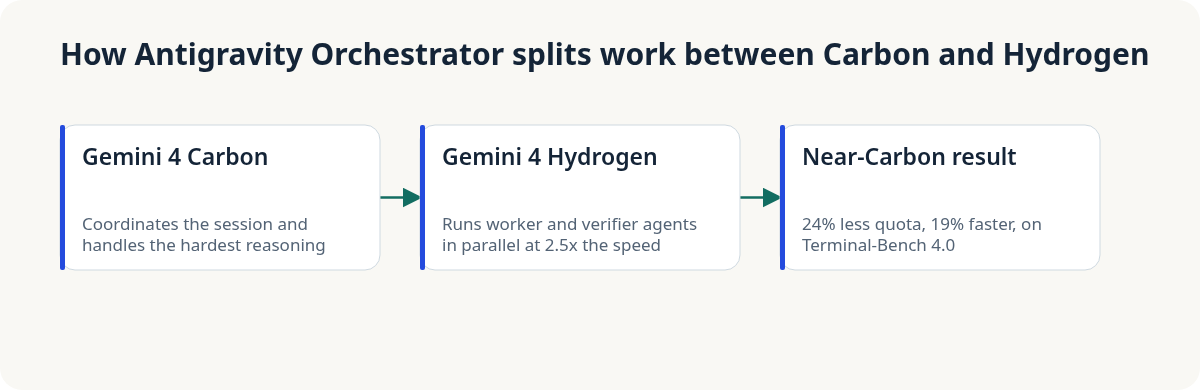
The more interesting part of the announcement, for anyone building agent systems rather than just calling a chat API, is Antigravity Orchestrator. It automatically switches between Carbon and Hydrogen within a single session rather than forcing a developer to pick one model up front. Carbon acts as the coordinator, handling planning and the reasoning steps that genuinely need the frontier model. Hydrogen powers the worker and verifier agents underneath it, running in parallel.
On Terminal-Bench 4.0, that split achieves near-Carbon task success rates while consuming 24% less quota and finishing 19% faster than running Carbon for everything. That’s the actual argument for this release: not that Hydrogen alone beats Carbon at hard reasoning — it doesn’t claim to — but that most of what an agent session spends its tokens on is verification, retries, and parallel exploration, not the hardest single reasoning step. Routing that work to a cheaper, faster model while keeping the expensive model on coordination duty is a cost structure change, not just a new model on a leaderboard.
Where it lands against the competition, and where it doesn’t
Google’s own benchmark table puts Hydrogen at #5 on Agent Arena, 53.4% on the Multimodal Knowledge Agent benchmark, and #1 overall on the Vals Tax Agent Bench at 52.3%. Those are competitive numbers for a mid-tier model, and the tax-agent result in particular suggests real strength on tasks that mix structured reasoning with following detailed, changeable rules — exactly the kind of task an enterprise agent deployment tends to be built around. None of these numbers put Hydrogen ahead of Carbon on raw capability, and Google isn’t claiming that. The pitch is entirely about the Carbon-plus-Hydrogen combination beating a Carbon-only deployment on cost and latency at a similar success rate, not about Hydrogen winning outright.
The hallucination-rate claim is worth flagging as a claim rather than treating it as settled. “More than 5x fewer fabricated claims” compared to Gemini 3.8 Flash is a meaningful improvement if it holds across real workloads, and it’s exactly the kind of number that benchmark suites can be tuned toward without the underlying behavior in production matching it. Teams putting Hydrogen into a workflow where a fabricated claim is costly — anything customer-facing, anything touching numbers that get reported upward — should still run their own eval against their own data before trusting the headline multiplier.
What this means if you’re building on Gemini
If your agent workflows are currently calling Gemini 3.8 Flash directly, switching to Hydrogen is close to a strict upgrade at the same price point — faster, fewer fabricated claims, better on the benchmarks that map to real coding and agent tasks. The bigger decision is whether to adopt Antigravity Orchestrator’s automatic routing rather than hand-picking a model per call. Letting the orchestrator route work between Carbon and Hydrogen only pays off if your workload actually has the shape Google is optimizing for: a mix of hard coordination steps and high-volume parallel verification work. A workflow that’s uniformly simple doesn’t need Carbon in the loop at all, and a workflow that’s uniformly hard won’t see the 24% quota savings the orchestrator is built around.
The practical move is to benchmark your own agent pipeline against both configurations — Hydrogen alone, and Carbon-plus-Hydrogen through the orchestrator — before committing either way. The numbers Google published are real improvements on real benchmarks. Whether they translate into the quota and latency savings your specific workload needs is the one thing a published benchmark table can’t tell you.
Source: Google, “Introducing Gemini 4 Hydrogen for Agentic Workflows”, November 12, 2026.
Related reading

· 4 min read
agentic-ai
LangChain Raised $300M. The Interesting Part Isn't the Valuation.
LangChain's $300M Series C at a $3B valuation is the headline, but the money is going into LangSmith's observability, evaluation, and governance layer for agents already running at Toyota, Rippling, and NVIDIA. Here's what that actually buys a team shipping agents.
Read more
· 4 min read
agentic-ai
Cursor Projects Just Learned to Let Your Agents Talk to Each Other
Cursor's Projects feature went multiplayer on November 10, adding a shared task board and shared context so a team's coding agents can spot conflicts before they turn into merge hell. Here's what actually changed and who should care.
Read more
· 4 min read
agentic-ai
DeepMind Got AI Agents to Write 6.5 Million Lines of Proof for Signal's Crypto Code
DeepMind's AlphaProof Code formally verified Signal's cryptographic code in four weeks instead of years, with AI agents writing every line of the proof. Here's what it actually checked, and what it didn't.
Read more
Discussion
Comments are reviewed before publication. Your email is kept private.