
JOURNAL
TikTok hashtags and series: organize a library around real questions
Use truthful topic labels and standalone episodes to make an educational content library easier to navigate and evaluate.
On this page
Hashtags should help describe what a video actually contains. A series should help people move between related answers. Neither is a substitute for a useful demonstration. The practical question is not how many tags will unlock reach, but whether someone arriving at an individual episode can understand the topic, receive a complete answer and find a sensible continuation.
A topic label is not a distribution formula
TikTok includes hashtags among the content information considered in recommendations. Its public explanation does not give a magic hashtag count or promise that broad trending tags improve every post. See the official recommendation guide. Use tags that truthfully describe the subject and audience; treat any additional performance claim as a hypothesis that would need evidence.
For an adult-created paper bridge lesson, an activity label and an educational context label can be more informative than a string of unrelated trends. The exact number is a production choice, not a ranking rule. A tag referring to preschool activities would misdescribe a lesson designed for older children, even if it appears popular. Metadata should not broaden the promise beyond what the lesson safely and accurately delivers.
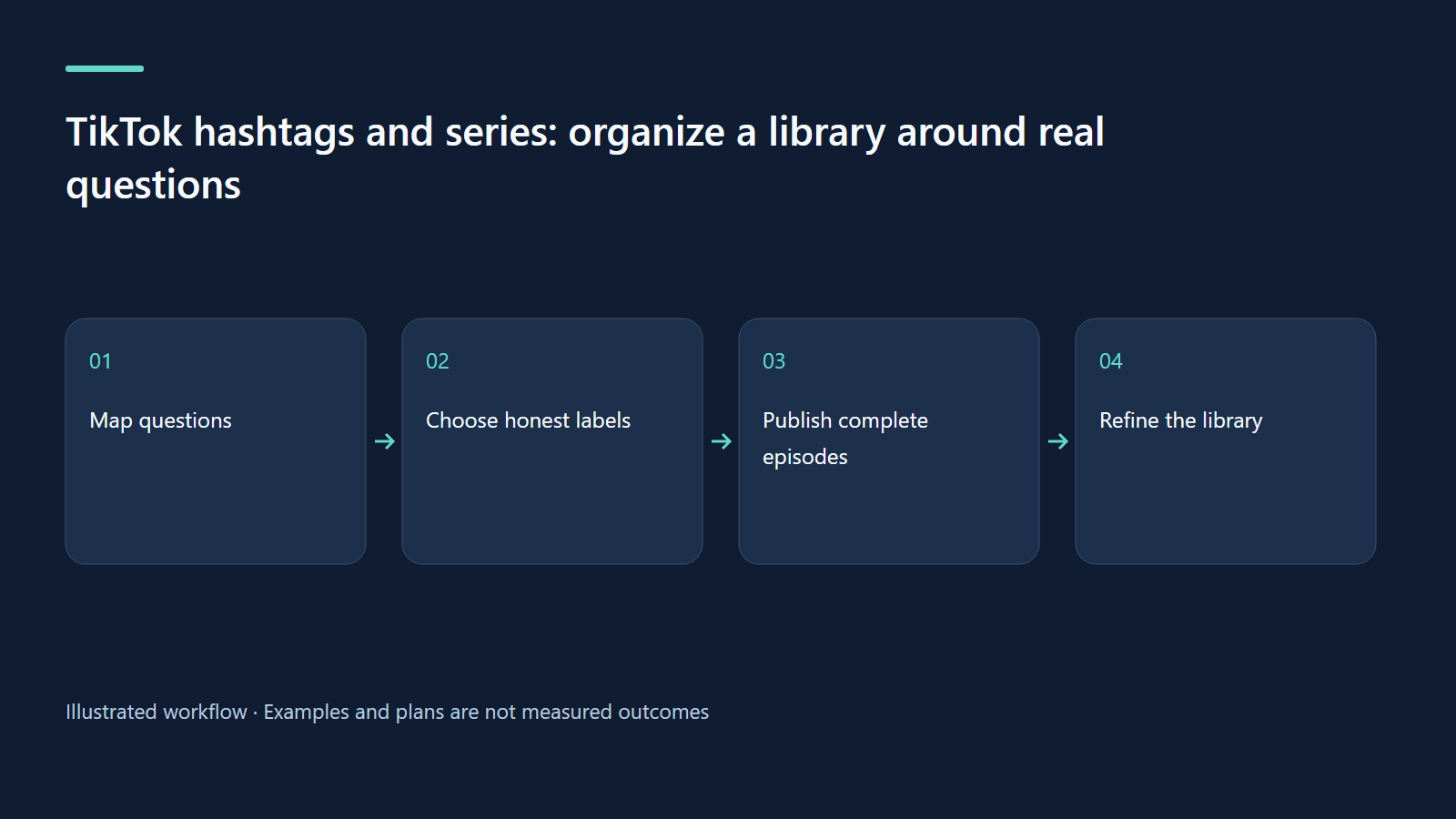
Build the series from questions rather than episode numbers
A parent may encounter episode four before episode one. Therefore, “Part 4” alone is a weak title. A clearer episode name is “Why does the folded paper bridge hold more weight?” The series identity can still appear in a small label, but the useful question leads. Each episode should explain the materials and assumptions needed for its own answer rather than requiring the viewer to search through the archive.
Start a series map with the main task, then separate the questions that genuinely need different demonstrations. For paper bridges, the setup, shape comparison, fair-test method and cleanup variations could each form an episode. Do not split a simple answer into fragments merely to create more uploads. The audience should gain something complete from each visit, even when a follow-up deepens the lesson.
| Episode question | Complete answer | Relevant continuation |
|---|---|---|
| How do I set up a paper bridge? | Materials, spacing and a basic fold. | Compare two shapes. |
| Why does folding change the result? | Show flat and folded versions under comparable loads. | Design a fair test. |
| How can I make the comparison fair? | Keep paper and cup spacing consistent. | Record results offline. |
| How can I reduce preparation and cleanup? | Use a tray and a simple materials checklist. | Choose another low-preparation activity. |
Keep the account’s subject coherent without becoming repetitive
A coherent library can include several formats: demonstration, explanation, troubleshooting and planning advice. The common thread is the adult audience’s work. A teacher account can discuss AI-assisted production and lesson review if both support preparing useful teaching materials. Randomly adding unrelated niches because a tag is fashionable makes it harder for a visitor to understand why following the account would help.
Coherence does not require identical openings or identical lengths. A setup episode might start with the materials laid out; a troubleshooting episode can begin with the failure; a review episode can compare an incorrect and corrected frame. Keep the underlying audience and standards stable while changing the visual problem. This is an editorial organization principle, not an assertion that consistency has a particular algorithmic weight.
Navigation must work without special account features
If the account has suitable grouping features, use them after verifying their current availability and behavior. Otherwise, use clear covers, consistent episode names and specific references to related videos. “Watch my next video” is fragile because publication order changes. “The paper bridge fair-test lesson explains how to keep the comparison consistent” remains understandable when someone arrives later.
A profile description should tell adult viewers what kind of answers the library offers. For example, “Practical lesson preparation and home STEM activities for parents and teachers” sets a useful expectation. Do not promise results the archive cannot support, such as guaranteed educational outcomes or guaranteed earnings from content. The profile is an invitation to inspect the work, not evidence that the work has already succeeded.
Practical exercise: audit tags and episode independence
Choose four existing videos or four proposed briefs. Write each video’s main question without its series name. If two questions are indistinguishable, combine them or clarify the difference. Under each question, write the material shown, the adult audience and the result. Check every planned tag against those three fields. Remove labels that imply a different age, language, tool or outcome.
Then ask a reviewer to watch one episode without the rest. Can they understand the setup? Does the answer end at a useful point? Does the suggested continuation name a real unresolved question? If the episode only creates suspense, it needs more substance. If the continuation is unrelated, remove it rather than forcing the viewer into another topic.
Troubleshooting a series with uneven performance
If episode one performs well and later episodes do not, check whether later titles depend on the earlier context. If viewers repeatedly ask for the beginning, the setup may be missing. If tags draw a different audience than the demonstration addresses, tighten the description. If a series receives fewer views but more relevant parent questions, examine its purpose before discarding it; a smaller useful audience may be appropriate for a specialized educational library.
Evaluate episodes at comparable ages and keep notes on their different questions, not just their tags. A strong result following a metadata change does not prove the tags caused it: the opening, topic, audience and timing may also differ. Keep the library organized around the work it helps adults do. That produces a clearer archive even while platform behavior and account features change.
Related learning paths
Related reading
08 Oct 2026 · 5 min read
TikTok SEO
TikTok search and For You: design for two different discovery moments
Build a useful answer for searchers without losing the visual proof that makes a recommendation worth watching.
Read more
08 Oct 2026 · 5 min read
TikTok SEO
Creator Search Insights: turn topic signals into a defensible content brief
Use search topics and content gaps as research leads, then validate audience fit and your ability to deliver a complete answer.
Read more
08 Oct 2026 · 5 min read
TikTok SEO
TikTok SEO across script, caption and screen: one promise in three forms
Coordinate the spoken explanation, post caption and visible labels so an adult viewer understands the task and can act on it.
Read more
Discussion
Comments are reviewed before publication. Your email is kept private.