
JOURNAL
From 6 Months Outsourcing to 2 Weeks With AI — A Business Owner’s Playbook
How a non-technical business owner went from painful outsourcing cycles to building products himself with Claude, Gemini, Codex, and Google Stitch. Real workflow, real tools, real numbers.
On this page
My boss is a pure business guy. No CS degree. Can’t write a for-loop. But last month, he built a working product demo, showed it to a client, closed a deal — and shipped the POC in 12 days.
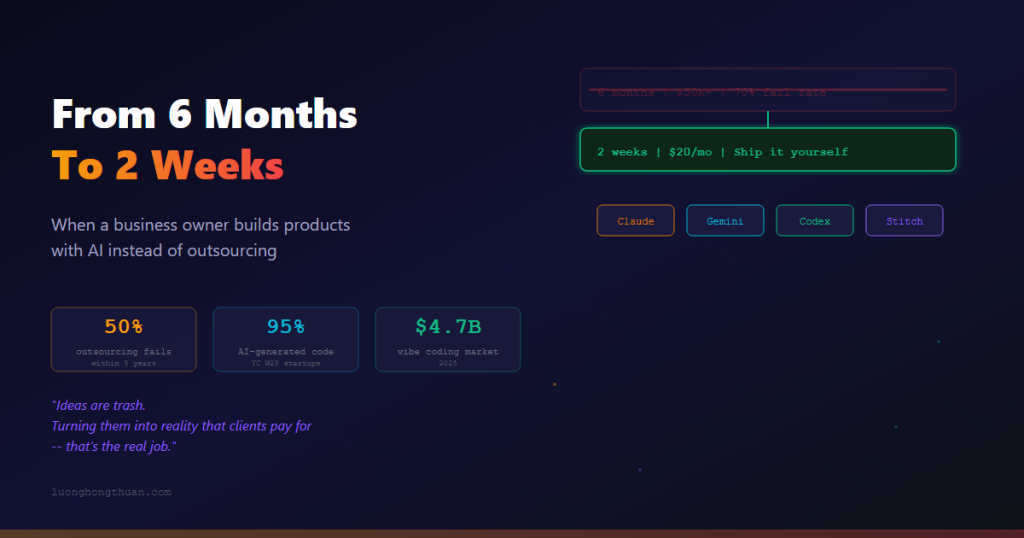
The old way? Find an outsourcing partner. Write a brief. Go back and forth for weeks. Wait 3-6 months. Pay $30K-$60K. Cross your fingers and hope the result matches what you described.
That era is over.
The Old Outsourcing Playbook (And Why It’s Broken)
Let’s not romanticize the old process. The numbers are brutal:
- 50% of outsourcing relationships fail within 5 years — Dun & Bradstreet
- 70% of projects fail because of communication problems — Deloitte
- 52.7% of projects exceed budget by an average of 189% — Standish Group
- 31% of software projects are canceled before completion
A “simple” MVP costs $30,000-$120,000 outsourced and takes 10-14 weeks on average. And that’s optimistic — most founders I know have at least one horror story of burning $50K+ on something that never shipped.
The hidden killer? Communication overhead. Nearly 60% of organizations experience unexpected expenses from communication barriers (Deloitte). A project manager spending 5 extra hours per week coordinating with offshore teams. Technical lead review sessions. Business stakeholder alignment meetings. The cost savings that justified outsourcing? They evaporate.
My boss lived this cycle for years. Brief the agency. Wait for wireframes. Request changes. Wait again. Review the build. More changes. Months go by. The final product doesn’t match the vision because somewhere between the 47th email and the 12th Zoom call, the intent got lost in translation.
The New Reality: Build It Yourself (In 2 Weeks)
Here’s what my boss’s workflow looks like now:
Day 1-2: Research & Strategy (Claude)
Open Claude, dump the business context:
“I need a SaaS platform for [industry]. My clients need [specific problem solved]. Here are my competitors: [URLs]. Analyze their pricing, features, and positioning. Then propose a product strategy with unique differentiators.”
Claude doesn’t just search the web — it thinks. It cross-references competitor strategies, identifies gaps, proposes positioning. My boss gets a strategic brief that would take a business analyst a week.
Claude Projects takes this further. Upload your company’s pricing sheets, past proposals, brand guidelines, industry reports. Claude becomes a domain expert on your specific business. The growth marketing team at Anthropic built an agentic workflow that processes hundreds of ad variations in minutes — work that took hours manually.
As of December 2025, users have created over 500 million Claude Artifacts — interactive apps, dashboards, landing pages, tools — many by non-developers.
Day 3-5: Design & Prototype (Google Stitch)
This is where it gets wild.
Google Stitch (launched May 2025, major 2.0 update March 2026) lets you describe what you want in plain language. No Figma skills needed:
“Design a dashboard for fleet management. Left sidebar navigation. Main area shows a map with vehicle locations. Bottom panel shows alerts. Dark theme. Professional.”
Stitch generates the full UI design. Don’t like something? Just say: “Make the sidebar collapsible and add a search bar at the top.”
Stitch 2.0 capabilities:
- AI-native infinite canvas — drag in images, text, code as context
- Multi-screen generation — click once, it auto-generates logical next screens
- Interactive prototyping — stitch screens together, hit Play, demo the full app flow
- Voice mode — speak to your canvas, get real-time design critiques
- DESIGN.md export — an agent-friendly markdown file that carries your design system to coding tools
My boss goes from idea to clickable prototype in 2-3 days. Not a mockup. A prototype you can click through and show to clients.
Day 5-8: Build the Working App (Gemini + AI Studio)
Take your Stitch design, export the code, import it into Google AI Studio Build Mode.
Then just talk to it:
“Add user authentication with Google login. Create a REST API for the vehicle data. Connect to a PostgreSQL database. Add real-time WebSocket updates for vehicle positions.”
AI Studio Build Mode supports:
- Server-side logic (not just frontend toys)
- Secure secrets management
- npm packages
- React frontend + server runtime
- One-click deploy to Google Cloud Run
No DevOps knowledge needed. No terminal. No Docker. You describe what you want, it builds it, you deploy it.
Day 8-12: Polish, Test, Demo (Codex + Claude)
OpenAI Codex (the 2025-2026 agent, not the old API) runs inside ChatGPT. Give it your codebase:
“Review this app for security vulnerabilities. Add input validation to all API endpoints. Write unit tests for the auth module. Fix any bugs you find.”
Codex works asynchronously — you assign tasks, go do other work, come back to completed pull requests. It takes 1-30 minutes per task. The latest GPT-5.3-Codex version handles debugging, deployment, monitoring, even writing PRDs.
Meanwhile, use Claude to:
- Generate marketing copy for the landing page
- Write API documentation
- Create a pitch deck for the client demo
- Build an interactive demo dashboard as an Artifact
Day 12: Ship. Show the client. Close the deal.
The Numbers Don’t Lie
This isn’t just one person’s anecdote. The industry data is staggering:
| Metric | Old Way | AI Way | Source |
|---|---|---|---|
| Time to MVP | 10-14 weeks | 1-2 weeks | McKinsey 2025 |
| Cost | $30K-$120K | $20-200/mo (subscriptions) | Industry avg |
| Communication overhead | 56% of failures | Talk to AI directly | Deloitte |
| Code generation | 100% manual | 95% AI-generated | YC W25 batch |
| Task completion | Baseline | 55% faster | GitHub/Microsoft Research |
Y Combinator data (2025):
- 25% of YC Winter 2025 startups have codebases that are 95% AI-generated (TechCrunch)
- These startups are the fastest-growing and most profitable in YC’s fund history (CNBC)
- Companies reaching $10M revenue with teams under 10 people
Garry Tan (YC CEO) rebuilt his 2008 startup Posterous — 70,000 lines of code — in 90 hours using AI. His quote:
“I could create in 80 hours what I couldn’t with $5M and five engineers in two years.”
He then shipped 600,000+ lines of production code in 60 days while running YC full-time.
The vibe coding market — coined by Andrej Karpathy in February 2025 and named Collins Dictionary’s Word of the Year — is valued at $4.7 billion and projected to reach $12.3 billion by 2027. 63% of vibe coding users are non-developers.
But Let’s Be Honest: What You Still Can’t Do
My boss can build a POC. He can demo it to clients. He can validate the idea in days instead of months.
But he can’t:
- Scale to production — Load balancing, database optimization, caching layers, CDN configuration. These need engineering.
- Security hardening — Authentication edge cases, SQL injection prevention, rate limiting, penetration testing. AI generates reasonable security, not bulletproof security.
- Maintain complex systems — When 15 microservices need to talk to each other and one breaks at 3 AM, you need a dev team.
- Handle compliance — GDPR, SOC2, HIPAA. Real compliance needs real engineers and real auditors.
The play isn’t “replace your dev team.” The play is:
Validate in 2 weeks what used to take 6 months. Then bring in engineers for what matters — production, scale, security.
My boss focuses on what he’s best at: finding clients and closing deals. In his words:
“Ideas are trash. Turning ideas into reality that clients pay for — that’s the real job.”
AI didn’t replace his need for engineers. It eliminated the 4-month gap between “I have an idea” and “let me show you a working demo.”
The Complete Tool Stack (2026)
| Tool | What It Does | Cost | Best For |
|---|---|---|---|
| Claude (Anthropic) | Strategy, research, writing, coding, artifacts | $20/mo Pro | Thinking partner, full-stack prototyping |
| Google Stitch | UI design from text/voice | Free (beta) | Non-designers creating professional UIs |
| Google AI Studio | Full-stack app builder | Free tier available | Backend logic, deployment |
| OpenAI Codex | Agentic code review, testing, debugging | Included in ChatGPT Plus ($20/mo) | Code quality, automated testing |
| Gemini 2.5 Pro | Research, analysis, multimodal | $20/mo | Long-context analysis, video/image understanding |
Total monthly cost: $20-60/month vs. $30,000-120,000 outsourced.
How to Start (This Week)
If you’re a business owner who has never coded:
Tonight: Sign up for Claude Pro ($20/mo). Describe your product idea. Ask it to create a competitive analysis, product spec, and landing page as an Artifact.
Tomorrow: Open Google Stitch (free). Describe your app’s main screen. Generate a UI. Click through the multi-screen flow.
Day 3: Take the Stitch design into Google AI Studio Build Mode. Add backend logic conversationally. Deploy to a link you can share.
Day 4-5: Use Claude to polish the copy. Use Codex to review the code. Use Gemini for any research you need.
By Friday: You have a working demo. Show it to a client. Get feedback. Iterate.
If you’re a tech lead managing a business owner like this:
Your role just changed. You’re no longer the bottleneck for POC creation. Instead:
- Set up guardrails (code review the AI-generated code before production)
- Define the handoff point (POC validated → engineering takes over)
- Build the production pipeline (CI/CD, testing, monitoring)
- Focus on what AI can’t do: architecture decisions, scalability, security
The Uncomfortable Truth
The outsourcing industry is $430 billion globally. It’s built on a simple premise: businesses can’t build software themselves.
That premise is crumbling.
Not because AI replaces engineers — it doesn’t. But because AI eliminates the validation gap. The months of uncertainty between “I think this product would work” and “let me show you.”
McKinsey says fully integrated AI platforms will reduce time-to-market by 30%. My boss says it’s more like 90% — for the POC phase.
More than a third of all new companies are now started by solo founders. 92% of US developers use AI coding tools daily. 41% of all code is AI-generated. The trend line is clear.
If you’re a business owner still sending RFPs to outsourcing agencies for prototypes — you’re leaving speed on the table. And in business, speed is money.
Built and validated in 2 weeks. Production in 2 months. That’s the new playbook.
Related reading
07 Oct 2026 · 4 min read
ai
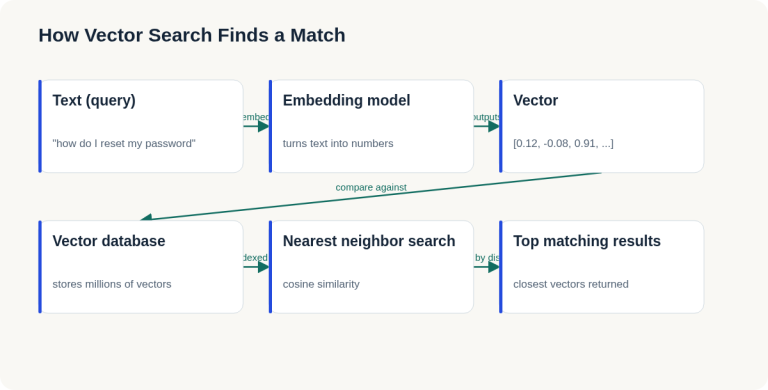
English Lesson — Tuesday Morning: Embeddings & Vector Search Vocabulary
Daily English practice for tech professionals: embed, vector database, and nearest neighbor search vocabulary with pronunciation and exercises.
Read more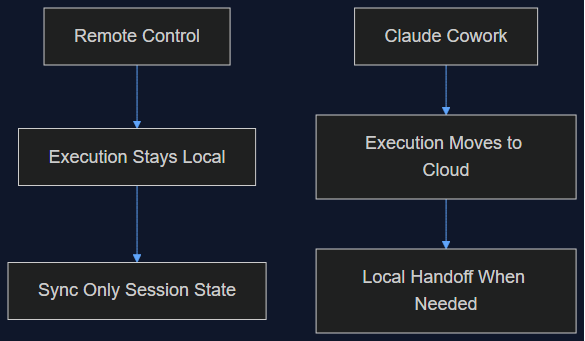
06 Oct 2026 · 5 min read
agentic coding
Claude Cowork Just Did the Thing I Said Remote Control Wasn't Doing
In August I wrote that Claude Code's Remote Control was a sync layer, not a cloud migration, and that keeping execution local was the point. This week Anthropic moved Cowork's execution to the cloud by default. Here's why both were the right call — for different products.
Read more
03 Oct 2026 · 4 min read
agents
950 Agents, 21 Hours, 210M Tokens: What Anthropic's CRISPR Search Actually Proves About Fan-Out
Anthropic's life-sciences lab ran 950 agents in parallel to surface a possible new CRISPR-like enzyme system. The funnel math is a genuinely useful fan-out pattern — but the scientist pushback is the part worth reading closely.
Read more
Discussion
Comments are reviewed before publication. Your email is kept private.