Thuan: My 1-on-1 with my manager is usually: “Everything okay?” “Yep.” “Okay, see you next week.” Fifteen seconds. I know I should get more value from it, but I don’t know what to ask — or how to ask it in English.
Alex: And your 1-on-1s with your reports?
Thuan: Even worse. I ask “How are you doing?” and they say “Fine.” Then we sit in awkward silence until one of us finds an excuse to end the meeting.
Alex: Both problems have the same root: no structure and no prepared questions. Let’s fix both.
Part A: 1-on-1 With Your Manager (Managing Up)
Alex: Your manager’s 1-on-1 is your chance to: get feedback, remove blockers, align on priorities, and advance your career. Don’t waste it.
Before the Meeting: Prepare 3 Things
| Prep Item | Example |
|---|---|
| One update — something they should know | ”We completed the migration ahead of schedule.” |
| One ask — something you need from them | ”I need your help unblocking [X] approval.” |
| One career topic — something about your growth | ”I’d like to discuss taking on more architecture work.” |
Opening the 1-on-1
| Goal | Phrase |
|---|---|
| Start with context | ”A few things I wanted to cover today: [X, Y, Z]. What’s on your list?” |
| Share good news | ”Quick win to share: we shipped [feature] ahead of schedule.” |
| Raise a concern | ”I want to flag something: [issue]. Here’s what I’m thinking for a solution.” |
Asking for Feedback
Most people wait for feedback. Great employees ask for it:
| Type | Phrase |
|---|---|
| General | ”How am I doing overall? Anything I should adjust?” |
| Specific | ”Regarding [project/meeting], was there anything I could have done better?” |
| Forward-looking | ”What’s one thing I should focus on to be more effective this quarter?” |
| Perception | ”How is the team perceived by other departments? Any feedback I should know about?” |
Raising Difficult Topics
| Topic | Phrase |
|---|---|
| Team burnout | ”The team is stretched. We’ve been above capacity for 3 sprints. I’m worried about burnout and quality. Can we discuss lightening the load?” |
| Resource needs | ”We need one more engineer to hit the Q3 deadline. Here’s my analysis: [data].” |
| Compensation | ”I’d like to revisit my compensation. I’ve prepared a summary of my contributions and market data.” |
| Role clarity | ”I’m unclear on where my responsibilities end and [role]‘s begin. Can we clarify?” |
| Disagreement with direction | ”I have some concerns about the current direction for [project]. Can I share my perspective?” |
When Your Manager Gives You Hard Feedback
| Reaction | Phrase |
|---|---|
| Listening | ”I appreciate the feedback. Can you give me a specific example so I can understand better?” |
| Accepting | ”That’s fair. I hadn’t thought of it that way. I’ll work on that.” |
| Partially disagreeing | ”I see your point on [X]. For [Y], here’s the context from my side: [explanation]. Can we discuss?” |
| Requesting support | ”I want to improve on this. What resources or support would you recommend?” |
Part B: 1-on-1 With Your Reports (Managing Down)
Alex: As a tech lead, your 1-on-1s with developers are your most important leadership tool. Here’s where you build trust, catch problems early, and develop your team.
The 1-on-1 Framework
| Section | Duration | Purpose |
|---|---|---|
| Check-in | 2 min | How are they doing? (Personal + professional) |
| Their agenda | 10 min | What do they want to discuss? |
| Your agenda | 5 min | Feedback, updates, questions |
| Growth | 5 min | Career development, learning |
| Action items | 3 min | What are we both doing before next 1-on-1? |
Key Rule: It’s their meeting, not yours.
Opening Questions (That Actually Get Real Answers)
| Instead of… | Ask… |
|---|---|
| ”How are you?” (answer: “Fine”) | “What’s the best thing that happened this week?" |
| "Any problems?” (answer: “No”) | “What’s been the most frustrating thing this sprint?" |
| "Are you okay?” (answer: “Yes”) | “How’s your energy level right now? 1-10?" |
| "Need anything?” (answer: “No”) | “If you could change one thing about how we work, what would it be?” |
Giving Feedback to Your Reports
Positive Feedback
| Situation | Phrase |
|---|---|
| Good work | ”I want to call out the work you did on [X]. The [specific quality] was excellent.” |
| Growth | ”I’ve noticed real improvement in your [skill]. The [example] was much better than [previous example].” |
| Impact | ”Your [contribution] directly helped us [business outcome]. The team benefits from that.” |
Tip: Be specific. “Good job” is nice. “Your migration script saved us 3 days and zero bugs — that’s exceptional engineering” is powerful.
Constructive Feedback
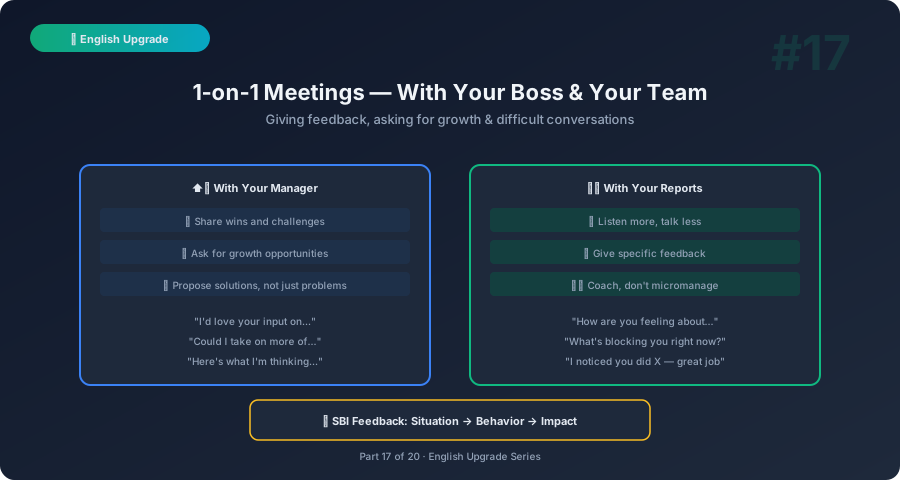
Use the SBI model: Situation → Behavior → Impact
Situation: “In yesterday’s code review…” Behavior: ”…I noticed the comments were quite brief — just ‘LGTM’ on a 500-line PR.” Impact: ”…I’m concerned the team might miss bugs, and it sets a norm that reviews aren’t important.” Request: “Could you spend a bit more time on reviews, especially for larger PRs?”
| Situation | Phrase |
|---|---|
| Missed deadline | ”The [task] was due Friday but delivered Tuesday. What happened? How can we prevent this?” |
| Quality issue | ”I noticed [specific issue] in the recent PR. I want to help — want to pair on this type of problem?” |
| Communication gap | ”I’ve heard from [team] that they felt out of the loop on [topic]. Can we discuss how to improve that?” |
| Not participating | ”I noticed you’ve been quiet in meetings. Your perspective is valuable — what would help you share more?” |
Career Development Conversations
| Question | Purpose |
|---|---|
| ”Where do you see yourself in a year?” | Understanding their ambition |
| ”What skills are you most interested in developing?” | Aligning growth with opportunity |
| ”Is there a project or area you’d love to work on?” | Finding motivation drivers |
| ”What’s one thing I can do to better support your growth?” | Improving your leadership |
| ”Do you feel challenged enough? Too much? Too little?” | Calibrating workload |
Handling Difficult 1-on-1 Moments
When Someone Wants to Quit
“I appreciate you telling me. Before you make a final decision, can you share what’s driving this? I want to understand if there’s anything we can address.”
When Someone Is Underperforming
“I want to have an honest conversation. Your performance on [project] hasn’t met expectations in these areas: [specifics]. I want to help you improve. Let’s create a plan together.”
When Two Team Members Are in Conflict
“I’ve noticed tension between you and [name]. I’d like to help resolve it. Can you tell me your perspective? I’ll talk to [name] separately, and then we’ll find a path forward together.”
When They’re Not Talking
“I notice our 1-on-1s tend to be short. I want to make sure this time is valuable for you. What format would work best? We could try walking meetings, async check-ins, or a different cadence.”
The 1-on-1 Document
Thuan: Should I take notes?
Alex: Yes. A shared document that both of you can add to:
# 1-on-1: Thuan ↔ [Name]

## [Date]
### Their Topics
- [Topic 1]
- [Topic 2]

### My Topics
- [Feedback / update]

### Action Items
- [ ] [Name]: [action] — by [date]
- [ ] Thuan: [action] — by [date]

### Career Notes
- Interested in [area]. Look for opportunities.
Thuan: This creates accountability — we both know what we committed to.
Alex: And over time, it becomes a record of growth, feedback, and decisions. Incredibly useful for promotion discussions.
10-Minute Self-Practice
Manager 1-on-1 Prep (5 min before each 1-on-1)
- Write: one update, one ask, one career topic
- Practice your opening: “Here’s what I’d like to cover today…”
- Prepare one question to ask for feedback
Report 1-on-1 Prep (5 min before each 1-on-1)
- Review last meeting’s action items
- Prepare one specific piece of feedback (positive or constructive)
- Write one open-ended question (not “How are you?”)
What’s Next
1-on-1s are no longer awkward silences. Next post: Cross-Cultural Communication — navigating the unwritten rules when working with international teams.
This is Part 17 of the English Upgrade series. Pairs with English Upgrade #15: Career English — 1-on-1s are where career conversations happen.
Related: English Upgrade #6: Retros — team feedback skills in a group setting.