
JOURNAL
English Upgrade #18: Cross-Cultural Communication
Working with international teams — understanding cultural communication styles, avoiding misunderstandings, and adapting your English for global collaboration.
On this page
Thuan: I work with developers in Vietnam, QA in India, a PM in Germany, and a client in the US. Every culture communicates differently. I keep misunderstanding people — and they keep misunderstanding me.
Alex: Cross-cultural communication is the boss-level English skill. It’s not just about the words — it’s about what people mean when they say (or don’t say) certain things. Let’s decode the most common cultural communication patterns in tech.
The Communication Spectrum
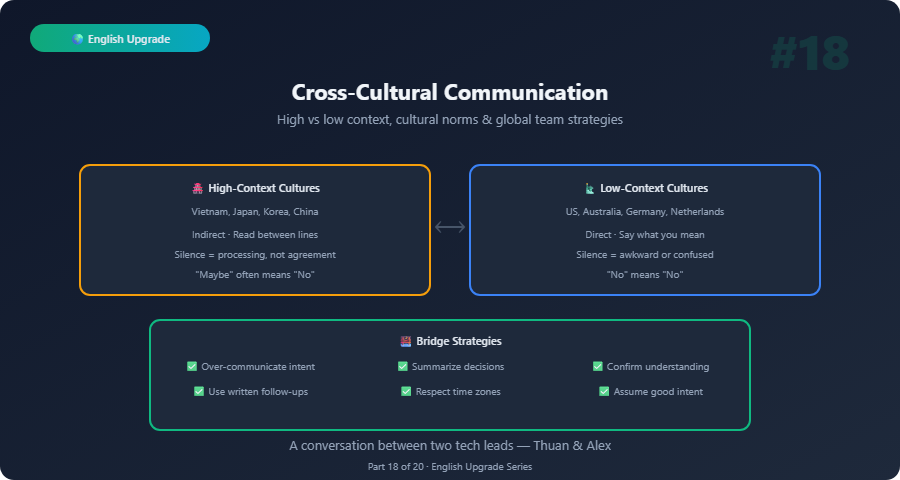
Alex: Cultures fall on a spectrum between high-context and low-context communication:
| High Context | Low Context |
|---|---|
| Meaning is implied, indirect | Meaning is explicit, direct |
| Relationships matter more than words | Words are taken at face value |
| “No” is avoided — softened with “maybe” or silence | “No” is said directly and isn’t rude |
| Vietnam, Japan, Korea, Thailand | US, Germany, Netherlands, Australia |
Thuan: So when my German PM says “This is not acceptable,” she’s just being direct — not angry?
Alex: Correct. And when you say “Maybe we can try” to your US client, they hear you’re not sure, while you mean I disagree but I’m being polite. That’s where misunderstandings happen.
Cultural Patterns in Tech Teams
Vietnamese / Asian Communication Challenges
| Pattern | What Happens | Fix |
|---|---|---|
| Avoiding “no” | Say “yes” when meaning “it’s difficult” | Practice: “That’s challenging. Here’s why: [reason].” |
| Indirect disagreement | Say nothing, then build differently | Practice: “I see it differently. Here’s my concern: [X].” |
| Hierarchy sensitivity | Won’t challenge senior people publicly | Practice: “I’d like to offer a different perspective.” |
| Saving face | Avoid admitting mistakes | Practice: “Good catch — I missed that. Fixing now.” |
| Over-apologizing | “Sorry” in every sentence | Reserve “sorry” for genuine mistakes. Use “thank you” instead. |
The “Yes” Problem
Thuan: This is my biggest issue. When my client asks “Can you deliver by Friday?” I say “Yes” because saying “No” feels rude. Then Friday comes and it’s not done.
Alex: This is a trust killer. Here’s the fix:
| Instead of “Yes” (when you mean no) | Say… |
|---|---|
| “Yes” | “We can commit to [partial scope] by Friday. The full scope would be ready by [date].” |
| “Yes, we’ll try” | “There’s a risk. Here’s our plan and the contingency if we fall behind.” |
| “Maybe” (meaning no) | “I need to check with the team before committing. Let me confirm by EOD.” |
Cultural Differences by Country
| Working with… | What to Know | How to Adapt |
|---|---|---|
| Americans | Value directness, efficiency, enthusiasm. “Awesome!” doesn’t always mean they’re amazed. | Be direct. Get to the point. Match their energy. |
| Germans | Very direct. Structured. Value precision. Silence after a question means they’re thinking. | Don’t take directness personally. Be specific with numbers and dates. |
| Japanese | High context. “It’s difficult” = “no.” Consensus-driven decisions. | Listen for what’s not said. Don’t push for immediate decisions. |
| Indians | Relationship-focused. “Yes, sir” may mean “I heard you,” not “I agree.” | Build rapport first. Ask follow-up questions: “Can you walk me through your plan?” |
| Australians | Informal, direct, use humor. “No worries” doesn’t mean they’ll fix it. | Match informality. Don’t over-formalize. |
| Brits | Indirect. “Quite good” = “mediocre.” “With the greatest respect” = “I disagree completely.” | Read between the lines. If they say “interesting,” they might mean “wrong.” |
British English Decoder Ring
Alex: British English deserves its own section because it’s the most indirect form of English:
| What They Say | What They Mean | What Non-Native Speakers Hear |
|---|---|---|
| “That’s quite good” | “It’s average” | “It’s excellent” |
| “I hear what you say” | “I disagree” | “They agree with me” |
| “With due respect” | “You’re wrong” | “They respect my opinion” |
| “That’s an interesting idea” | “That’s a bad idea” | “They like my idea” |
| “I’ll bear it in mind” | “I’ve already forgotten” | “They’ll act on it” |
| “Perhaps you should consider…” | “You need to change this” | “Optional suggestion” |
Thuan: This is terrifying. I’ve been misreading British feedback for years.
Alex: Most non-native speakers do. The trick: if a British person qualifies something (“quite,” “perhaps,” “rather”), they’re usually softening a negative.
Practical Cross-Cultural Phrases
Clarifying Without Offending
| Situation | Phrase |
|---|---|
| Not sure you understood | “Let me confirm my understanding: you’re saying [X]. Is that right?” |
| Not sure they understood you | “Just to make sure we’re aligned: the plan is [X]. Does that match your understanding?” |
| Cultural misunderstanding | “I think we might be interpreting this differently. Let me rephrase: [clarification].” |
| Asking for directness | “I want to make sure I get your honest feedback. Please be direct — I can handle it.” |
| Encouraging participation | “[Name], I’d love to hear your perspective on this.” |
Adapting Your Communication
| Goal | Technique |
|---|---|
| Be clearer with direct cultures | State conclusions first, then explain. “No” is professional, not rude. |
| Be warmer with relationship cultures | Start with small talk. Ask about their weekend. Show genuine interest. |
| Be more structured with detail cultures | Write agendas. Provide data. Follow up in writing. |
| Be more patient with consensus cultures | Don’t push for instant decisions. “Let us discuss internally” is a reasonable response. |
Time Zone Communication
Thuan: Working across time zones is another challenge. I get messages at midnight, and people expect replies before I wake up.
Alex: Here are the phrases and practices:
Setting Expectations
- “I’m in UTC+7. My working hours are 8 AM – 6 PM (your 1 AM – 11 AM, EST). I’ll respond to messages when I’m online.”
- “For urgent issues, ping me on [channel] — I have notifications on for that.”
- “Let’s find a meeting time that works for both zones. I can do mornings your time.”
Async-First Messages
When you know someone won’t read your message for 8 hours:
- “No rush on this — whenever you’re online.”
- “FYI (non-urgent): [update]. We’re proceeding with [plan]. Let me know if you have concerns.”
- “Leaving this for when you’re back: [question]. We’ll continue with [assumption] unless you flag something.”
10-Minute Self-Practice
The Cultural Decoder (5 min)
- Think of a recent misunderstanding with an international colleague
- Identify: was it a high-context vs. low-context gap?
- Rewrite what you said using the phrases from this post
- How would the conversation have gone differently?
The “No” Practice (5 min)
- Think of a recent time you said “yes” when you meant “maybe” or “no”
- Rewrite your response: be honest but professional
- Practice saying it aloud: “We can commit to [X] by [date]. For the full scope, we’d need until [later date].”
What’s Next
Cross-cultural skills unlocked. Next post: Hiring and Interviewing Candidates — the English you need to evaluate candidates, run panel interviews, and give hiring feedback.
This is Part 18 of the English Upgrade series. Pairs with English Upgrade #20: Remote/Async — remote work amplifies cross-cultural challenges.
Related: English Upgrade #12: Client Meetings — client meetings are often cross-cultural meetings.
Discussion
Comments are reviewed before publication. Your email is kept private.