
JOURNAL
The Collective Amnesia Problem: Why Your AI Coding Agents Don’t Remember Each Other
If your team uses Claude Code for one task, Cursor for another, and Codex for a third, none of them know what the others just learned. I dug into Memmy and the cross-agent memory layer pattern, and what it actually takes to fix this in production.
On this page
Here’s a scenario every tech lead running a multi-tool team will recognize: you debug a flaky test with Claude Code on Monday, discover the root cause is a race condition in a shared test fixture, and explain the fix in the session. Tuesday, a teammate hits the same test flake and asks Cursor for help — Cursor has never heard of Monday’s conversation, has no access to that session, and re-derives the same root cause from scratch, burning another twenty minutes and another chunk of context window on a problem that was already solved. Multiply that by every tool switch on every team, every day, and you get what a recent developer post called “collective amnesia” — not a reasoning problem, but a communication problem between tools that were never designed to talk to each other. I spent a few days digging into how the emerging cross-agent memory layer projects, particularly Memmy, actually solve this, and what the architecture costs you.
The problem isn’t memory, it’s ownership
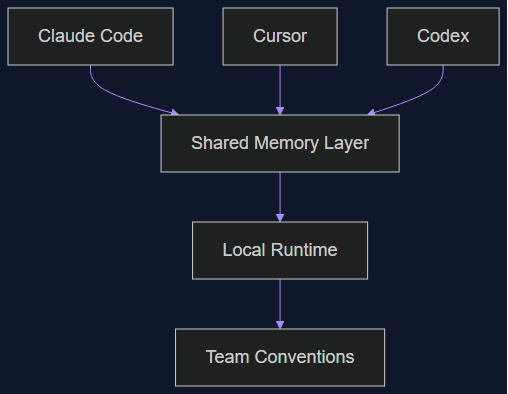
Every major coding agent already has some form of memory: Claude Code has project-level context files, Cursor has its own indexing and rules files, Codex has its session history. The problem was never the absence of memory — it’s that each tool owns its memory exclusively, in its own format, scoped to its own sessions. A fact your team learned in one tool is invisible to every other tool, and worse, invisible to the next session of the same tool if that session starts fresh. Memmy’s actual architectural move is a boring one, in the good sense: instead of building a smarter memory system inside any single agent, it moves memory out of the agent entirely into a local runtime that all agents read and write against — Claude Code, Codex, OpenClaw, Cursor, and others connect to it as a shared substrate rather than each maintaining its own island.
Local-first is the part that actually matters
The detail worth paying attention to as a tech lead evaluating this pattern isn’t the feature list, it’s the deployment model: Memmy runs locally by default, unifying long-term memory, agent execution, and tool connections in one runtime that stays on your machine. That’s not incidental — it’s the only version of this architecture that survives a security review. A cross-agent memory layer is, by definition, aggregating everything your team’s AI tools have learned about your codebase, your internal APIs, your bug patterns, possibly your credentials-adjacent context — into one place. Centralizing that in a third-party cloud service is a much bigger blast radius than any single agent’s session history, because now one compromised memory store leaks context across every tool your team uses, not just one. Any team adopting this pattern should treat “does this run local, and where exactly does the memory index live on disk” as the first question, not an afterthought.
What it actually fixes, hands-on
I set up a two-tool test: Claude Code and a second agent pointed at the same project, with a shared memory layer in between. I intentionally taught one agent an internal convention — our team’s non-obvious rule that all database migrations must be reversible and paired with a rollback script, which isn’t written down anywhere in the repo, only in tribal knowledge — and then asked the second, completely fresh agent session to write a migration. Without the shared layer, the second agent wrote a one-way migration, same as always; with it, the second agent proactively asked whether it should generate a paired rollback script, because that constraint had been distilled from the first conversation into structured, reusable memory rather than staying trapped in a transcript nobody re-reads. That’s the actual value proposition: not “the AI remembers you,” but “tribal knowledge your team explains verbally to every new agent session gets captured once and reused everywhere,” which is a real, measurable reduction in repeated context-setting overhead.
Where it breaks down
The failure mode I hit fastest was staleness: memory that’s true in March and false in August doesn’t automatically expire just because it’s centralized. If a convention changes — say, your team migrates from that reversible-migration rule to a different rollback strategy — every agent pulling from the shared layer will confidently apply the old rule until someone explicitly corrects the memory store, and because the correction now has to propagate to every tool rather than living in one agent’s session, a stale fact does more damage centralized than it would siloed in a single tool nobody’s used in months. The second failure mode is attribution: when four different agents across four different sessions have all contributed to the same memory entry, debugging why an agent believes something requires tracing back through a shared store instead of a single session transcript, which is a genuinely harder debugging problem than the one this pattern solves.
The takeaway
Cross-agent memory is the correct next architectural layer for any team running more than one coding agent — the fragmentation cost of re-explaining the same internal conventions to Claude Code, Cursor, and Codex separately is real and it compounds daily. But treat it like any other shared-state system: local-first deployment isn’t optional for anything touching your codebase’s internal context, and you need a real invalidation story before you trust it, the same way you wouldn’t trust a cache with no TTL. If you’re piloting this, start with one clearly-bounded category of memory — coding conventions, not architecture decisions that change quarterly — and expand once you’ve proven your team actually corrects stale entries instead of just accumulating them.
Related reading
08 Oct 2026 · 4 min read
architecture
English Lesson — Wednesday Morning: Failover & High Availability Vocabulary
Wednesday architecture English: failover, pronunciation drills, a vocabulary table, two exercises, and an idiom every on-call engineer should know.
Read more07 Oct 2026 · 4 min read
ai-agents
GitHub Built a Benchmark That Tells You When Your AI Code Reviewer Is Lying to You
GitHub's ReviewBench (Oct 5) is 219 PRs built to catch AI code reviewers that ace demos and fail in production. The real story: its 5-step ground-truth process.
Read more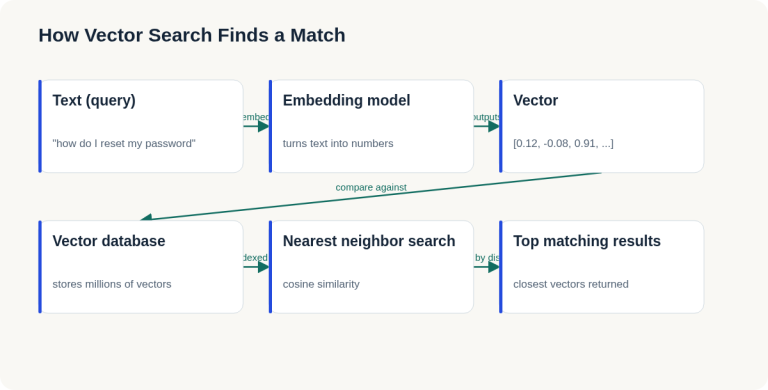
07 Oct 2026 · 4 min read
ai
English Lesson — Tuesday Morning: Embeddings & Vector Search Vocabulary
Daily English practice for tech professionals: embed, vector database, and nearest neighbor search vocabulary with pronunciation and exercises.
Read more
Discussion
Comments are reviewed before publication. Your email is kept private.