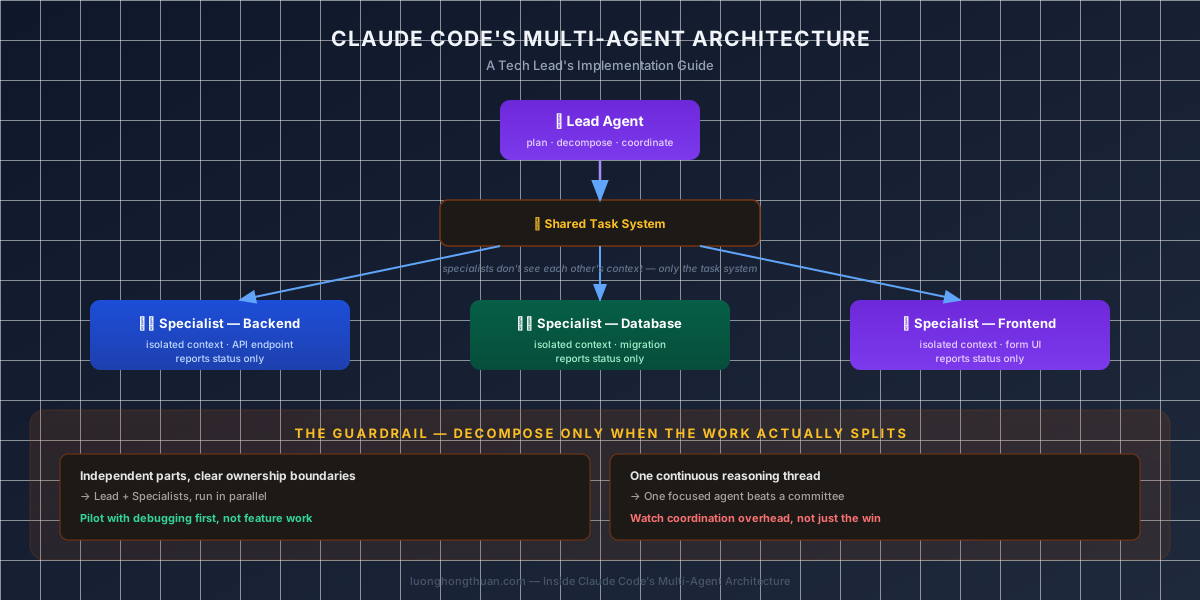
Every team that’s put a coding agent on a real feature has hit the same wall: the agent does great work for the first twenty minutes, then starts forgetting what it decided ten minutes ago, re-reading files it already read, and quietly overwriting a fix it made earlier in the session. That’s not a model-quality problem — it’s an architecture problem. A single agent working a multi-part task accumulates context until the context itself becomes the bottleneck: too much to reason over, too much irrelevant noise crowding out what actually matters right now.
Claude Code’s answer, described well in a recent piece by Devika Nekkalapu, is to stop treating this as one long-running agent and start treating it as a small team: a Lead Agent that owns the plan, a set of Specialist Agents that each own one narrow piece of execution, a Shared Task System that tracks who’s doing what, and Context Isolation that keeps each specialist’s window clean. It’s a deliberate mirror of how engineering teams already work, and that’s exactly why it’s worth a tech lead’s attention — the failure modes it fixes are the same ones you already manage in humans.
The Four Components
Lead Agent. Holds the overall goal, breaks it into discrete units of work, and decides which specialist handles each unit. It doesn’t do the implementation work itself — its job is decomposition and coordination, the same job a tech lead does when scoping a sprint.
Specialist Agents. Each one is spun up for a bounded piece of work — “implement the API endpoint,” “write the migration,” “wire up the frontend form” — with only the context it needs for that piece. It doesn’t inherit the Lead Agent’s entire history, and it doesn’t see what the other specialists are doing in real time.
Shared Task System. The coordination layer. Specialists report status and results back through it rather than through a shared, ever-growing conversation transcript. It’s the structured equivalent of a ticket board: state lives in the system, not in anyone’s head.
Context Isolation. The part that actually solves the original problem. Because each specialist’s context window only contains what’s relevant to its own task, none of them drown in the accumulated noise of everything that happened before. The Lead Agent stays lean too, because it’s tracking task state and results, not full implementation detail.
Where This Actually Pays Off
The piece gives two examples worth sitting with, because they map cleanly onto real team situations:
Parallel feature implementation. A feature that touches backend, database, and frontend gets split into three specialist tracks that run concurrently instead of sequentially — the way you’d actually staff it if you had three engineers instead of one. The Lead Agent doesn’t need to hold backend implementation detail in its head to coordinate the database and frontend pieces; it just needs to know what each track produced and whether it’s done.
Parallel debugging. Instead of one agent testing hypotheses one at a time down a single reasoning chain, multiple specialists investigate different hypotheses simultaneously — is it a race condition, a stale cache, a bad migration — and report back. This is exactly how a good incident response works: you don’t assign one person to check every theory serially, you split the theories across people and reconvene.
The underlying lesson isn’t “more agents is better.” It’s that reliability comes from several smaller, well-scoped reasoning loops coordinated by a clear owner, not from one enormous loop trying to hold everything at once. That’s a familiar principle — it’s why you don’t want one person owning an entire cross-cutting feature alone either.
Implementation Guide: Applying This at Work and Solo
This is where the architecture stops being interesting trivia and starts being something you can actually roll out. Two tracks: your team’s engineering workflows, and your own individual work.
At the company
- Audit where your current agent setups hit the context wall. Look at your team’s Claude Code / Copilot / Cursor sessions on anything that took more than a handful of turns. If you see the agent re-reading files, contradicting an earlier decision, or losing track of what’s already done — that’s the single-agent context-overload symptom, and it’s your signal to decompose.
- Decompose by ownership boundary, not by file type. The natural specialist split mirrors your team’s existing ownership lines: backend/API, data layer, frontend, infra/CI. If your team already has these boundaries for human work, they’re the right boundaries for agent work too — don’t invent a new decomposition scheme from scratch.
- Write the task contract before you parallelize. A Shared Task System only works if each specialist’s unit of work has a clear input, a clear output, and a clear “done” definition — the same discipline as writing a good ticket. If you can’t write that contract in two sentences, the task isn’t ready to be split off to a specialist yet.
- Start with debugging, not feature work, for your first pilot. Parallel-hypothesis debugging is lower-risk than parallel-feature implementation — the specialists don’t need to integrate their outputs into a single working system, they just need to report findings. It’s the easiest way to prove the pattern to a skeptical team before you trust it with something that ships.
- Keep a human as the Lead Agent’s Lead Agent, at least initially. Someone still needs to review the plan the Lead Agent produced before specialists start executing — the same review you’d want before three engineers start working three tracks in parallel. Don’t skip the plan review just because it’s an agent doing the planning.
- Watch the coordination overhead, not just the parallelism win. Splitting a task into specialists costs something — integration, context handoff, the Lead Agent’s own reasoning about how to divide the work. For a task simple enough to finish in one focused pass, a single agent is still faster. Reserve the multi-agent pattern for work that’s genuinely multi-part.
For your own projects
- Use the pattern for anything that spans layers you personally context-switch between. If you’re building a side project alone and find yourself losing track of decisions when you swap between backend and frontend work in one long session, that’s the same context-overload symptom at individual scale — split the work into scoped specialist sessions the same way you’d split it for a team.
- Treat your task list as the Shared Task System. Whatever you use — a markdown file, a lightweight tracker — the discipline is the same: state lives outside any single agent session, so you can pick a thread back up without re-deriving where you left off.
- Resist running everything as one mega-session out of convenience. It’s tempting to keep one long chat going because switching feels like overhead. But the context-overload failure mode shows up for solo work exactly the way it shows up on a team — the fix is the same discipline, just applied to a team of one.
The Guardrail
The risk with any multi-agent pattern is over-applying it — spinning up specialists for work that was never complex enough to need decomposition, and eating the coordination cost for nothing. Use the same test you’d use for a human team: if the work genuinely has independent, parallelizable parts with clear ownership boundaries, decompose it. If it’s one continuous thread of reasoning that doesn’t split cleanly, one focused agent — or one focused engineer — beats a committee.
This week: pick one recurring task where your current agent setup has hit the context wall, decompose it along your team’s real ownership boundaries, and run it as Lead + Specialists once. You’ll know within a single run whether the coordination overhead was worth it.
Source: Inside Claude Code’s Multi-Agent Architecture by Devika Nekkalapu.