Quality Assurance in the AI era is not about replacing testers with scripts. It is about using AI to dramatically expand the test surface — covering more scenarios, finding more edge cases, and running tests faster — while human QA engineers focus on the judgment calls that automation cannot make: is this product safe and good enough to release to real users?
This post covers how the QA/QC role transforms, the new AI-augmented testing pyramid, and the quality gates that enforce standards without slowing delivery.
The Testing Problem AI Solves
Traditional QA has a fundamental resource constraint: the team can only write and maintain as many tests as they have time for. This leads to:
- Happy-path bias: Tests cover the expected flow; edge cases get deferred
- Coverage decay: New features get tested; old tests rot and diverge from reality
- Regression debt: Each sprint adds features, and regression testing grows linearly with scope
- Manual testing bottleneck: UAT cycles are expensive and slow
AI attacks all four problems simultaneously.
The AI-Augmented Testing Pyramid
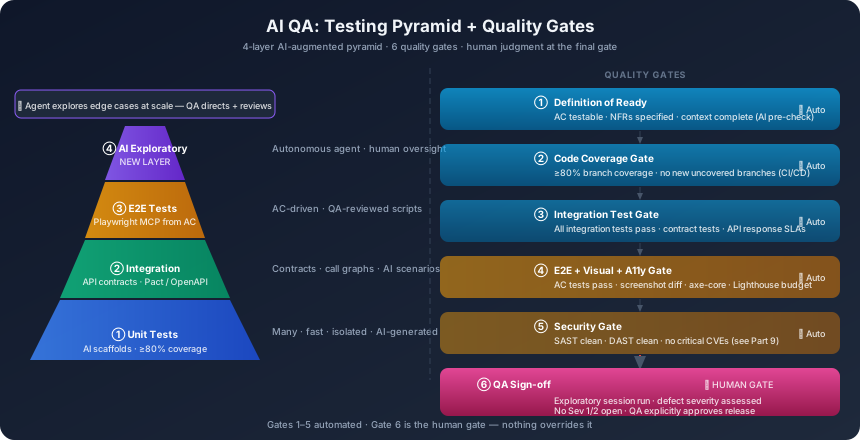
The classic “testing pyramid” (many unit tests, fewer integration tests, fewer E2E tests) gains a new top layer in AI-augmented teams: AI exploratory testing.
Layer 1: Unit Tests (AI-generated scaffolding)
- Developers use AI to generate unit test scaffolding (see Part 6)
- QA reviews unit test coverage reports and flags gaps
- AI generates missing test cases from the codebase and acceptance criteria
- Target: ≥80% branch coverage on all business logic
Layer 2: Integration Tests (AI-assisted contract validation)
- AI generates integration test scenarios from OpenAPI specs and event contracts
- AI identifies untested integration paths by analysing the call graph
- Contract testing (Pact) validation is AI-checked weekly
Prompt example:
Given this OpenAPI spec:
[paste spec]

Generate integration test scenarios covering:
1. All endpoint happy paths
2. Invalid input variations (type mismatches, boundary values, nulls)
3. Sequence-dependent scenarios (e.g. create before update)
4. Authentication and authorisation edge cases
5. Rate limit and timeout handling

Format: Playwright/REST Assured test scaffold
Layer 3: End-to-End Tests (AI Playwright generation)
- Acceptance criteria from user stories are fed directly to Playwright MCP
- AI generates E2E test scripts from the acceptance criteria
- QA reviews generated scripts for completeness and test isolation quality
- Critical rule: QA must understand every E2E test they own. AI-generated tests that QA cannot explain are not production-ready.
Playwright MCP pattern:
Story: [paste story]
Acceptance criteria: [paste Given/When/Then]

Generate a Playwright test that:
- Starts from an unauthenticated state
- Follows the user journey described
- Asserts each acceptance criterion explicitly
- Includes appropriate waiting strategies (no arbitrary sleeps)
- Is isolated (no shared state with other tests)
Layer 4: AI Exploratory Testing
This is the new layer that AI unlocks. AI agents (Playwright MCP + Claude) autonomously:
- Navigate the application looking for unhandled states and errors
- Try unexpected input combinations that humans wouldn’t think to test
- Explore boundary conditions at scale (thousands of permutations in minutes)
- Report findings as structured defect reports with reproduction steps
The QA Engineer directs the agent, reviews findings, and determines severity. This is not fully autonomous — it is a force multiplier.
Quality Gates: Automating the “Ship It” Decision
Quality gates prevent poor-quality code from reaching production. In an AI-augmented team, these are codified and automated:
Gate 1: Definition of Ready (pre-sprint)
AI checks every story before it enters a sprint:
- Acceptance criteria are testable (not “the page should be fast”)
- Edge cases are documented
- Non-functional requirements specified (performance SLA, accessibility level)
- Story has enough context to generate test cases from
Gate 2: Code Coverage Gate (CI/CD)
- Unit test coverage ≥ threshold (usually 80%)
- No new uncovered branches in changed code
- Gate runs automatically on every PR
Gate 3: Integration Test Gate (CI/CD)
- All integration tests pass
- No new failing contract tests
- API response times within SLA thresholds
Gate 4: E2E Gate (before deployment)
- All acceptance criteria E2E tests pass
- Visual regression baseline matches (screenshot diff)
- Accessibility audit passes (axe-core automated check)
- Performance budget met (Lighthouse score)
Gate 5: Security Gate (before release — see Part 9)
- SAST scan clean
- DAST scan clean
- No known high/critical CVEs in dependencies
Gate 6: QA Sign-off (before production)
- QA engineer explicitly signs off the build
- Exploratory session run (AI-directed, QA-reviewed)
- Defect severity assessment: no Severity 1/2 open
Gate 6 is the human gate. Gates 1–5 are automated. Nothing overrides Gate 6.
Defect Prediction and Prevention
AI monitors code changes and flags high-risk areas for targeted testing:
- Files with recent churn + low test coverage = high defect risk → inform QA focus areas
- New dependencies added → run expanded security and compatibility checks
- Functions with high cyclomatic complexity → flag for additional unit test generation
- Areas that have produced defects historically → always include in regression scope
This shifts QA from reactive (testing what was changed) to predictive (testing what is likely to break).
The Human-Irreplaceable QA Work
Release judgment: The final call on whether a product is good enough to ship is irreducibly human. AI can surface every known defect; humans must weigh severity, business impact, and acceptable risk.
Exploratory testing strategy: AI can execute exploratory sessions, but the QA engineer must define the strategy — which areas are highest risk, which user journeys are most business-critical, which edge cases represent real user behaviour.
Defect advocacy: When a defect is discovered close to release, a human QA engineer must judge whether it warrants blocking the release, communicate the risk clearly to stakeholders, and sometimes advocate forcefully for not shipping. AI cannot own this conversation.
User empathy: The most valuable QA skill is the ability to think like a real user — including a confused, rushed, or anxious user who doesn’t read instructions. AI can test edge cases; it cannot replicate genuine user confusion.
The AI QA’s Daily Workflow
| Time | Activity |
|---|---|
| 08:45 | Review overnight AI exploratory test results |
| 09:00 | Standup — report defect status |
| 09:20 | Review new stories for testability (AI pre-check run overnight) |
| 10:00 | Review AI-generated E2E tests for latest sprint |
| 11:00 | Triage and prioritise defect queue |
| 14:00 | Directed exploratory session for high-risk area |
| 15:00 | Update QA sign-off status; communicate to PM |
| 15:30 | Review coverage reports; commission AI test generation for gaps |
Tools for the AI QA Engineer
| Tool | Purpose |
|---|---|
| Playwright MCP | AI-directed E2E test generation and execution |
| Claude | Test case generation from AC, defect analysis, exploratory direction |
| Codecov / Istanbul | Coverage reporting and gap identification |
| axe-core | Automated accessibility testing |
| Lighthouse CI | Performance budget enforcement |
| Percy / Chromatic | Visual regression testing |
| Pact | Contract testing between services |
| k6 / Gatling | AI-generated load test scenarios |
Previous: Part 6 — The AI Developer ←
Next: Part 8 — The AI Technical Architect →
This is Part 7 of the AI-Powered Software Teams series.