
JOURNAL
OpenAI Is Letting Outsiders Inside Its Training Pipeline. Just Not as Far as It Promised.
OpenAI signed Apollo Research, METR, Transluce, and Goodfire for its first phase of embedded safety assessments, giving them scoped access to training data and model checkpoints. A Redwood researcher says it falls short of the employee-like access OpenAI originally promised.

On this page
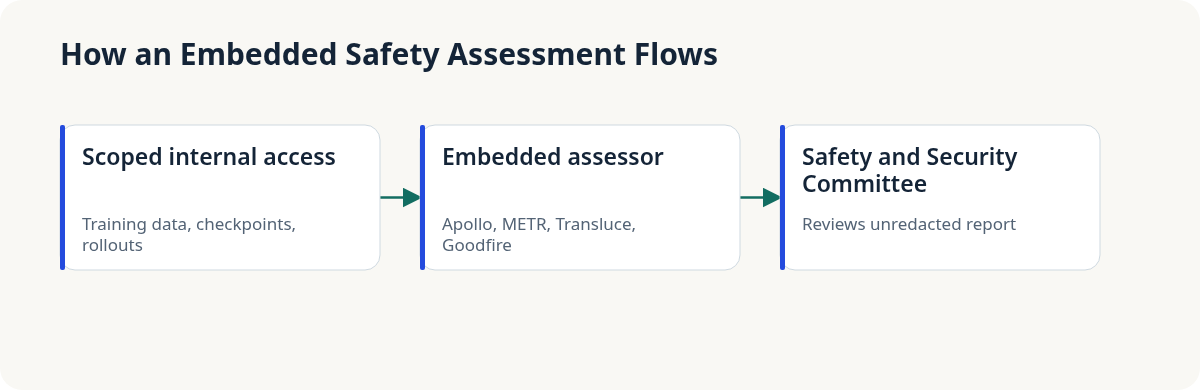
On November 16, 2026, OpenAI announced it had signed agreements with four outside organizations — Apollo Research, METR, Transluce, and Goodfire — to embed inside its safety work rather than evaluate it from a distance. The distinction matters. Most AI safety research happens after a model ships, probing a finished product through its API like everyone else. Embedded assessment means these four groups get scoped access to things that normally never leave OpenAI’s building: training code, datasets, reinforcement-learning rollouts with reasoning traces and rewards attached, and the ability to query intermediate model checkpoints mid-training, not just the final release.
Who’s doing what
Each of the four has a distinct, narrow mandate rather than a general audit license. Apollo Research is examining whether training incentives push models toward subverting alignment or control mechanisms, including whether a model can detect it’s being evaluated and behave differently as a result. METR is running two separate evaluations: hunting for unintended dangerous behavior the model itself might exhibit, and separately testing whether OpenAI’s own internal systems would even catch that behavior if it showed up. Transluce is assessing whether OpenAI’s post-training safety evaluations are rigorous enough, and says it plans to test how those safety results actually inform release decisions going into 2027 — a check on whether the evaluation data changes anything or just gets filed. Goodfire is using interpretability tooling to look inside the model during training itself, watching for undesired behavior by examining internals rather than just outputs.
The access is real, but it’s bounded on purpose
OpenAI’s own description of the access terms is specific about what it is not: assessors see data “tailored to their specific assessment scope,” restricted to “only the agreed claims and only for the specific models and time periods agreed.” Apollo, for instance, gets relevant training code and rollout data for the models and windows it’s actually assessing, not a standing key to everything. That’s a reasonable security posture for a company protecting model weights and training infrastructure, and it’s also the exact feature that limits how independent this independence actually is — OpenAI decides the scope before the assessor ever looks at anything, which means OpenAI is implicitly deciding in advance what questions are askable.
The oversight structure routes around that concern only partway. OpenAI’s Safety and Security Committee, an independent committee of the OpenAI Foundation’s board, reviews each assessor’s full unredacted report and can talk to the assessors directly, privately. The public only sees a redacted version. Assessors are allowed to publish their own independent conclusions, but OpenAI retains the ability to black out supporting evidence and can request delays for what it calls responsible disclosure. Apollo pushed, during negotiation, for the right to share findings with “an appropriate outside audience even if the developer was trying to prevent the disclosure of unfavorable findings” — language that only makes sense if that scenario was a live possibility being negotiated over, not a hypothetical.
Why an outside researcher called this short of the promise
Buck Shlegeris of Redwood Research put the gap plainly: “OpenAI said that they’d have embedded evaluations with employee-like access; the agreements announced today obviously don’t meet that bar.” That’s a useful sentence because it names the specific thing that changed between promise and delivery — not whether outside assessment exists at all, but how much it resembles actually working inside the company versus being handed a curated subset of what an employee could see. An OpenAI employee with model access doesn’t need anyone’s permission to decide which training run looks suspicious and go look. These assessors operate inside a scope that OpenAI set, reviewed by a board OpenAI’s own foundation appoints, with publication subject to OpenAI’s redaction authority. Every one of those checkpoints is a point where the company being assessed still holds a hand on the process.
None of that makes this phase worthless. Scoped access to rollouts, reasoning traces, and mid-training checkpoints is categorically more than any external researcher has had before, and OpenAI explicitly frames this as a first phase it expects to grow into “lasting, regular embedded arrangements.” If that expansion happens and the scope widens over successive rounds, the gap between this and employee-like access could close. If it doesn’t widen, the current arrangement is still worth something — a paper trail where an independent board has seen the unredacted version of whatever these four groups find, even when the public only gets the edited one. For anyone building on top of OpenAI’s models and making security or deployment decisions based on claimed safety properties, the practical takeaway is narrower than the headline: treat today’s announcement as evidence that external scrutiny of training-time behavior is now structurally possible, not as evidence that it has already happened to the depth OpenAI itself originally described.
Sources: CNBC, “OpenAI inks agreements with four independent evaluators to boost company’s safety work” and TechCrunch, “OpenAI will embed Apollo researchers to investigate AI subversion”, November 16, 2026.
Related reading

· 4 min read
AI models
GPT-6.2 Astra and Sol: A Cheaper Model Family, With One Catch
OpenAI's GPT-6.2 release cuts prices and nudges intelligence scores up, but the coding benchmarks tell a messier story than the headline numbers suggest.
Read more
· 5 min read
ai-agents
Inside OpenAI's Performance Factory: Codex Hunting Its Own Regressions
OpenAI built a Codex-powered pipeline that investigates ChatGPT performance regressions, argues with itself, and ships fixes with a human still holding the merge button.
Read more
· 8 min read
agentic-ai
I Went Looking for One Cross-Model AI Safety Scorecard. I Found Four Benchmarks That Don't Talk to Each Other
Four public AI safety benchmarks measure four different things, and the closest one to "official" leaves out Claude, GPT, and Gemini.
Read more
Discussion
Comments are reviewed before publication. Your email is kept private.