
JOURNAL
Read YouTube analytics and design experiments without misleading conclusions
Use source-aware comparisons, metric definitions and decision logs to learn from small channels without claiming unsupported causality.
On this page
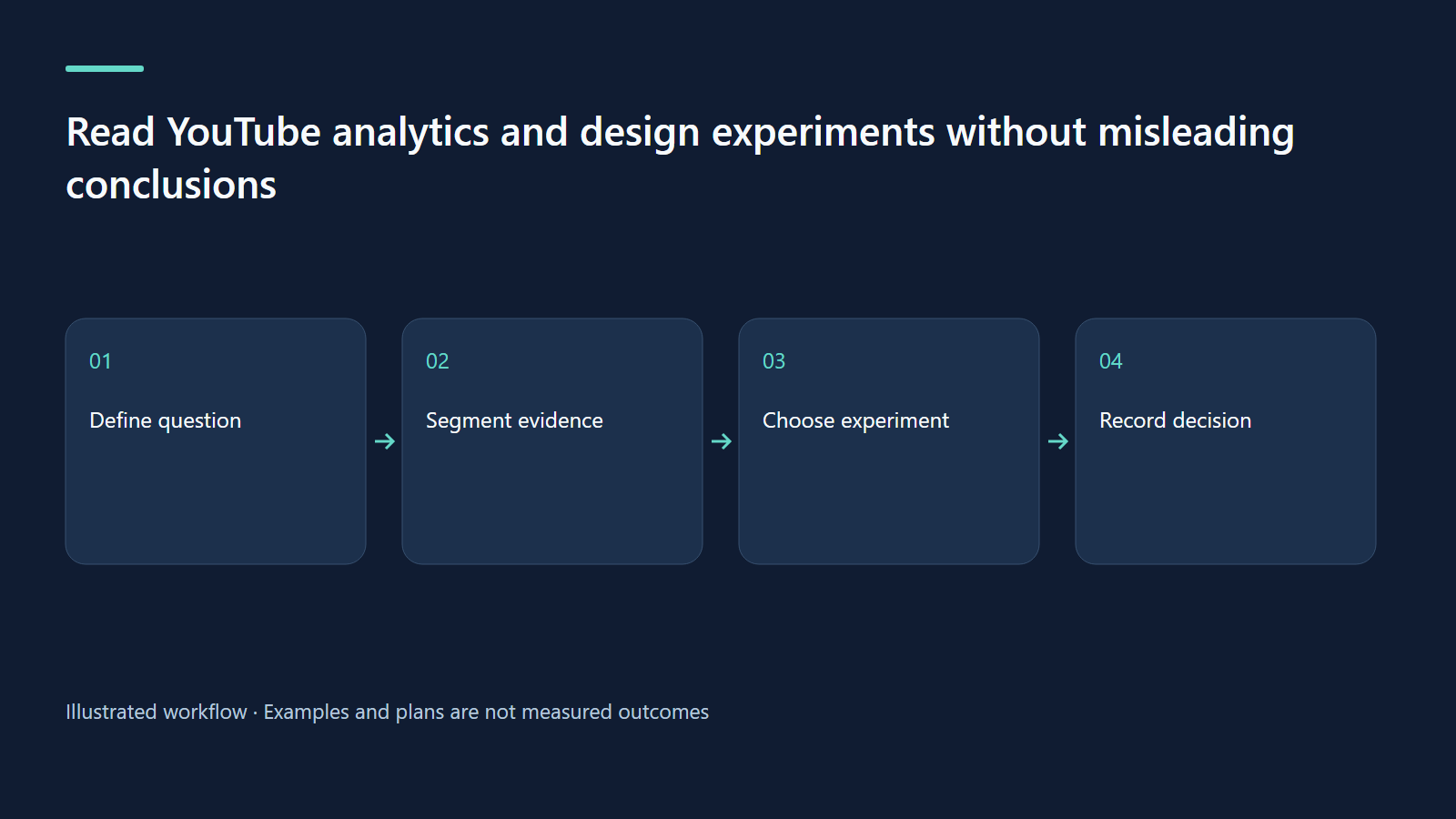
Analytics should help a creator decide what to do next. It becomes less useful when every chart is treated as a verdict on talent or every change is announced as an algorithm breakthrough. A practical review begins with a question that can be answered from available evidence. “Are viewers leaving before the promised demonstration?” is more actionable than “Why does YouTube dislike my channel?” This article builds a review routine for adult creator tutorials and keeps observations separate from causal conclusions.
Write the decision before opening the dashboard
Choose one upload and one decision. You may be deciding whether to shorten an introduction, clarify a title or make a follow-up lesson. Write the video’s promise, format and publication date. Then choose a review window and record why it is suitable. A newly published lesson and a two-year-old evergreen tutorial have different exposure histories; comparing their lifetime totals alone usually obscures the question you are trying to answer.
Preserve the context of the export: date range, source filters, device filters if used and the metric labels shown in Studio. Metric definitions and availability can change, so a saved number without its meaning is fragile. Do not assume all public views have identical relationships to engagement measures. The goal is not to create a huge report but to make the eventual decision traceable to a specific set of observations.
Read sources before aggregate ratios
YouTube’s Reach documentation identifies search terms, suggesting videos and traffic sources, alongside impression and viewing measures. Use those reports to distinguish how people encountered the lesson. Search can support a task-focused query review. Browse involves a broader discovery context. Suggested asks whether the video fits a sensible next viewing step. Shorts needs an opening and engaged-viewing review rather than simply borrowing a long-form thumbnail diagnosis.
| Question | Relevant observation | Possible action | Limit |
|---|---|---|---|
| Does Search match the lesson? | Available query wording | Clarify scope and description | Not every query is available |
| Does the opening deliver? | Retention around the first example | Move evidence earlier next time | Curve does not reveal private motives |
| Does the package communicate? | Eligible concurrent package test | Select a supported variant | Applies to tested audience and period |
| Does a Short retain interest? | Stayed-to-watch and engagement | Clarify the first visual action | Different format and exposure |
Work through an illustrative comparison
Suppose a fictional tutorial has 1,000 registered impressions and 70 views resulting from those registered impressions in one window, then 4,000 impressions and 200 views resulting from those impressions in another. The arithmetic produces 7% and 5% respectively. These are illustrative numbers, not a channel result. The lower ratio coexists with more views from impressions. Before concluding that a package deteriorated, check whether the exposure moved from familiar viewers to a broader audience and whether the source mix changed.
Now suppose the second period includes a newsletter link. Some viewing may come from that external route, while the thumbnail impression ratio describes its own registered population. Dividing all views by the thumbnail impressions would mix incompatible quantities. Keep denominators attached to their definitions. Also read watch behavior: more starts are not automatically better learning if the promised answer appears too late or the people attracted are looking for something else.
Choose an experiment that fits the question
For an eligible adult long-form tutorial, the native title and thumbnail testing tool offers concurrent variants. Verify the eligibility requirements in the linked documentation before committing resources. A combined title-and-image test answers a question about the package. A title-only test is more focused when the image is intentionally held constant. Do not run an experiment whose result would not change a real decision.
Write the hypothesis, the variants and your decision rule in advance. For instance, compare a direct task title with a question title for an existing audio tutorial, keeping both accurate. Allow the tool to report its result; do not select a winner halfway through because an early number looks attractive. If the result is inconclusive, record that clearly. It is reasonable to choose the more readable design editorially while acknowledging that the experiment did not establish a performance difference.
Use before-and-after evidence with restraint
When a native test is unavailable, a manual revision can still be useful. Save the original, note the revision time and record changes in sharing, upload schedule and topic interest. Compare suitable windows and describe the result as observational. Do not say a caption update caused a view increase when audience composition and distribution changed at the same time. A smaller claim is more credible and often points to a better next experiment.
Likewise, retention comparisons across two different scripts can inform production without isolating a cause. The new lesson may have a more urgent topic, a shorter duration or a different audience. Record these differences. There is no universal CTR threshold that resolves them. Use your own comparable material as context, and avoid turning one exceptional upload into a requirement every later lesson must satisfy.
Exercise: write a decision log
Review one upload for thirty minutes. Write one question, three observations, two alternative explanations and one next action. Attach the relevant date range and source context. A good entry might conclude that the demonstration arrives late and should move earlier in the next script, while leaving the package unchanged until clearer evidence exists. The result is a bounded production decision, not a diagnosis of an invisible algorithm.
Finish with a review date and an explicit uncertainty statement. If traffic is sparse, say that a reliable comparison is unavailable and use a structured editorial audit instead. Preserve negative and inconclusive outcomes so the team does not repeatedly test the same weak distinction. Over time, this log becomes a record of how the channel learns: careful questions, accurate measurements and practical improvements whose claims stay within the evidence.
Related learning paths
Related reading
08 Oct 2026 · 5 min read
YouTube SEO
YouTube SEO: separate Search, Browse, Suggested and Shorts
Build a practical discovery diagnosis around viewer intent, traffic sources and the promise your video actually delivers.
Read more
08 Oct 2026 · 5 min read
YouTube SEO
Build a YouTube keyword and topic map that improves the lesson
Turn audience questions into a manageable video library with intent clusters, language decisions and production-ready briefs.
Read more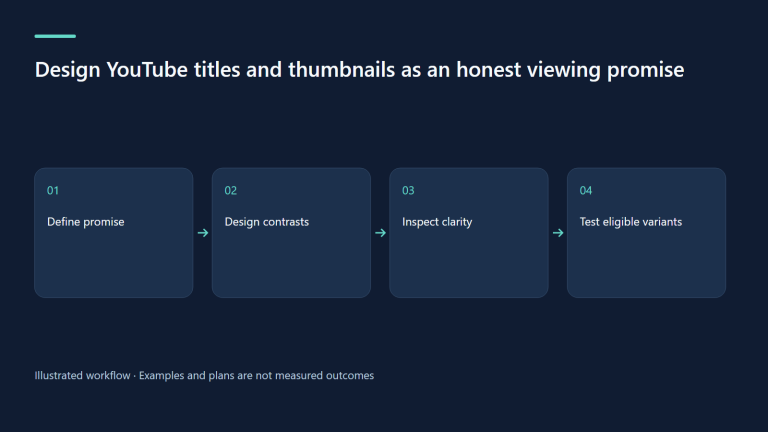
08 Oct 2026 · 5 min read
YouTube SEO
Design YouTube titles and thumbnails as an honest viewing promise
Create complementary title and thumbnail concepts, inspect small-screen clarity and plan eligible native experiments.
Read more
Discussion
Comments are reviewed before publication. Your email is kept private.