
JOURNAL
Local SEO & International SEO — Ranking Everywhere
Complete guide to local SEO and international SEO in 2026. Master Google Business Profile optimization, local citations, NAP consistency, review management, hreflang implementation, geo-targeting, and multi-region site architecture. Part 10 of the SEO Leader's Complete Playbook.
On this page
Whether you’re a local business serving one city or a global brand targeting 50 countries, location-based SEO is critical. Local SEO puts you in front of customers when they search “near me.” International SEO ensures your content reaches the right audience in the right language, worldwide. In 2026, both are more important than ever as search becomes increasingly personalized by location.
This is Part 10 of the SEO Leader’s Complete Playbook.
Local SEO: Dominating Your Local Market
Google Business Profile Optimization
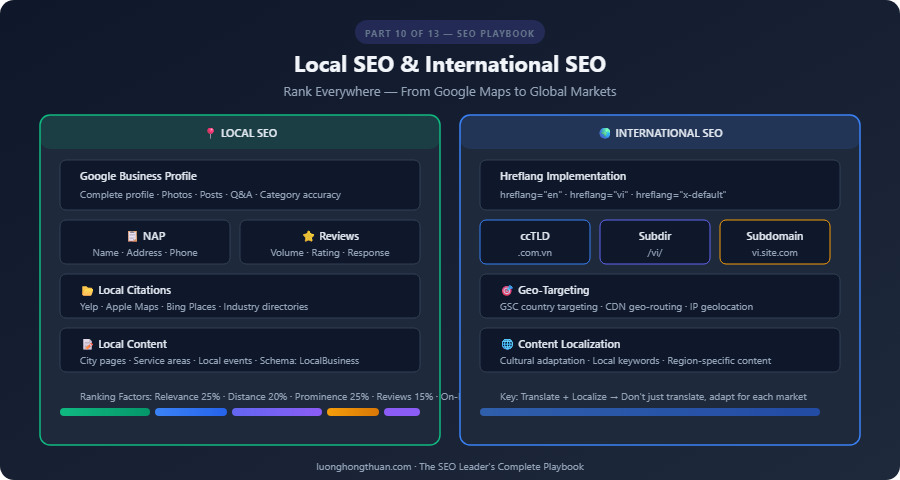
Google Business Profile (GBP) is the single most important local SEO tool. A fully optimized GBP can put you in the Local Pack — the map results that appear above organic results for local queries.
Complete GBP Setup Checklist
- Business name matches exactly across all platforms
- Primary category is highly specific (not just “Restaurant” — use “Vietnamese Restaurant”)
- Secondary categories cover all relevant services
- Full address with consistent formatting
- Phone number is a local number (not toll-free)
- Business hours are accurate, including holidays
- Website URL points to a relevant landing page (not just homepage)
- Business description includes target keywords naturally (750 chars)
- Photos — minimum 10 high-quality photos (exterior, interior, products, team)
- Products/Services listing with descriptions and prices
- Attributes filled out (accessibility, amenities, etc.)
- Q&A section pre-populated with common questions
- Regular posts (weekly updates, offers, events)
NAP Consistency
NAP (Name, Address, Phone) must be identical everywhere online:
| Platform | Importance |
|---|---|
| Google Business Profile | Critical — primary source |
| Website (footer, contact) | Critical — must match GBP exactly |
| Facebook Business Page | High |
| Yelp | High |
| Apple Maps | High |
| Bing Places | Medium |
| Industry-specific directories | Medium |
| Local chamber of commerce | Medium |
Common mistakes:
- “St” vs “Street” vs “St.”
- Suite numbers missing or inconsistent
- Old phone numbers on forgotten profiles
- Different business name variations
Local Citations
Citations are mentions of your NAP on other websites. Key citation sources:
General directories: Google Business, Bing Places, Apple Maps, Yelp, Facebook, Yellow Pages
Industry-specific: TripAdvisor (hospitality), Healthgrades (healthcare), Avvo (legal), Houzz (home services)
Local: Chamber of commerce, local newspapers, community sites, local business associations
Review Management
Reviews are a top local ranking factor and directly influence consumer decisions.
Getting reviews:
- Ask happy customers via email follow-up
- Add review links to receipts and invoices
- Create QR codes linking to your GBP review page
- Train staff to ask for reviews after positive interactions
- Never buy fake reviews — Google detects and penalizes this
Responding to reviews:
- Respond to every review — positive and negative
- Thank positive reviewers specifically
- Address negative reviews professionally and offer solutions
- Use keywords naturally in responses
Local Schema Markup
{
  "@context": "https://schema.org",
  "@type": "LocalBusiness",
  "name": "InkViet",
  "description": "Vietnamese storytelling and reading platform",
  "@id": "https://inkviet.com",
  "url": "https://inkviet.com",
  "image": "https://inkviet.com/logo.png",
  "address": {
    "@type": "PostalAddress",
    "addressLocality": "Ho Chi Minh City",
    "addressCountry": "VN"
  },
  "sameAs": [
    "https://facebook.com/inkviet",
    "https://twitter.com/inkviet"
  ]
}
International SEO: Reaching Global Audiences
URL Structure Options
| Structure | Example | Pros | Cons |
|---|---|---|---|
| ccTLD | example.vn, example.com.au | Strong geo-signal, local trust | Expensive, separate domains to maintain |
| Subdirectory | example.com/vi/, example.com/en/ | Single domain authority, easy to manage | Weaker geo-signal |
| Subdomain | vi.example.com, en.example.com | Moderate geo-signal | Split domain authority |
Recommendation for most sites: Subdirectories. They maintain a single domain authority while allowing clear language segmentation.
Hreflang Implementation
Hreflang tags tell Google which language and region each page targets:
<!-- In <head> of every page -->
<link rel="alternate" hreflang="vi" href="https://inkviet.com/vi/truyen-thieu-nhi/" />
<link rel="alternate" hreflang="en" href="https://inkviet.com/en/childrens-stories/" />
<link rel="alternate" hreflang="x-default" href="https://inkviet.com/" />
Hreflang rules:
- Every page MUST include a self-referencing hreflang tag
- All alternates must reciprocally link to each other
- Use ISO 639-1 language codes (vi, en, ja, zh)
- Use ISO 3166-1 Alpha-2 for regions (en-US, en-GB, pt-BR)
x-defaultspecifies the fallback page
Common Hreflang Mistakes
| Mistake | Impact | Fix |
|---|---|---|
| Missing self-referencing tag | Google ignores hreflang | Add self-reference on every page |
| Non-reciprocal tags | Google ignores the relationship | Ensure both pages reference each other |
| Wrong language codes | Google can’t interpret | Use ISO 639-1 codes only |
| Hreflang on non-indexed pages | Wastes crawl budget, confusing signals | Only add hreflang to indexed pages |
| Missing x-default | Users may see wrong language | Always include x-default |
Content Localization vs Translation
| Approach | What It Means | When to Use |
|---|---|---|
| Translation | Same content in different languages | Technical documentation, product specs |
| Localization | Culturally adapted content + translation | Marketing content, blog posts, landing pages |
| Transcreation | Completely new content for regional audience | Campaigns, ads, emotional content |
For inkviet.com:
- Vietnamese stories → content localization for English audience (cultural context added)
- UI elements → translation with cultural adaptation
- Marketing content → transcreation for international markets
Geo-Targeting in Google Search Console
- Go to GSC → Settings → International Targeting
- Set the country target for your domain/subdirectory
- This is only needed for generic TLDs (.com, .org, .net)
- ccTLDs (.vn, .au) are automatically geo-targeted
Hands-On: Local SEO Setup
Step 1: Claim and Optimize GBP (30 minutes)
- Go to business.google.com and claim your listing
- Complete every field in the profile
- Add 10+ photos (exterior, interior, products)
- Write a keyword-rich business description
Step 2: Build Citations (1 hour)
- Create listings on top 10 citation sources
- Ensure NAP consistency across all listings
- Use a citation management tool (BrightLocal, Moz Local) to monitor
Step 3: Set Up Review Strategy (15 minutes)
- Create a direct review link for your GBP
- Email 10 recent happy customers asking for reviews
- Set up a process for responding to all reviews weekly
Key Takeaways
- GBP is the foundation of local SEO — optimize it completely
- NAP consistency is critical — identical name, address, phone everywhere
- Reviews drive local rankings and conversions — actively manage them
- Hreflang is essential for multilingual sites — but easy to implement incorrectly
- Localize, don’t just translate — adapt content for cultural context
- Subdirectories are the safest international SEO structure for most sites
What’s Coming Next
In Part 11, we cover SEO Analytics & Reporting — how to measure what actually matters, build actionable dashboards, and prove SEO ROI to stakeholders.
Full Series Navigation
- Part 1: SEO in the AI Era — What Changed, What Didn’t, and What You Must Do Now
- Part 2: The Complete Technical SEO Audit — A 100-Point Checklist
- Part 3: On-Page SEO Mastery — From Title Tags to Topical Authority
- Part 4: Off-Page SEO & Link Building — The Authority Playbook
- Part 5: Core Web Vitals & PageSpeed — Getting a Perfect Score
- Part 6: Content Strategy for SEO — Topic Clusters, Pillar Pages, and Content That Ranks
- Part 7: Advanced Keyword Research — From Search Intent to Semantic Strategy
- Part 8: SEO for AI — How to Get Cited by ChatGPT, Google AI Overviews, and Perplexity
- Part 9: AI-Powered SEO Workflow — Tools, Automation, and Prompt Engineering
- Part 10: Local SEO & International SEO — Ranking Everywhere (you are here)
- Part 11: SEO Analytics & Reporting — Measuring What Actually Matters
- Part 12: The Complete SEO Best Practices Checklist — Your Team’s Daily Reference
- Part 13: SEO in Action — Step-by-Step for luonghongthuan.com, inkviet.com & cublearn.app
Related reading
10 Mar 2026 · 10 min read
case-study
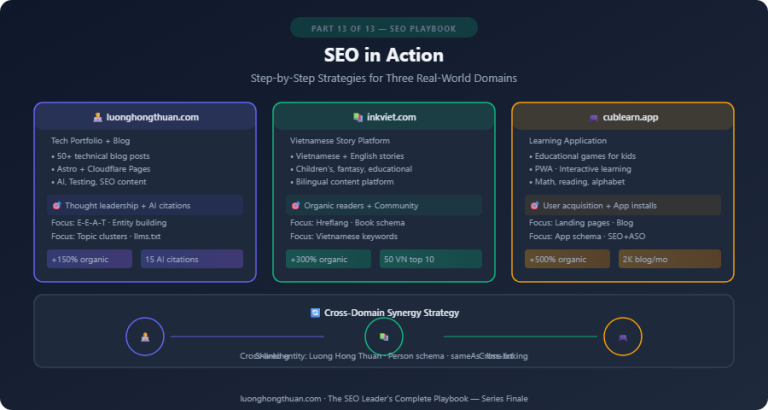
SEO in Action — Step-by-Step Strategies for luonghongthuan.com, inkviet.com & cublearn.app
Real-world SEO implementation for three domains: a tech portfolio blog, a Vietnamese story platform, and a learning app. Complete domain-specific audits, keyword strategies, content plans, AI visibility optimization, and a cross-domain synergy strategy. Part 13 of the SEO Leader's Complete Playbook.
Read more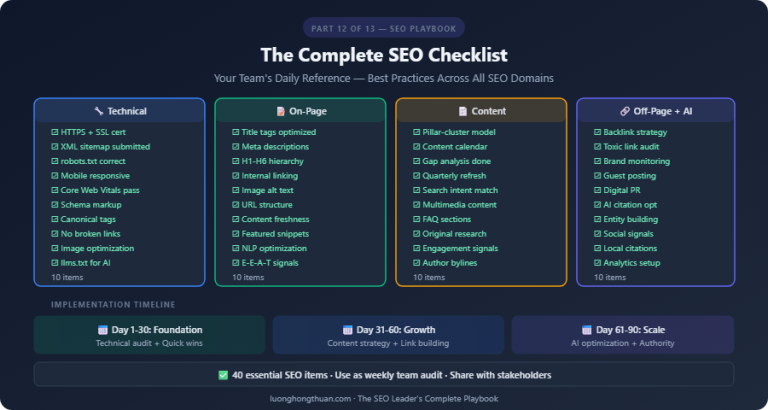
09 Mar 2026 · 8 min read
best-practices
The Complete SEO Best Practices Checklist — Your Team's Daily Reference
The ultimate SEO checklist for 2026. Every best practice from technical SEO, on-page, off-page, content strategy, Core Web Vitals, AI optimization, and analytics — consolidated into a single actionable reference. Includes 30/60/90-day implementation plans. Part 12 of the SEO Leader's Complete Playbook.
Read more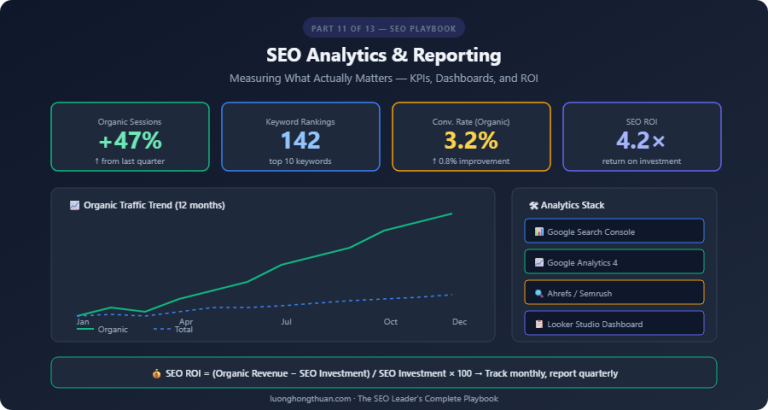
08 Mar 2026 · 7 min read
analytics
SEO Analytics & Reporting — Measuring What Actually Matters
Master SEO analytics and reporting in 2026. Build actionable dashboards with GA4 and Google Search Console. Track the right KPIs, calculate SEO ROI, and create reports that stakeholders actually read. Part 11 of the SEO Leader's Complete Playbook.
Read more
Discussion
Comments are reviewed before publication. Your email is kept private.