
JOURNAL
Advanced Keyword Research — From Search Intent to Semantic Strategy
Master keyword research for 2026. Learn to find high-value keywords, classify search intent, build semantic keyword clusters, analyze competitor gaps, and target SERP features. Includes step-by-step process with free and paid tools. Part 7 of the SEO Leader's Complete Playbook.
On this page
Keyword research is the compass of your SEO strategy. It tells you what your audience is searching for, how competitive each topic is, and where the highest-value opportunities hide. In 2026, keyword research goes far beyond volume numbers — it’s about understanding semantic relationships, mapping user intent, and finding the keyword clusters that build topical authority.
This is Part 7 of the SEO Leader’s Complete Playbook — a 13-part series for SEO teams who want results backed by data.
Beyond Volume: The Modern Keyword Metrics
In 2026, keyword volume alone is a poor indicator of value. Here are the metrics that actually matter:
| Metric | What It Tells You | Why It Matters |
|---|---|---|
| Search Volume | How many people search monthly | Basic demand indicator |
| Keyword Difficulty (KD) | How hard it is to rank | Determines resource investment |
| Search Intent | Why people search this term | Determines content format |
| CPC (Cost Per Click) | What advertisers pay per click | Indicates commercial value |
| Click-Through Rate | % of searchers who click a result | Some queries have zero clicks |
| SERP Features | Featured snippets, AI Overviews, PAA | Opportunities beyond #1 ranking |
| Trend Direction | Growing, stable, or declining | Invest in growing topics |
The Keyword Value Formula
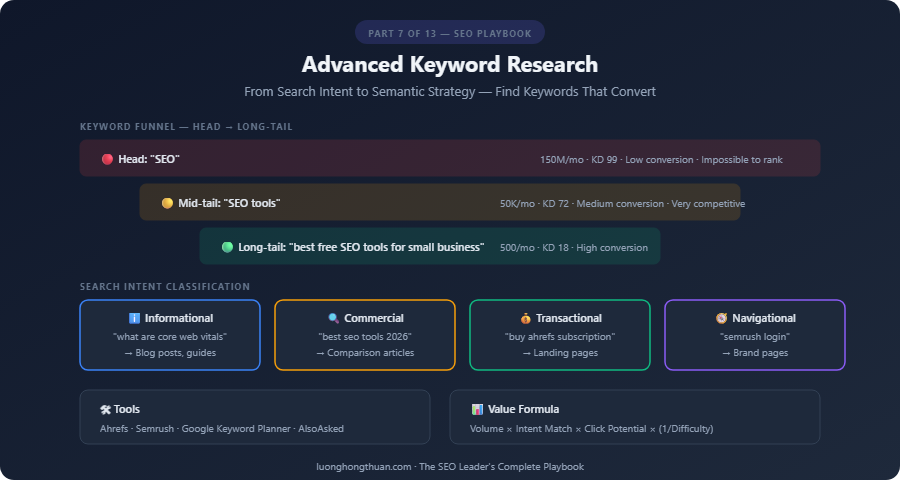
Keyword Value = Volume × Intent Match × Click Potential × (1 / Difficulty)
A keyword with 500 monthly searches, high commercial intent, and low difficulty is more valuable than a keyword with 50,000 searches, informational intent, and extreme competition.
Tools for Keyword Research in 2026
Paid Tools
| Tool | Strengths | Best For | Price |
|---|---|---|---|
| Ahrefs Keywords Explorer | Largest keyword database, accurate difficulty scores, SERP analysis | Comprehensive research | $99+/mo |
| Semrush Keyword Magic Tool | Intent classification, topic grouping, trend data | Strategic planning | $129+/mo |
| Moz Keyword Explorer | Priority score (combines metrics), SERP analysis | Quick prioritization | $99+/mo |
| Keyword Insights | AI-powered keyword clustering and intent mapping | Large-scale projects | $58+/mo |
| WriterZen | Topic discovery, keyword clustering, content planning | Content-focused workflows | $27+/mo |
Free Tools
| Tool | What It Provides |
|---|---|
| Google Keyword Planner | Volume ranges, CPC, competition (basic) |
| Google Search Console | Your actual keyword performance data |
| Google Trends | Trend direction, seasonal patterns, related queries |
| AnswerThePublic | Question-based keywords visualized |
| AlsoAsked.com | People Also Ask chains from Google |
| Google Autocomplete | Real-time search suggestions |
| Ubersuggest (free tier) | Basic volume, difficulty, content ideas |
The Keyword Research Process
Step 1: Seed Keyword Generation
Start with broad topics related to your business. Methods for generating seed keywords:
From your business:
- Products/services you offer
- Problems you solve
- Questions customers ask
- Industry terminology
- Features and benefits
From competitors:
- Competitor homepage keywords
- Competitor blog topics
- Competitor top-ranking pages (Ahrefs → Site Explorer → Top Pages)
From search engines:
- Google Autocomplete suggestions
- Google “People Also Ask” boxes
- Google “Related Searches” at bottom of SERP
- YouTube search suggestions
Step 2: Keyword Expansion
Take your seed keywords and expand them using tools:
Seed keyword: "SEO audit"

Expanded keywords (from Ahrefs):
├── "seo audit checklist" (1,200/mo, KD 35)
├── "seo audit tool" (800/mo, KD 42)
├── "seo audit template" (500/mo, KD 28)
├── "free seo audit" (2,500/mo, KD 55)
├── "technical seo audit" (400/mo, KD 22)
├── "seo audit report" (300/mo, KD 30)
├── "how to do seo audit" (600/mo, KD 18)
├── "seo site audit" (700/mo, KD 38)
├── "ecommerce seo audit" (200/mo, KD 15)
└── "seo audit services" (150/mo, KD 25)
Step 3: Intent Classification
Classify every keyword by search intent to determine the right content format:
| Keyword | Volume | Intent | Content Format |
|---|---|---|---|
| “what is technical seo” | 1,500 | Informational | Comprehensive guide |
| “seo audit tool comparison” | 800 | Commercial | Comparison article |
| “screaming frog pricing” | 600 | Navigational | Price comparison (or skip) |
| “buy semrush subscription” | 400 | Transactional | Landing page / affiliate |
| “seo audit checklist pdf” | 500 | Informational / Lead gen | Downloadable resource |
Step 4: Keyword Clustering
Group related keywords that can be targeted by a single page. This is critical for 2026 SEO because Google ranks pages for topics, not individual keywords.
Manual Clustering:
Cluster: "Technical SEO Audit"
├── "technical seo audit" (primary)
├── "technical seo checklist"
├── "seo technical analysis"
├── "website technical audit"
├── "how to do a technical seo audit"
├── "technical seo audit template"
└── "seo audit crawlability"
→ Target all with ONE comprehensive page
AI-Powered Clustering: Tools like Keyword Insights and WriterZen use NLP to automatically cluster keywords by content topic, saving hours of manual work on large keyword sets.
Step 5: Competitor Gap Analysis
Find keywords your competitors rank for that you don’t:
- Open Ahrefs Content Gap (or Semrush Keyword Gap)
- Enter your domain in the first field
- Enter 3-5 competitor domains in the comparison fields
- Filter results:
- Minimum volume: 100
- Your position: Not ranking
- Competitor position: Top 20
- Sort by volume and scan for relevant topics
- Export and categorize by priority
Step 6: SERP Feature Analysis
Identify which SERP features appear for your target keywords — they determine your strategy:
| SERP Feature | Opportunity | Strategy |
|---|---|---|
| Featured Snippet | Can capture position #0 even with lower rankings | Format content for snippet (Q&A, lists, tables) |
| AI Overview | Content can be cited without ranking in top 3 | Structured, authoritative, concise content |
| People Also Ask | Expand content to cover related questions | Add FAQ sections covering PAA questions |
| Video Carousel | First-page visibility through video | Create video content + embed on page |
| Knowledge Panel | Brand visibility | Build entity signals across platforms |
| Local Pack | Local search dominance | Google Business Profile optimization |
| Shopping Results | Product visibility | Product schema + Google Merchant Center |
Long-Tail Keyword Strategy
Long-tail keywords (3+ words) are the hidden goldmine of SEO:
Why Long-Tail Keywords Win
- Lower competition — easier to rank for
- Higher conversion — more specific intent = closer to action
- AI visibility — conversational queries that AI platforms answer using your content
- Voice search — people speak in long-tail queries (“how do I fix layout shift on my website”)
Finding Long-Tail Keywords
Head keyword: "SEO" (150M searches/mo, impossible to rank)
    ↓
Mid-tail: "SEO tools" (50K searches/mo, very competitive)
    ↓
Long-tail: "best free SEO tools for small business" (500/mo, rankable!)
    ↓
Ultra-long-tail: "how to do SEO audit for wordpress site without paying" (50/mo, easy to rank)
Long-Tail Sources
- Google Autocomplete — type your keyword slowly
- People Also Ask — click to expand, reveals more questions
- Reddit and Quora — real questions from real people
- Customer support tickets — exact language your users use
- GSC queries — keywords you already get impressions for
- ChatGPT/Claude — ask “What questions do people ask about [topic]?”
Semantic Keywords and NLP
Google understands topics semantically — it knows related concepts, entities, and co-occurring terms.
What Are Semantic Keywords?
For the keyword “Core Web Vitals,” semantic keywords include:
- LCP, INP, CLS (specific metrics)
- PageSpeed Insights, Lighthouse (measurement tools)
- Page experience, user experience (related concepts)
- Loading speed, interactivity, visual stability (definitions)
- Chrome UX Report, field data, lab data (data sources)
How to Find Semantic Keywords
- Examine top-ranking content — what terms do they consistently use?
- Use Surfer SEO or Clearscope — NLP tools identify important terms
- Review Google’s “Related Searches” at the bottom of SERPs
- Check entity databases — Wikidata, Google Knowledge Graph
- Use AI tools — ask Claude/ChatGPT to list related entities and concepts
Using Semantic Keywords
Don’t: Stuff them artificially into your content Do: Include them naturally when they add value for the reader
Voice Search Optimization
With the rise of smart speakers and mobile voice search, optimizing for conversational queries is increasingly important:
Voice Search Characteristics
- Conversational: “What’s the best way to improve page speed?”
- Question-based: “How do I fix CLS on my website?”
- Local intent: “SEO agency near me”
- Long-tail: Queries are 5-7+ words on average
Optimization Tips
- Target question keywords (how, what, why, when, where)
- Include concise, direct answers (40-60 words)
- Use FAQ schema for Q&A content
- Optimize for local queries if relevant
- Write in natural, conversational language
Hands-On: Complete Keyword Research for a Niche
Let’s walk through keyword research for the topic “testing automation” as a real example:
Step 1: Generate Seeds (10 minutes)
Seeds: test automation, automated testing, QA automation,
playwright testing, selenium vs playwright, BDD testing
Step 2: Expand with Tools (20 minutes)
Using Ahrefs Keywords Explorer, expand each seed into 50-200 keyword suggestions. Filter by:
- Volume ≥ 50
- KD ≤ 60
- Shows CPC (indicates commercial value)
Step 3: Classify Intent (15 minutes)
Categorize each keyword as informational, commercial, or transactional.
Step 4: Cluster (20 minutes)
Group keywords into topic clusters. Each cluster = one content piece.
Step 5: Prioritize (10 minutes)
Score each cluster: Volume × (1/KD) × Business Relevance = Priority Score.
Step 6: Map to Content (15 minutes)
For each top-priority cluster, define:
- Content format (guide, comparison, tutorial)
- Target word count
- Key sections and subtopics to cover
- Internal linking opportunities
Key Takeaways
- Look beyond volume — intent, difficulty, and click potential matter more
- Cluster keywords by topic — one page targets a cluster, not a single keyword
- Long-tail keywords are your best opportunity — lower competition, higher conversion
- Competitor gap analysis reveals easy wins — find what they rank for and you don’t
- Semantic keywords build topical relevance — include related entities naturally
- Voice search is growing — optimize for conversational, question-based queries
What’s Coming Next
In Part 8, we tackle the most exciting frontier in SEO: SEO for AI Platforms — how to get cited by ChatGPT, appear in Google AI Overviews, and make Perplexity recommend your content. This is where SEO is heading.
Full Series Navigation
- Part 1: SEO in the AI Era — What Changed, What Didn’t, and What You Must Do Now
- Part 2: The Complete Technical SEO Audit — A 100-Point Checklist
- Part 3: On-Page SEO Mastery — From Title Tags to Topical Authority
- Part 4: Off-Page SEO & Link Building — The Authority Playbook
- Part 5: Core Web Vitals & PageSpeed — Getting a Perfect Score
- Part 6: Content Strategy for SEO — Topic Clusters, Pillar Pages, and Content That Ranks
- Part 7: Advanced Keyword Research — From Search Intent to Semantic Strategy (you are here)
- Part 8: SEO for AI — How to Get Cited by ChatGPT, Google AI Overviews, and Perplexity
- Part 9: AI-Powered SEO Workflow — Tools, Automation, and Prompt Engineering
- Part 10: Local SEO & International SEO — Ranking Everywhere
- Part 11: SEO Analytics & Reporting — Measuring What Actually Matters
- Part 12: The Complete SEO Best Practices Checklist — Your Team’s Daily Reference
- Part 13: SEO in Action — Step-by-Step for luonghongthuan.com, inkviet.com & cublearn.app
Related reading
10 Mar 2026 · 10 min read
case-study
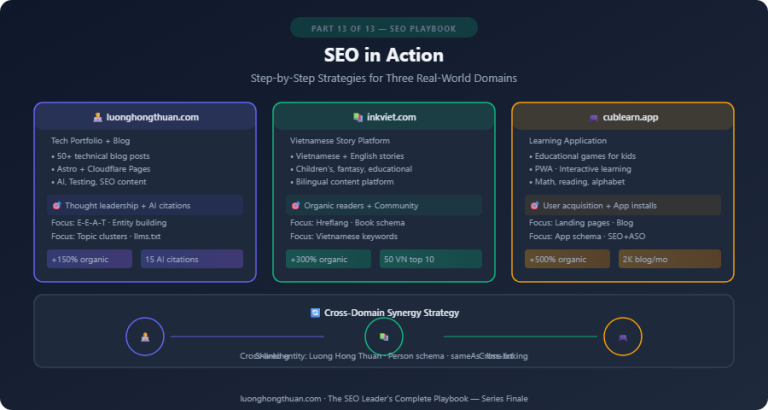
SEO in Action — Step-by-Step Strategies for luonghongthuan.com, inkviet.com & cublearn.app
Real-world SEO implementation for three domains: a tech portfolio blog, a Vietnamese story platform, and a learning app. Complete domain-specific audits, keyword strategies, content plans, AI visibility optimization, and a cross-domain synergy strategy. Part 13 of the SEO Leader's Complete Playbook.
Read more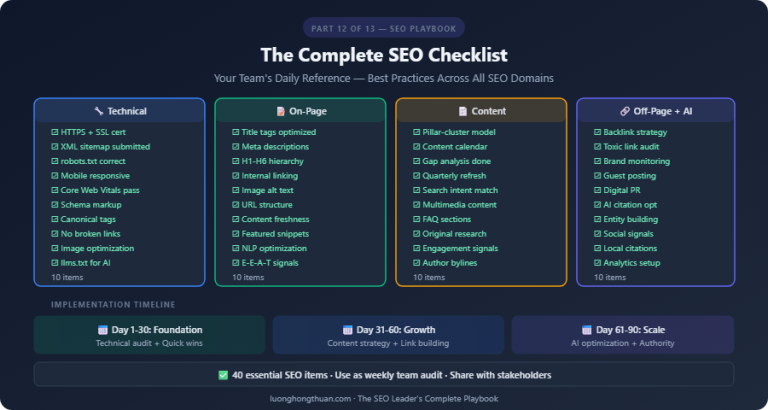
09 Mar 2026 · 8 min read
best-practices
The Complete SEO Best Practices Checklist — Your Team's Daily Reference
The ultimate SEO checklist for 2026. Every best practice from technical SEO, on-page, off-page, content strategy, Core Web Vitals, AI optimization, and analytics — consolidated into a single actionable reference. Includes 30/60/90-day implementation plans. Part 12 of the SEO Leader's Complete Playbook.
Read more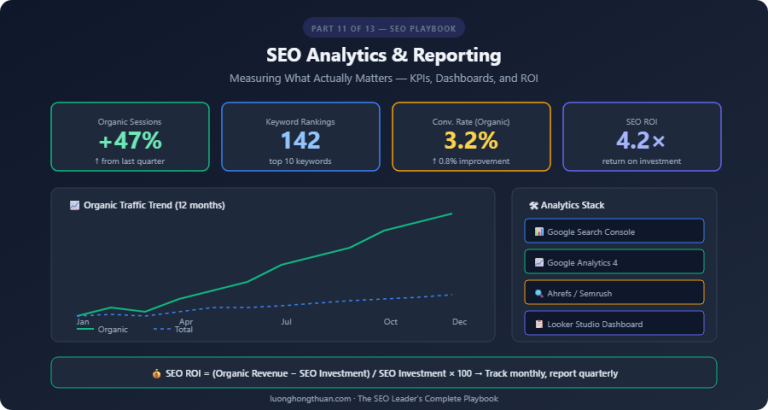
08 Mar 2026 · 7 min read
analytics
SEO Analytics & Reporting — Measuring What Actually Matters
Master SEO analytics and reporting in 2026. Build actionable dashboards with GA4 and Google Search Console. Track the right KPIs, calculate SEO ROI, and create reports that stakeholders actually read. Part 11 of the SEO Leader's Complete Playbook.
Read more
Discussion
Comments are reviewed before publication. Your email is kept private.