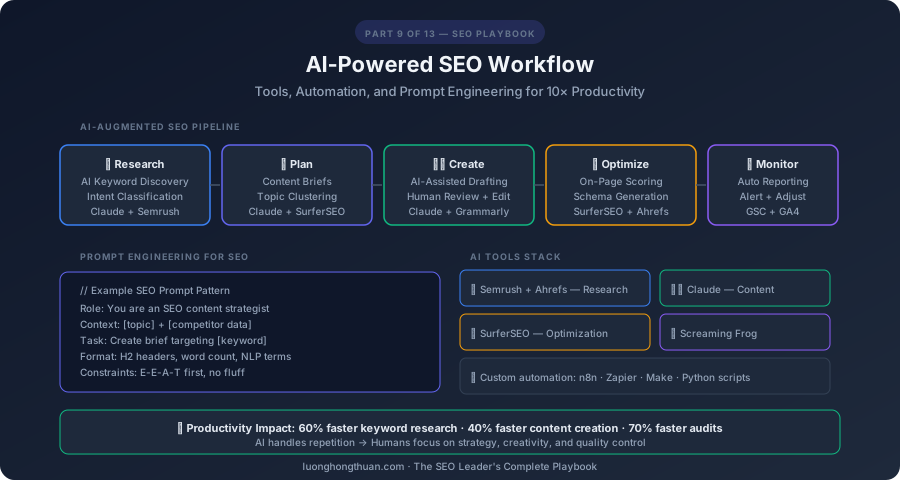
AI isn’t replacing SEO professionals — it’s making the best ones 10x more productive. In 2026, the SEO teams winning are the ones who’ve integrated AI tools into every phase of their workflow: research, content creation, technical audits, link building, and reporting. This guide covers the exact tools, workflows, and prompts that turn a 5-person team into one that operates like 50.
This is Part 9 of the SEO Leader’s Complete Playbook — a 13-part series for SEO teams who want to work smarter.
The AI-Powered SEO Tech Stack
AI Tools by SEO Function
| Function | Tool | What It Does | Best For |
|---|---|---|---|
| Keyword Research | Semrush AI, Ahrefs AI | AI-powered keyword suggestions, clustering | Strategic keyword planning |
| Content Optimization | Surfer SEO | NLP analysis, real-time content scoring | On-page optimization |
| Content Optimization | Clearscope | Entity coverage analysis, content grading | Comprehensive content |
| Content Optimization | MarketMuse | AI content briefs, gap analysis | Content strategy |
| Content Optimization | Frase.io | SERP analysis, AI-generated outlines | Research-heavy writing |
| Content Writing | Claude / ChatGPT | Draft creation, editing, research | Content ideation and drafting |
| Content Writing | Jasper AI | SEO-focused content generation | Marketing copy and blogs |
| Content Writing | NeuronWriter | NLP-powered writing with SEO signals | SEO content creation |
| Link Building | Pitchbox | Outreach automation with AI personalization | Link building campaigns |
| Link Building | Respona | AI-powered prospect research + outreach | Digital PR |
| Technical SEO | Screaming Frog | AI-enhanced crawl analysis | Technical audits |
| Technical SEO | ContentKing | Real-time monitoring with AI alerts | Continuous monitoring |
| Reporting | Google Looker Studio | Automated dashboards | Client/stakeholder reports |
| Automation | AirOps | AI SEO workflow automation | Scaling SEO operations |
| Automation | Zapier AI | Cross-tool automation | Connecting SEO tools |
AI for Keyword Research
Using AI to Find Hidden Keyword Opportunities
Prompt for Claude/ChatGPT:
I'm doing keyword research for a blog about [TOPIC]. My site targets
[AUDIENCE].

1. Give me 20 long-tail keywords grouped by search intent
   (informational, commercial, transactional)
2. For each keyword, estimate search volume (low/medium/high)
   and competition (low/medium/high)
3. Suggest which content format would rank best for each keyword
   (guide, listicle, comparison, tutorial, case study)
4. Identify 5 keyword clusters I could target with single pages
5. What questions would my audience ask about each cluster?
AI-Enhanced Keyword Clustering
Prompt: Here's a list of 100 keywords related to "test automation":
[paste keywords]

Group these into topic clusters, where each cluster can be
effectively targeted by a single comprehensive piece of content.
For each cluster:
- Suggest a primary keyword
- List supporting keywords
- Recommend the content format
- Estimate total combined volume
- Rank difficulty as low/medium/high
AI for Content Creation
The AI Content Workflow
Phase 1: Research and Brief
- Use AI to analyze top-ranking content for your target keyword
- Generate a content brief with required sections, entities, and questions to answer
- Identify gaps in competitor content
Phase 2: Draft Creation
- Use AI to generate an initial draft based on your brief
- Focus on structure, not perfection — AI drafts are starting points
- Add your unique experience, data, and insights
Phase 3: Optimization
- Run through Surfer SEO or Clearscope for NLP scoring
- Ensure all required entities and topics are covered
- Check readability and content depth
Phase 4: Human Review
- Verify all facts, statistics, and claims
- Add personal experience and case studies
- Ensure the tone matches your brand voice
- Remove any AI-typical patterns (generic sentences, unnecessary qualifiers)
Content Brief Generation Prompt
Create a detailed SEO content brief for the keyword
"[PRIMARY KEYWORD]":

1. SERP Analysis:
   - What type of content ranks in the top 5?
   - What topics do they all cover?
   - What's the average word count?
   - What SERP features appear?

2. Content Outline:
   - Suggested H1 title (under 60 chars)
   - Meta description (155 chars)
   - H2 and H3 structure
   - Must-cover topics and subtopics

3. Semantic Requirements:
   - Key entities to mention
   - Related terms and concepts
   - Questions to answer (from PAA)

4. Differentiation:
   - What unique angle should this content take?
   - What do top results miss?
   - What original data/experience can we add?
Content Optimization Prompt
Review this content for SEO optimization:

[PASTE CONTENT]

Target keyword: [KEYWORD]

1. Does the content fully satisfy the search intent?
2. Are all important subtopics covered?
3. Is the content structure optimal for featured snippets?
4. Are there opportunities for FAQ schema?
5. Is the content AI-extractable (TL;DR, direct answers)?
6. What topics are missing that top competitors cover?
7. Suggest improvements for the title tag and meta description
AI for Technical SEO
Automated Technical Audits
Prompt for Schema Markup Generation:
Generate JSON-LD structured data for this page:

URL: https://luonghongthuan.com/blog/seo-fundamentals-ai-era-part1/
Title: SEO in the AI Era — What Changed and What You Must Do Now
Description: Complete guide to SEO in 2026...
Author: Luong Hong Thuan
Published: 2026-02-26
Updated: 2026-02-26
Type: Blog post / Guide article

Include:
- BlogPosting/Article schema
- Author as Person with sameAs links
- Publisher as Organization
- FAQ schema for the FAQ section
- BreadcrumbList schema
robots.txt and Sitemap Review
Review this robots.txt file for issues:

[PASTE ROBOTS.TXT]

Check for:
1. Important pages accidentally blocked
2. Missing sitemap declaration
3. AI crawler configuration (GPTBot, ClaudeBot)
4. Crawl budget waste
5. Best practice compliance
AI for Link Building
Prospect Research
I need to find link building prospects for a blog about
[TOPIC]. My domain authority is [DA].

Find types of sites that would likely link to content about
[TOPIC], including:
1. Resource page opportunities
2. Guest posting targets
3. Industry publications covering this topic
4. Sites that frequently link to similar content
5. Non-competing sites in adjacent niches

For each type, suggest:
- Search queries to find them
- How to evaluate quality
- Outreach angle/pitch approach
Outreach Email Generation
Write a personalized link building outreach email for:
- Target site: [SITE URL]
- Their article: [THEIR ARTICLE URL]
- Our content: [OUR CONTENT URL]
- Our angle: [WHY OUR CONTENT ADDS VALUE]

The email should be:
- Under 150 words
- Personal and specific (not template-feeling)
- Clear about the value we provide
- Professional but conversational
- Include one specific reason they'd want to link to us
AI for SEO Reporting
Automated Report Generation
Based on this SEO data, create a monthly performance summary:

Organic Traffic: [DATA]
Top Keywords: [DATA]
New Backlinks: [DATA]
Core Web Vitals: [DATA]
Top-performing content: [DATA]

Include:
1. Executive summary (3 sentences)
2. Key wins this month
3. Areas needing attention
4. Recommended actions for next month
5. Year-over-year comparison
Prompt Engineering Best Practices for SEO
The Anatomy of an Effective SEO Prompt
ROLE:     "You are an expert SEO strategist with 10+ years experience..."
CONTEXT:  "I'm optimizing a [type] site for [audience] in [industry]..."
TASK:     "Analyze/Create/Optimize [specific deliverable]..."
FORMAT:   "Present results as [table/list/JSON/markdown]..."
CRITERIA: "Prioritize by [metric]. Include [specific details]..."
EXAMPLE:  "Here's an example of what I'm looking for: [example]..."
Common SEO Prompts Library
Title Tag Optimization:
Generate 10 title tag variations for a page about [TOPIC].
Each should be:
- Under 60 characters
- Include the primary keyword [KEYWORD] near the front
- Be compelling enough to drive clicks
- Include the year 2026 where natural
- Use proven title formulas (How to, Complete Guide, X Ways, etc.)
Meta Description Writing:
Write 5 meta descriptions for a page about [TOPIC]
targeting the keyword [KEYWORD].
- Each under 155 characters
- Include a call-to-action
- Highlight unique value proposition
- Match the search intent: [informational/commercial/transactional]
Internal Linking Analysis:
Here are my site's blog post titles and URLs:
[LIST]

For the page about [TOPIC], suggest:
1. 5 pages that should link TO this page (with suggested anchor text)
2. 5 pages this page should link OUT to (with suggested anchor text)
3. Any topic gaps where I should create new content to complete a cluster
Content Gap Analysis:
Compare these two pages and identify what Page A covers that Page B doesn't:

Page A (competitor): [paste content or URL summary]
Page B (ours): [paste content or URL summary]

For each gap:
1. What subtopic is missing?
2. How important is it for ranking (1-5)?
3. How should we add this coverage?
4. What additional keywords would this help us target?
When NOT to Use AI
AI is powerful but has clear limitations for SEO:
AI Excels At
- Generating content briefs and outlines
- Keyword research and clustering
- Schema markup generation
- Draft creation and editing
- Data analysis and reporting
- Pattern recognition in large datasets
AI Fails At
- Original experience and case studies — AI can’t share your real experiences
- Accurate statistics — AI may hallucinate data; always verify numbers
- E-E-A-T signals — Real expertise can’t be faked with AI
- Brand voice — AI needs heavy editing to match your unique voice
- Strategic judgment — AI suggests, humans decide
- Real-time data — Most AI lacks access to current analytics/rankings
Google’s AI Content Policy
Google’s position is clear: AI-generated content is not penalized per se, but content must demonstrate E-E-A-T regardless of how it was created (Google, 2023).
Best practice: Use AI as a tool, not a replacement. AI accelerates your workflow; your expertise, experience, and editorial judgment make the content valuable.
Building an AI-Augmented SEO Team
Role Evolution
| Traditional Role | AI-Augmented Role | New Responsibilities |
|---|---|---|
| Content Writer | Content Strategist + AI Editor | AI prompt engineering, editorial review, experience injection |
| SEO Analyst | SEO Data Scientist | AI-powered analysis, pattern recognition, predictive modeling |
| Link Builder | Digital PR + AI Outreach | AI-personalized outreach, relationship strategy |
| Technical SEO | Technical SEO + AI Engineer | AI tool integration, automation, monitoring |
| SEO Manager | AI-Augmented SEO Lead | Tool selection, workflow optimization, quality control |
Team Workflow Integration
- Morning: AI-generated daily performance digest → review and flag issues
- Content planning: AI-generated briefs → human strategy review → approved briefs
- Content creation: AI-assisted drafts → human editing + experience → review → publish
- Technical monitoring: AI-powered alerts → human diagnosis → AI-assisted fixes
- Reporting: AI-generated reports → human insights and recommendations → stakeholder delivery
Hands-On: Set Up an Automated Content Pipeline
Step 1: Keyword Research Pipeline
GSC Data → Export to spreadsheet →
AI clusters keywords →
Output: Prioritized content calendar
Step 2: Content Brief Automation
Target keyword → AI generates SERP analysis →
AI creates content brief →
Human reviews and approves →
Brief sent to writer
Step 3: Content Quality Check
Draft submitted →
Surfer SEO content score →
AI checks for factual claims →
Human editorial review →
Publish with schema markup
Step 4: Performance Monitoring
Daily: AI scans GSC for anomalies
Weekly: AI generates performance report
Monthly: AI identifies refresh candidates
Quarterly: Full content audit with AI analysis
Key Takeaways
- AI makes SEO teams 10x more productive — use it for research, drafting, analysis, and automation
- The best AI workflow: AI assists, humans decide — never fully automate quality decisions
- Prompt engineering is a core SEO skill — better prompts produce better results
- AI excels at scale tasks — keyword clustering, content briefs, outreach personalization
- AI fails at experience — always add real cases, data, and expertise
- Google doesn’t penalize AI content — but it does penalize low-quality content regardless of source
What’s Coming Next
In Part 10, we cover Local SEO & International SEO — how to rank for local searches with Google Business Profile optimization, and how to expand globally with hreflang, geo-targeting, and content localization strategies.
Full Series Navigation
- Part 1: SEO in the AI Era — What Changed, What Didn’t, and What You Must Do Now
- Part 2: The Complete Technical SEO Audit — A 100-Point Checklist
- Part 3: On-Page SEO Mastery — From Title Tags to Topical Authority
- Part 4: Off-Page SEO & Link Building — The Authority Playbook
- Part 5: Core Web Vitals & PageSpeed — Getting a Perfect Score
- Part 6: Content Strategy for SEO — Topic Clusters, Pillar Pages, and Content That Ranks
- Part 7: Advanced Keyword Research — From Search Intent to Semantic Strategy
- Part 8: SEO for AI — How to Get Cited by ChatGPT, Google AI Overviews, and Perplexity
- Part 9: AI-Powered SEO Workflow — Tools, Automation, and Prompt Engineering (you are here)
- Part 10: Local SEO & International SEO — Ranking Everywhere
- Part 11: SEO Analytics & Reporting — Measuring What Actually Matters
- Part 12: The Complete SEO Best Practices Checklist — Your Team’s Daily Reference
- Part 13: SEO in Action — Step-by-Step for luonghongthuan.com, inkviet.com & cublearn.app