Keyword research is the compass of your SEO strategy. It tells you what your audience is searching for, how competitive each topic is, and where the highest-value opportunities hide. In 2026, keyword research goes far beyond volume numbers — it’s about understanding semantic relationships, mapping user intent, and finding the keyword clusters that build topical authority.
This is Part 7 of the SEO Leader’s Complete Playbook — a 13-part series for SEO teams who want results backed by data.
Beyond Volume: The Modern Keyword Metrics
In 2026, keyword volume alone is a poor indicator of value. Here are the metrics that actually matter:
| Metric | What It Tells You | Why It Matters |
|---|---|---|
| Search Volume | How many people search monthly | Basic demand indicator |
| Keyword Difficulty (KD) | How hard it is to rank | Determines resource investment |
| Search Intent | Why people search this term | Determines content format |
| CPC (Cost Per Click) | What advertisers pay per click | Indicates commercial value |
| Click-Through Rate | % of searchers who click a result | Some queries have zero clicks |
| SERP Features | Featured snippets, AI Overviews, PAA | Opportunities beyond #1 ranking |
| Trend Direction | Growing, stable, or declining | Invest in growing topics |
The Keyword Value Formula
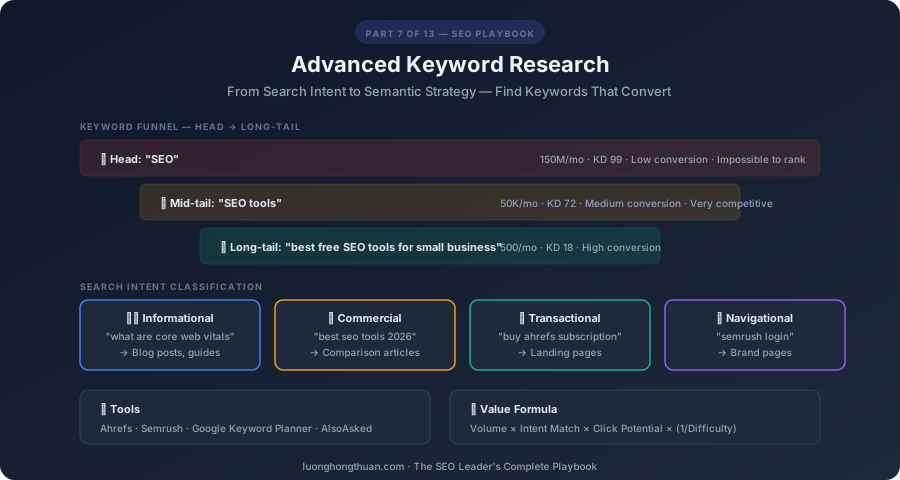
Keyword Value = Volume × Intent Match × Click Potential × (1 / Difficulty)A keyword with 500 monthly searches, high commercial intent, and low difficulty is more valuable than a keyword with 50,000 searches, informational intent, and extreme competition.
Tools for Keyword Research in 2026
Paid Tools
| Tool | Strengths | Best For | Price |
|---|---|---|---|
| Ahrefs Keywords Explorer | Largest keyword database, accurate difficulty scores, SERP analysis | Comprehensive research | $99+/mo |
| Semrush Keyword Magic Tool | Intent classification, topic grouping, trend data | Strategic planning | $129+/mo |
| Moz Keyword Explorer | Priority score (combines metrics), SERP analysis | Quick prioritization | $99+/mo |
| Keyword Insights | AI-powered keyword clustering and intent mapping | Large-scale projects | $58+/mo |
| WriterZen | Topic discovery, keyword clustering, content planning | Content-focused workflows | $27+/mo |
Free Tools
| Tool | What It Provides |
|---|---|
| Google Keyword Planner | Volume ranges, CPC, competition (basic) |
| Google Search Console | Your actual keyword performance data |
| Google Trends | Trend direction, seasonal patterns, related queries |
| AnswerThePublic | Question-based keywords visualized |
| AlsoAsked.com | People Also Ask chains from Google |
| Google Autocomplete | Real-time search suggestions |
| Ubersuggest (free tier) | Basic volume, difficulty, content ideas |
The Keyword Research Process
Step 1: Seed Keyword Generation
Start with broad topics related to your business. Methods for generating seed keywords:
From your business:
- Products/services you offer
- Problems you solve
- Questions customers ask
- Industry terminology
- Features and benefits
From competitors:
- Competitor homepage keywords
- Competitor blog topics
- Competitor top-ranking pages (Ahrefs → Site Explorer → Top Pages)
From search engines:
- Google Autocomplete suggestions
- Google “People Also Ask” boxes
- Google “Related Searches” at bottom of SERP
- YouTube search suggestions
Step 2: Keyword Expansion
Take your seed keywords and expand them using tools:
Seed keyword: "SEO audit"

Expanded keywords (from Ahrefs):
├── "seo audit checklist" (1,200/mo, KD 35)
├── "seo audit tool" (800/mo, KD 42)
├── "seo audit template" (500/mo, KD 28)
├── "free seo audit" (2,500/mo, KD 55)
├── "technical seo audit" (400/mo, KD 22)
├── "seo audit report" (300/mo, KD 30)
├── "how to do seo audit" (600/mo, KD 18)
├── "seo site audit" (700/mo, KD 38)
├── "ecommerce seo audit" (200/mo, KD 15)
└── "seo audit services" (150/mo, KD 25)
Step 3: Intent Classification
Classify every keyword by search intent to determine the right content format:
| Keyword | Volume | Intent | Content Format |
|---|---|---|---|
| ”what is technical seo” | 1,500 | Informational | Comprehensive guide |
| ”seo audit tool comparison” | 800 | Commercial | Comparison article |
| ”screaming frog pricing” | 600 | Navigational | Price comparison (or skip) |
| “buy semrush subscription” | 400 | Transactional | Landing page / affiliate |
| ”seo audit checklist pdf” | 500 | Informational / Lead gen | Downloadable resource |
Step 4: Keyword Clustering
Group related keywords that can be targeted by a single page. This is critical for 2026 SEO because Google ranks pages for topics, not individual keywords.
Manual Clustering:
Cluster: "Technical SEO Audit"
├── "technical seo audit" (primary)
├── "technical seo checklist"
├── "seo technical analysis"
├── "website technical audit"
├── "how to do a technical seo audit"
├── "technical seo audit template"
└── "seo audit crawlability"
→ Target all with ONE comprehensive page
AI-Powered Clustering: Tools like Keyword Insights and WriterZen use NLP to automatically cluster keywords by content topic, saving hours of manual work on large keyword sets.
Step 5: Competitor Gap Analysis
Find keywords your competitors rank for that you don’t:
- Open Ahrefs Content Gap (or Semrush Keyword Gap)
- Enter your domain in the first field
- Enter 3-5 competitor domains in the comparison fields
- Filter results:
- Minimum volume: 100
- Your position: Not ranking
- Competitor position: Top 20
- Sort by volume and scan for relevant topics
- Export and categorize by priority
Step 6: SERP Feature Analysis
Identify which SERP features appear for your target keywords — they determine your strategy:
| SERP Feature | Opportunity | Strategy |
|---|---|---|
| Featured Snippet | Can capture position #0 even with lower rankings | Format content for snippet (Q&A, lists, tables) |
| AI Overview | Content can be cited without ranking in top 3 | Structured, authoritative, concise content |
| People Also Ask | Expand content to cover related questions | Add FAQ sections covering PAA questions |
| Video Carousel | First-page visibility through video | Create video content + embed on page |
| Knowledge Panel | Brand visibility | Build entity signals across platforms |
| Local Pack | Local search dominance | Google Business Profile optimization |
| Shopping Results | Product visibility | Product schema + Google Merchant Center |
Long-Tail Keyword Strategy
Long-tail keywords (3+ words) are the hidden goldmine of SEO:
Why Long-Tail Keywords Win
- Lower competition — easier to rank for
- Higher conversion — more specific intent = closer to action
- AI visibility — conversational queries that AI platforms answer using your content
- Voice search — people speak in long-tail queries (“how do I fix layout shift on my website”)
Finding Long-Tail Keywords
Head keyword: "SEO" (150M searches/mo, impossible to rank)
    ↓
Mid-tail: "SEO tools" (50K searches/mo, very competitive)
    ↓
Long-tail: "best free SEO tools for small business" (500/mo, rankable!)
    ↓
Ultra-long-tail: "how to do SEO audit for wordpress site without paying" (50/mo, easy to rank)
Long-Tail Sources
- Google Autocomplete — type your keyword slowly
- People Also Ask — click to expand, reveals more questions
- Reddit and Quora — real questions from real people
- Customer support tickets — exact language your users use
- GSC queries — keywords you already get impressions for
- ChatGPT/Claude — ask “What questions do people ask about [topic]?”
Semantic Keywords and NLP
Google understands topics semantically — it knows related concepts, entities, and co-occurring terms.
What Are Semantic Keywords?
For the keyword “Core Web Vitals,” semantic keywords include:
- LCP, INP, CLS (specific metrics)
- PageSpeed Insights, Lighthouse (measurement tools)
- Page experience, user experience (related concepts)
- Loading speed, interactivity, visual stability (definitions)
- Chrome UX Report, field data, lab data (data sources)
How to Find Semantic Keywords
- Examine top-ranking content — what terms do they consistently use?
- Use Surfer SEO or Clearscope — NLP tools identify important terms
- Review Google’s “Related Searches” at the bottom of SERPs
- Check entity databases — Wikidata, Google Knowledge Graph
- Use AI tools — ask Claude/ChatGPT to list related entities and concepts
Using Semantic Keywords
Don’t: Stuff them artificially into your content Do: Include them naturally when they add value for the reader
Voice Search Optimization
With the rise of smart speakers and mobile voice search, optimizing for conversational queries is increasingly important:
Voice Search Characteristics
- Conversational: “What’s the best way to improve page speed?”
- Question-based: “How do I fix CLS on my website?”
- Local intent: “SEO agency near me”
- Long-tail: Queries are 5-7+ words on average
Optimization Tips
- Target question keywords (how, what, why, when, where)
- Include concise, direct answers (40-60 words)
- Use FAQ schema for Q&A content
- Optimize for local queries if relevant
- Write in natural, conversational language
Hands-On: Complete Keyword Research for a Niche
Let’s walk through keyword research for the topic “testing automation” as a real example:
Step 1: Generate Seeds (10 minutes)
Seeds: test automation, automated testing, QA automation,
playwright testing, selenium vs playwright, BDD testing
Step 2: Expand with Tools (20 minutes)
Using Ahrefs Keywords Explorer, expand each seed into 50-200 keyword suggestions. Filter by:
- Volume ≥ 50
- KD ≤ 60
- Shows CPC (indicates commercial value)
Step 3: Classify Intent (15 minutes)
Categorize each keyword as informational, commercial, or transactional.
Step 4: Cluster (20 minutes)
Group keywords into topic clusters. Each cluster = one content piece.
Step 5: Prioritize (10 minutes)
Score each cluster: Volume × (1/KD) × Business Relevance = Priority Score.
Step 6: Map to Content (15 minutes)
For each top-priority cluster, define:
- Content format (guide, comparison, tutorial)
- Target word count
- Key sections and subtopics to cover
- Internal linking opportunities
Key Takeaways
- Look beyond volume — intent, difficulty, and click potential matter more
- Cluster keywords by topic — one page targets a cluster, not a single keyword
- Long-tail keywords are your best opportunity — lower competition, higher conversion
- Competitor gap analysis reveals easy wins — find what they rank for and you don’t
- Semantic keywords build topical relevance — include related entities naturally
- Voice search is growing — optimize for conversational, question-based queries
What’s Coming Next
In Part 8, we tackle the most exciting frontier in SEO: SEO for AI Platforms — how to get cited by ChatGPT, appear in Google AI Overviews, and make Perplexity recommend your content. This is where SEO is heading.
Full Series Navigation
- Part 1: SEO in the AI Era — What Changed, What Didn’t, and What You Must Do Now
- Part 2: The Complete Technical SEO Audit — A 100-Point Checklist
- Part 3: On-Page SEO Mastery — From Title Tags to Topical Authority
- Part 4: Off-Page SEO & Link Building — The Authority Playbook
- Part 5: Core Web Vitals & PageSpeed — Getting a Perfect Score
- Part 6: Content Strategy for SEO — Topic Clusters, Pillar Pages, and Content That Ranks
- Part 7: Advanced Keyword Research — From Search Intent to Semantic Strategy (you are here)
- Part 8: SEO for AI — How to Get Cited by ChatGPT, Google AI Overviews, and Perplexity
- Part 9: AI-Powered SEO Workflow — Tools, Automation, and Prompt Engineering
- Part 10: Local SEO & International SEO — Ranking Everywhere
- Part 11: SEO Analytics & Reporting — Measuring What Actually Matters
- Part 12: The Complete SEO Best Practices Checklist — Your Team’s Daily Reference
- Part 13: SEO in Action — Step-by-Step for luonghongthuan.com, inkviet.com & cublearn.app