
JOURNAL
NVIDIA Open-Sourced Its GPU Kubernetes Stack — With One String Attached
NVIDIA released NVKE and NVKR, Apache 2.0 tools for running managed Kubernetes on GPU fleets. Here's what they actually do, and why the real dependency is NVIDIA's own infra controller, not Kubernetes itself.

On this page
On Nov 10, NVIDIA’s developer blog described two new projects coming out of its DSX AI Factory Platform: NVIDIA Kubernetes Engine (NVKE) and NVIDIA Kubernetes Recipes (NVKR). Both are Apache 2.0, both are in public preview, and both are explicitly flagged as not yet recommended for production. If you run GPU infrastructure for a living, that combination — real open source license, real preview-grade warning — is worth five minutes before you decide whether to kick the tires.
What each piece does
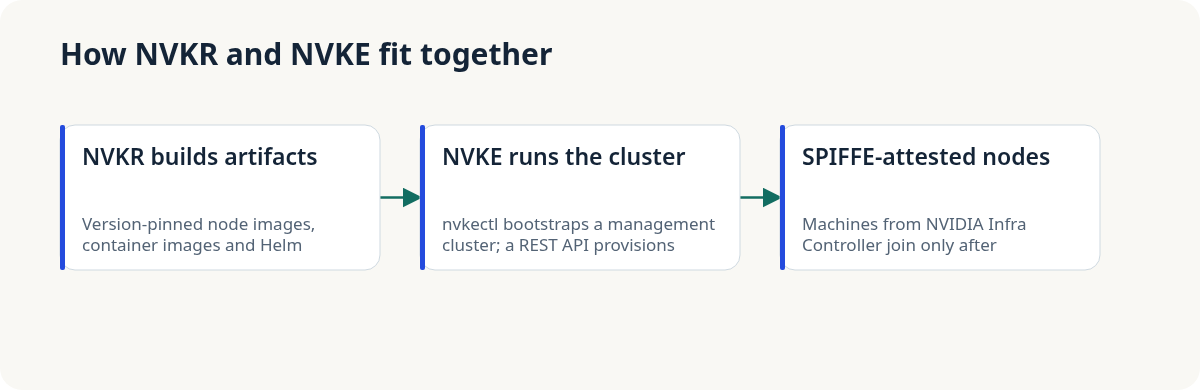
NVKR is the build layer. It takes version-pinned sources and produces node images, container images, binaries, and Helm charts, recording every build input along the way so the output is reproducible and auditable. NVKE is the operations layer: a management cluster, bootstrapped by a CLI called nvkectl through a temporary seed cluster, exposing a REST API and controllers that provision and manage separate workload clusters — each with its own control plane and its own etcd, not a shared multi-tenant control plane.
They’re designed to be adopted independently. NVKE has no runtime dependency on NVKR — you can feed it artifacts built some other way. NVKR, in turn, can produce artifacts for Kubernetes management systems that aren’t NVKE at all. That’s a genuinely composable design, and it’s the part of this release that reads like NVIDIA actually wants external adoption rather than just open-sourcing a demo.
The part that’s actually interesting: how nodes get trusted
The detail I’d pay attention to before the licensing or the Apache badge is how NVKE sources and trusts machines. Nodes come from NVIDIA’s own Infra Controller (NICo) through a Cluster API provider called CAPNICo, and a machine isn’t allowed to join a cluster until it presents an attested SPIFFE identity — a cryptographically verifiable proof of what the machine actually is, checked before any join credential gets issued. NVKE is also certified as both a Kubernetes AI Platform and a Kubernetes Installer, conformance-tested against Kubernetes 1.36, and ships OpenTelemetry-based telemetry collection out of the box.
That’s a legitimately good security default for bare-metal GPU fleets, where a rogue or misconfigured node joining a cluster with access to expensive, often multi-tenant accelerators is a real risk, not a theoretical one. It’s also the actual lock-in. The license is Apache 2.0, the code is public, but the node-provisioning path runs through NICo. If you don’t already run NVIDIA’s infrastructure controller, or aren’t planning to, NVKE’s attestation flow isn’t something you can just swap in — you’d be rebuilding the equivalent plumbing yourself, which defeats a chunk of the point of adopting it.
Who NVIDIA is actually selling this to
The named integration partners tell you who the target customer is: Firmus, SK Telecom, Mirantis, Rafay, Spectro Cloud, OpenNebula Systems, vCluster, and Netris. That’s a list of neoclouds and Kubernetes management vendors, not enterprise platform teams running a handful of training clusters. The stated use case backs this up directly — organizations that want to offer managed Kubernetes-on-GPU as a service to their own customers, while keeping control of the operations and software stack themselves, rather than handing that control to a hyperscaler’s managed Kubernetes product.
Read that way, this release is less “NVIDIA open-sources a Kubernetes distro” and more “NVIDIA packages the control plane it already built for its own GPU cloud partners, and lets anyone running NICo-based infrastructure use the same stack instead of building their own.” That’s a narrower and more honest framing than the GitHub-organization announcement suggests, and it’s the framing that should decide whether this is relevant to you: if you’re a neocloud or GPU-infrastructure operator already in NVIDIA’s orbit, this is worth evaluating now. If you’re running GPU workloads on EKS, GKE, or a vanilla on-prem cluster with no NICo in the picture, there isn’t much here for you yet beyond watching how NVKR’s artifact-building half performs standalone.
The preview-not-production warning is also doing real work in the announcement text, not boilerplate. APIs, configuration, and behavior are explicitly called out as subject to change between releases. If you’re the kind of team that runs ahead of a 1.0 to shape the roadmap, that’s an invitation. If you’re running production GPU capacity today, treat the next few release cycles as the actual evaluation window, not this one.
One more thing I’d check before any pilot: the conformance claims are specific enough to verify rather than take on faith. NVKE is listed as a Certified Kubernetes AI Platform and a Certified Kubernetes Installer, tested against Kubernetes 1.36 — both are CNCF conformance programs with public results you can look up independently of NVIDIA’s own blog post. If you’re evaluating NVKE against an existing Cluster API-based stack, that conformance badge plus the separate CAPNICo provider is the concrete thing to pilot against a real workload cluster, not the marketing copy around “AI factories.”
Source: NVIDIA Developer Blog, “Manage Kubernetes Clusters for GPU Infrastructure with NVIDIA Kubernetes Engine”, Nov 10, 2026.
Related reading

· 5 min read
ai-infrastructure
Railway's October Breach Shows What AI Inference Fraud Actually Looks Like
A misconfigured OIDC trust binding plus a build-isolation escape let an attacker decrypt 1,852 users' provider tokens and run roughly $740,000 in AI inference fraud in about 26 hours. Railway's own incident report has the timeline.
Read more
· 4 min read
ai-infrastructure
Project Suncatcher's First Orbital Inference Was a Haiku, and a Power Budget
Google ran its first AI inference from a TPU in orbit on October 30, sending back a haiku. The milestone that matters is the one-kilowatt power budget forcing a four-chip satellite down to one active chip at a time.
Read more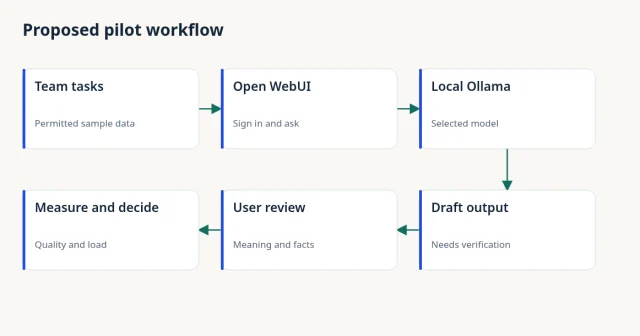
· 4 min read
AI Ideas
Open WebUI and Ollama: test an internal AI workspace before buying a GPU
A scoped internal AI pilot: choose tasks, map data flow, measure quality and latency, then decide whether server investment makes sense.
Read more
Discussion
Comments are reviewed before publication. Your email is kept private.