
JOURNAL
Project Suncatcher’s First Orbital Inference Was a Haiku, and a Power Budget
Google ran its first AI inference from a TPU in orbit on October 30, sending back a haiku. The milestone that matters is the one-kilowatt power budget forcing a four-chip satellite down to one active chip at a time.

On this page
Blue marble below, / Data streams in silent grace, / Starlight feeds my core. That’s the first complete sentence an AI model ever generated in orbit and sent back to Earth. Google CEO Sundar Pichai posted it on X on October 30, along with the fact that confirms what it actually was: a haiku, requested from a TPU sitting in a satellite, downlinked during a single pass over a ground station in Svalbard, Norway.
This is Project Suncatcher, Google’s bet on running AI compute off the planet. The prototype satellite, built with Planet, launched October 1 on a SpaceX Transporter-18 rideshare. It carries four Trillium-generation TPU chips — the same chip family Google uses in its terrestrial data centers for both training and inference. On October 30, Google sent a command up, booted one of those chips, ran a prompt, and got a response back. Pichai’s own words: “successfully sent a command up to orbit, booted up the TPU, ran the prompt, and received our first complete response back on earth.”
One chip, not four
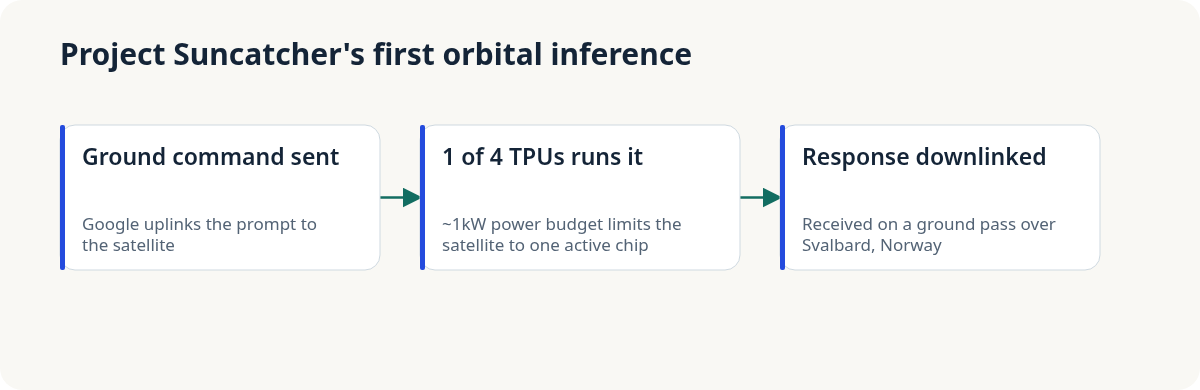
Here’s the detail that matters more than the poem. The satellite has four TPUs on board, but it can only run one at a time. The reason is power: roughly a one-kilowatt budget, which is nothing compared to what a single TPU pod draws on the ground. That ceiling also caps each inference window at about twenty minutes — the length of time the chip can stay active before the satellite’s power and thermal limits force it back down.
Twenty minutes to generate a three-line poem is not a data center. It’s a proof that the plumbing works: command uplink, chip boot, inference, response downlink, all across a few hundred kilometers of vacuum and a ground station that’s only in view for part of the orbit. That’s a real engineering milestone. It is not evidence that orbital AI compute is close to being useful at any meaningful scale, and Google hasn’t claimed otherwise — the “first complete response” framing is accurate, not inflated, but it’s easy to round it up to something bigger in your head.
The vision this is actually testing
Google’s long-term pitch for Suncatcher isn’t one satellite with four chips. It’s constellations of solar-powered satellites, each carrying TPUs, linked to each other by free-space optical communication instead of radio, so that compute can scale the way a terrestrial data center does — many chips working together — without the power and cooling constraints of a planet’s surface. Solar panels in orbit get roughly eight times the sunlight a ground panel gets, with no atmosphere, weather, or night cycle in the way. That’s the actual economic argument: not that space is a better place to put a chip, but that unlimited, uninterrupted solar power might eventually make it cheaper per unit of compute than anything you can build on the ground, if the rest of the problem gets solved.
The rest of the problem is the part this test didn’t touch. Radiation hardening for TPUs designed for air-conditioned server rooms, not cosmic ray flux, over a multi-year mission life. Downlink bandwidth for anything bigger than a haiku — training workloads move terabytes, and a single ground-station pass is a bad fit for that kind of data volume. Thermal management without convection, since there’s no air in orbit to carry heat away, only radiation. None of these are solved by one TPU answering one prompt during one twenty-minute window, and Google’s own materials frame this as an early test of feasibility, not a working product.
What I’d actually watch for next
If you’re tracking this because you think it’ll matter for where your own inference workloads run, the honest answer is: not soon, and that’s fine — that’s not what this test was for. The number worth remembering isn’t the haiku, it’s the one-kilowatt power budget forcing a four-chip satellite down to one active chip at a time. Scaling that to something that competes with a ground-based TPU pod means either much bigger solar arrays, much more efficient chips, or both, and neither shows up in what Google announced this week.
What’s worth watching instead is whether Google publishes a second-generation test with more than one chip running concurrently, or any numbers on downlink throughput for larger payloads. That’s the test that tells you whether this is a research program building toward something real on a ten-year horizon, or a one-off demo that answers “can we do it at all” and stops there until the economics catch up. Right now it’s squarely the former, and there’s nothing wrong with that — just don’t let a good haiku make it sound further along than it is.
Sources
OfficeChai: Google Successfully Runs Inference From A TPU In Space Under Project Suncatcher (October 30, 2026, citing Sundar Pichai’s X post).
Scientific American: Google tests its plan for AI data centers in space with Project Suncatcher (retrieved November 2, 2026).
Related reading

· 4 min read
ai-infrastructure
AWS Just Opened a Private Pipe Straight Into Azure. Here's Why an AI Team Should Care
AWS Interconnect – multicloud with Azure went into preview in August, capped at 1 Gbps and four regions. That's not enough bandwidth for training, but it's exactly enough to fix the multi-vendor inference problem we've been duct-taping for a year.
Read more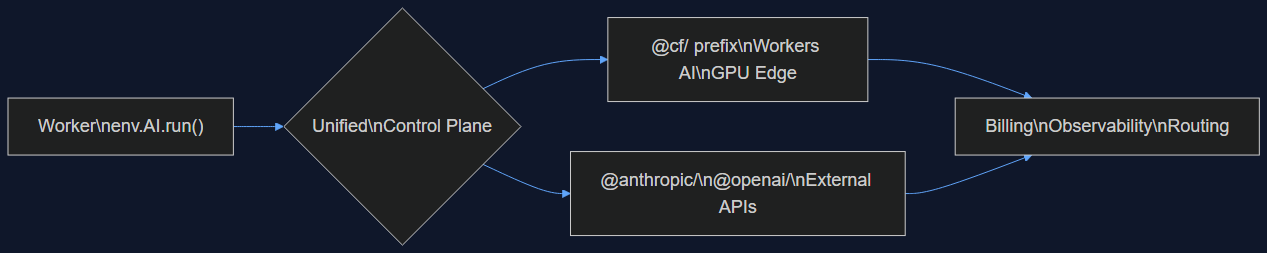
· 5 min read
ai-infrastructure
Cloudflare Unifies Workers AI and AI Gateway: One API for All Your Models
As of August 7, 2026, Cloudflare merged AI Gateway and Workers AI into a single control plane. One binding, one billing, unified observability across Cloudflare's managed GPUs and external providers. Here's what changed and what it means for AI infrastructure decisions.
Read more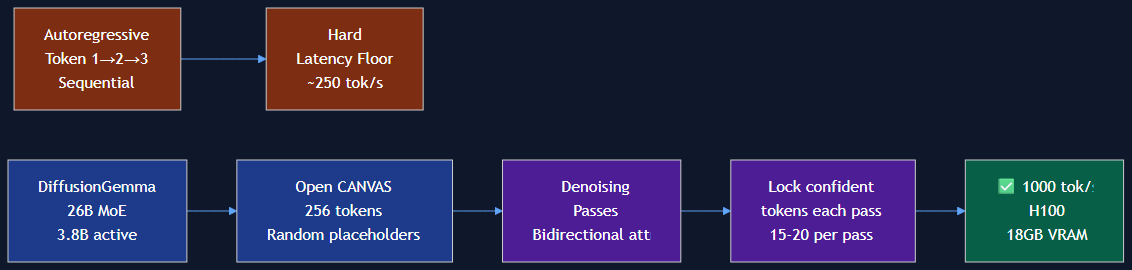
· 6 min read
ai
DiffusionGemma-26B: What 1,000 Tokens/Second Means for Developer Tooling
Google just open-sourced the first credible text diffusion model from a major lab — DiffusionGemma-26B generates 1,000+ tokens/sec by abandoning autoregressive token generation entirely. Here's how Uniform State Diffusion actually works, when this architecture matters, and what it means for building with open-weights models.
Read more
Discussion
Comments are reviewed before publication. Your email is kept private.