
JOURNAL
From cultural signals to useful video ideas with HyperFrames
Build a research habit that turns current cultural signals into specific, testable video briefs.
On this page
Start with a question somebody actually has
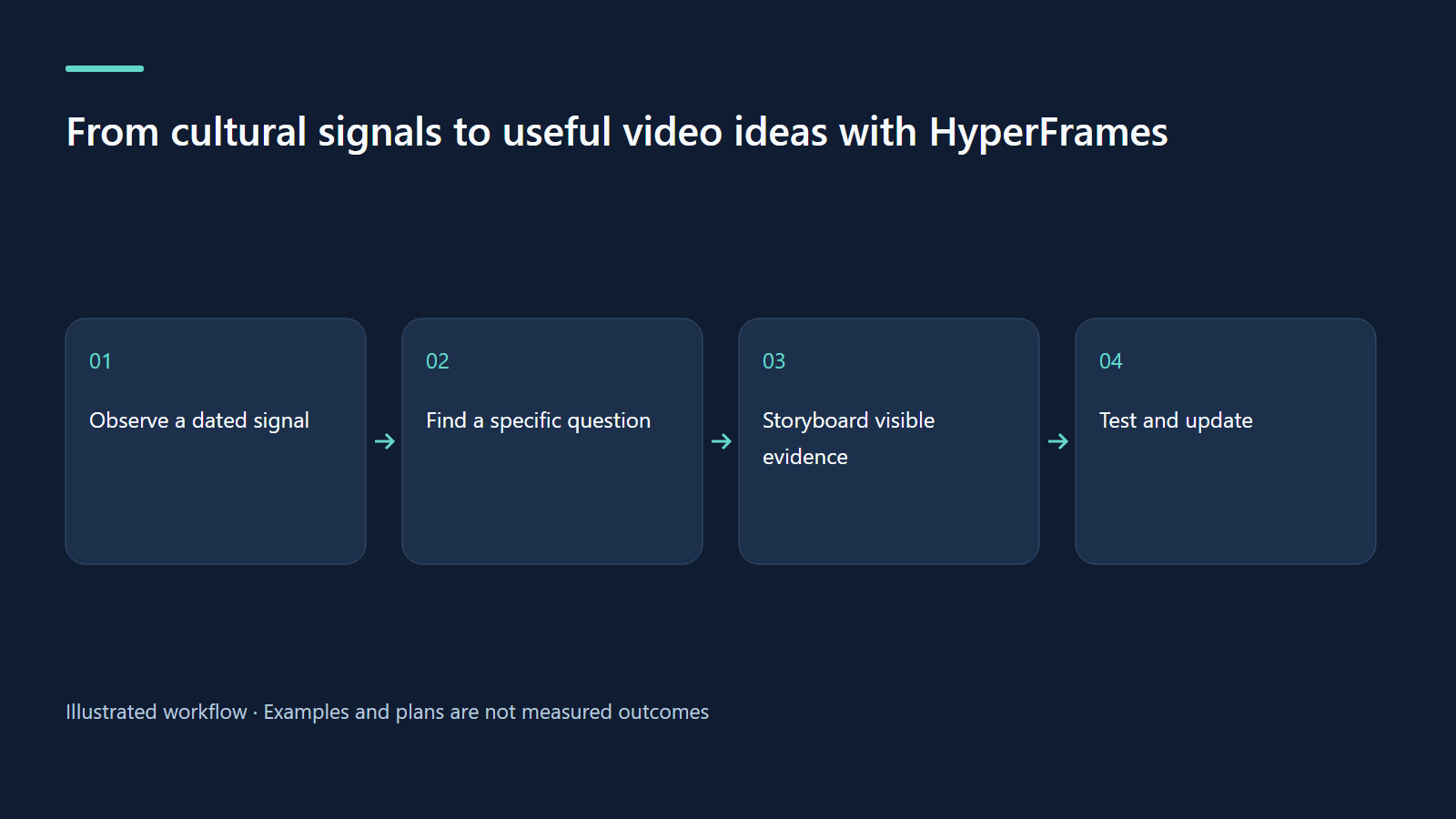
A trend is useful when it helps you recognize a human question. A creator who teaches office workers how to prepare morning coffee might notice conversations about home cafés, then investigate the practical frustration beneath them: how can I enjoy a satisfying drink without turning every morning into another project? That question is more productive than copying the first popular transition. It gives the video a viewer, a constraint, and a useful ending. HyperFrames becomes the production partner after those choices exist.
Write the question before you collect references. Add the situation in which it arises, what the viewer already knows, and the decision the video should make easier. This protects your research from becoming a folder of attractive but unrelated clips.
What the current reports actually tell us
TikTok’s 2026 report forecasts process-oriented storytelling and intentional buying; it includes home café culture as an example. Treat that as a directional hypothesis, not a live Vietnamese search ranking. TikTok Next 2026 is a platform’s own commercial research, with its own framing and interests.
YouTube’s September research separates cultural visibility, understanding, and participation. That distinction helps explain why a familiar meme can still need explanation in your audience. YouTube’s research article describes surveys of online respondents aged 14–44. Neither report establishes what your neighborhood, parents, students, or customers are searching for today. Use the reports to formulate questions; use your own audience evidence to choose the next film.
Keep a signal notebook with an expiry date
Create one entry per possible subject. Record the exact source URL, publication date, date observed, geographic scope, and your interpretation in separate fields. Put direct observations beside interpretations rather than mixing them. A public comment asking whether a recipe works without a milk frother is evidence of that person’s question. It is not evidence that every Vietnamese office worker wants the same thing. Record uncertainty explicitly, including whether a conversation came from your followers or an unrelated community.
Add an expiry rule: review the entry before producing a new version next month. Some ideas are seasonal; others are durable. A habit tutorial may remain useful after the hashtag fades.
An original scenario: the seven-minute morning
Imagine a small educational channel testing a home-coffee episode for people leaving an apartment before work. This is a proposed scenario, not a measured audience discovery. The episode asks whether preparing one component the night before makes the morning less rushed. Film the actual preparation, the next morning’s assembly, and the cleanup. Leave a visible label if you compress waiting time. Do not invent a stopwatch result or claim that a routine saves money until you have measured the ingredients and process yourself.
The useful twist is the constraint: no new equipment. That connects the cultural signal to intentional consumption without encouraging another purchase. A failed first attempt can be part of the lesson if the correction is visible and understandable. The final invitation asks viewers which step makes their mornings difficult, providing research for the next episode.
Route by the film you are making
Start the request with /hyperframes. For an invented explanatory diagram about habit design, the owning route is /faceless-explainer. For a film combining your real coffee footage, text, and voiceover, /general-video is the appropriate custom composition route. If the deliverable markets a café website or its products, use /product-launch-video instead. A reference to coffee does not decide the route; the requested output does. The official HyperFrames repository documents the router and these workflow distinctions.
Then describe needed domains: /media-use for permitted footage and audio, /hyperframes-creative for the visual voice, /hyperframes-animation for purposeful movement, and /hyperframes-cli for validation and export. A named graphic treatment calls for /hyperframes-registry before custom construction. You do not need to request every skill simply because it exists.
| Time | Scene | Evidence and editorial purpose |
|---|---|---|
| 0–5s | Morning constraint | Actual workspace; ask one concrete question |
| 5–14s | Evening preparation | Show the supplied process, label time compression |
| 14–27s | Morning assembly | No new tools; visible ingredient labels |
| 27–37s | Cleanup and limitation | Show remaining work; no invented savings |
| 37–45s | Audience question | Invite a specific next-episode problem |
A prompt you can adapt
Using /hyperframes, plan a 45-second Vietnamese-first vertical video about a rushed morning coffee routine without buying new equipment. Route the real-footage composition through /general-video. Use only my supplied clips; identify missing evidence instead of inventing it. Show preparation the previous evening, morning assembly and cleanup. Label compressed waiting time. Draft a storyboard and narration before building, keep captions readable, use /media-use for assets and /hyperframes-cli for verification. Do not claim measured time or money savings. End by asking which step viewers find difficult. Prepare an English version as a separate localization.
Build the storyboard around uncertainty
The proposed forty-five-second sequence gives the viewer a problem, a constrained trial, an observation, and a question. Avoid opening with a trend-report title: the audience wants to know why this matters to their morning. Keep the report as an editorial input, while visible evidence carries the film. A small diagram can show the night-before step moving out of the morning sequence, but it must not imply a quantified efficiency gain.
Use different jobs for picture and narration. Picture shows preparation and texture; narration explains the choice and limitation. Captions support comprehension with sound off. Keep ingredient amounts on screen long enough to read. If the video contains two languages, make separate versions rather than crowding both scripts into every frame.
When trend borrowing becomes a failure
A common failure is translating a global hashtag literally and assuming it carries the same cultural meaning locally. Repair it by testing the question with familiar language: ask three people to explain your opening sentence without your help. Another failure is dressing generic advice in a current meme. Remove the meme temporarily; if no useful lesson remains, rewrite the idea. A third failure is treating one positive comment as market validation. Preserve it as an anecdote and collect additional observations before broadening the claim.
Production can fail through visual overstatement too. Racing progress bars, fabricated counters, and dramatic before-and-after graphs make an unmeasured routine look scientifically established. Replace them with a plainly labeled checklist or sequence. Be particularly careful when topics touch health, household budgets, or children’s learning: a friendly tone does not turn unsupported advice into reliable evidence.
Review the editorial promise before export
Ask a reviewer who did not help write the script to state the promise, the evidence, and the limitation. If they remember only the animation, simplify the presentation. Check captions against narration, ingredient labels against the footage, and source attribution against the actual research paragraph. Verify that screenshots and comments are yours to use; anonymize private conversations instead of turning them into decoration. Inspect the opening, the busiest frame, and the ending on a phone.
For an example of a real, bounded UI demonstration, visit the Be Vui Học Studio walkthrough. Its fixture demonstrations illustrate a different kind of evidence. A demonstrable interaction can be shown directly, whereas a cultural hypothesis needs observation and testing.
A modest experiment that produces learning
Make two openings with the same body: one starts with the rushed-morning problem, the other with the no-new-equipment constraint. Decide the review window and outcome before posting. Compare early viewer retention where the platform exposes it, meaningful questions, and saves when available. Keep reach, watch behavior, and usefulness separate. A version shown to far more people is not automatically a fair comparison, and a small sample cannot establish a general law about hooks.
Keep a qualitative log of misunderstandings. If viewers think the recipe requires an expensive tool, that is an editorial problem even if the clip gets views. If they request a different ingredient, that can justify a new tutorial. Never publish invented percentages to make the experiment appear decisive; an inconclusive comparison is still useful when it narrows the next question.
Practice turning one signal into three briefs
Choose one current report signal and write three different viewer problems: a beginner explanation, a practical demonstration, and a community question. For each, name one piece of evidence you can obtain, one uncertainty, and the appropriate HyperFrames route. Reject the brief whose main promise cannot be demonstrated. Then produce only a storyboard for the strongest candidate and ask somebody in the intended audience what they expect to learn.
Finally, rewrite that candidate without any hashtag. If the idea still has value, you have found a durable subject beneath the trend. Keep the rejected briefs and the reason for rejecting them.
Sources and research boundary
Primary sources checked on 9 October 2026, Asia/Saigon. Scenarios, timings, experiments and prompts are original editorial proposals, not published campaign results.
Continue learning
Related reading
· 7 min read
HyperFrames
A small business product video that helps people decide
Use a home-coffee-kit scenario to build an honest product video around fit, evidence and purchase questions.
Read more
· 7 min read
HyperFrames
HyperFrames for bilingual learning: small lessons children can actually use
Plan a calm EN/VI lesson with practice pauses, independent language QA, and family privacy.
Read more
· 7 min read
HyperFrames
HyperFrames for food, travel, and everyday stories: a four-shot diary
Build a personal café-corner or travel diary with owned assets and reviewed bilingual storytelling.
Read more
Discussion
Comments are reviewed before publication. Your email is kept private.