Thuan: I know I should practice English every day. I start a routine, keep it for a week, then life happens — sprint deadlines, production issues, family — and the routine dies.
Alex: That’s because most English study routines are designed for students, not working professionals. You don’t need an hour of textbook study. You need 15 minutes of targeted practice that fits into your existing workday.
Thuan: 15 minutes? That actually works?
Alex: 15 minutes daily beats 3 hours on the weekend. Consistency is more powerful than intensity. Let’s build your system.
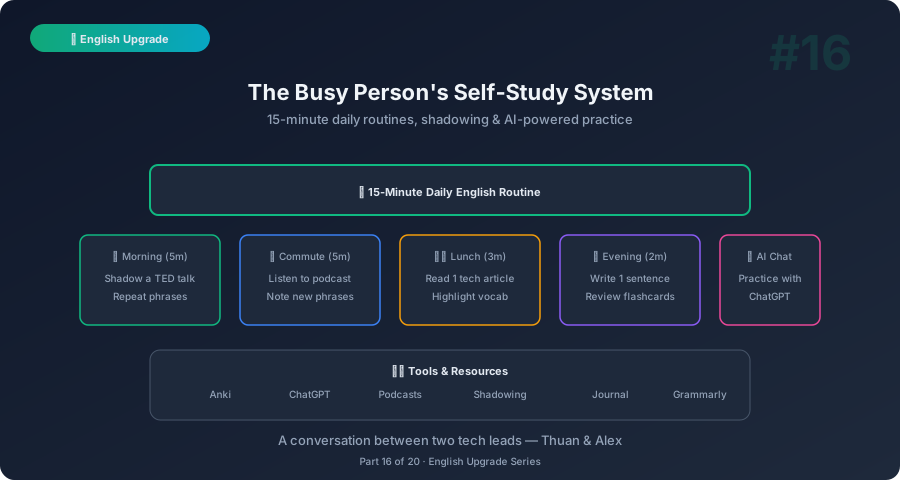
The 15-Minute Daily System
Alex: Here’s the complete system. Pick one slot per day — or do all three if you’re on a roll:
| Time Block | Activity | Duration | When |
|---|---|---|---|
| ☕ Morning | Shadowing practice | 5 min | Before standup |
| 🖥️ Working hours | Work-integrated practice | 5 min | During work |
| 🌙 Evening | Reflection + vocabulary | 5 min | After work |
☕ Morning: Shadowing (5 Minutes)
Thuan: What’s shadowing?
Alex: Shadowing is repeating what a native speaker says, at the same time or right after them. It’s the fastest way to improve pronunciation, rhythm, and natural phrasing.
How to Shadow
- Pick a short video (2-3 minutes) — tech talks, conference talks, engineering podcasts
- Listen to one sentence
- Pause and repeat it, mimicking the rhythm and stress
- Move to the next sentence
- Do this for 5 minutes
Best Sources for Shadowing
| Source | Why |
|---|---|
| Tech conference talks (YouTube) | Professional English in your domain |
| Engineering podcasts (Syntax, Software Engineering Daily) | Conversational tech English |
| Meeting recordings (your own!) | Practice YOUR specific communication context |
| TED Talks | Clear, well-paced English |
Tip: Use YouTube’s speed control — start at 0.75x if speakers are too fast.
🖥️ Working Hours: Work-Integrated Practice (5 Minutes)
This is the most valuable practice because it uses real work as study material:
| Work Activity | Practice |
|---|---|
| Writing a Slack message | Before sending, read it aloud. Does it sound natural? |
| Sending an email | Use one new phrase from this series. Replace one boring word with a better one. |
| In a meeting | Write down one phrase you heard that was new or useful. |
| After a meeting | Summarize the meeting in 3 sentences — in English, aloud, to yourself. |
| Reading a PR | Note any comment that used an interesting phrase. Save it. |
| Before standup | Write your update first, then say it aloud once before the meeting. |
Thuan: So I’m not adding new study time — I’m transforming work I already do into practice?
Alex: Exactly. Every email is practice. Every meeting is a listening exercise. Every PR comment is a writing exercise. You’re already studying — you just need to be intentional about it.
🌙 Evening: Reflection + Vocabulary (5 Minutes)
| Activity | How |
|---|---|
| Collect | Write 2-3 new words or phrases you encountered today |
| Understand | Look up the meaning if needed. Write a sentence using each one. |
| Review | Re-read yesterday’s words. Can you use them naturally? |
Vocabulary Tools
| Tool | Best For |
|---|---|
| Anki | Spaced repetition flashcards (free) |
| Notion/Obsidian | Personal phrase bank |
| Google Keep | Quick capture throughout the day |
| Phone notes app | Quick voice-to-text entries |
Thuan: Just 2-3 words a day? That seems too easy.
Alex: 2-3 words × 365 days = 730-1,095 new words per year. Most professionals actively use about 3,000 words. In 3 years, you’ll have doubled your active business vocabulary. Small numbers, compounding effect.
AI-Powered Practice
Alex: AI tools have changed self-study dramatically. Here are the most effective uses:
ChatGPT / Claude as English Tutor
| Use | Prompt |
|---|---|
| Email rewrite | ”I want to send this email to my PM. Can you make it more professional and clear? [your draft]“ |
| Meeting prep | ”I have a sprint review in 1 hour. Help me practice: I need to explain that we missed 2 stories because of a dependency delay.” |
| Phrase alternatives | ”What are 5 ways to politely say ‘I disagree with this approach’ in a meeting?” |
| Grammar check | ”Is this sentence natural in business English? [sentence]“ |
| Roleplay | ”Act as a client. I’ll practice demoing a new feature to you. Ask tough questions.” |
Voice Practice with AI
| Tool | How to Use |
|---|---|
| ChatGPT voice mode | Have a conversation in English — practice speaking, not typing |
| Google Translate (voice) | Speak a sentence and check if it transcribes correctly |
| Otter.ai | Record yourself during meetings, review the transcript |
| Loom | Record screen + voice, watch yourself present |
Thuan: Using AI for roleplay is genius. I can practice difficult conversations without embarrassment.
Alex: You can simulate salary negotiations, client presentations, or difficult retro conversations — all without another human. It’s like a flight simulator for English.
The “No Excuse” Micro-Practices
For the days when even 15 minutes feels impossible:
| Time | Activity |
|---|---|
| 2 minutes | Read one English tech article headline and say it aloud |
| 3 minutes | Write tomorrow’s standup update in English |
| 5 minutes | Shadow one paragraph of a tech talk |
| During commute | Listen to an English podcast (passive input counts) |
| While cooking | Narrate what you’re doing in English (seriously, it works) |
| Before sleep | Review today’s 2-3 new words |
Building a Phrase Bank
Alex: Your most powerful tool isn’t an app — it’s a personal phrase bank. A collection of phrases you use in your job.
How to Build It
- Create a document (Notion, Google Doc, Notes app)
- Create categories: Emails, Meetings, Code Review, Standups, Pushback
- Every time you use a good phrase (or hear one), add it
- Review weekly — pick 2-3 phrases to actively use next week
Example Phrase Bank
## Emails
- "Following up on our discussion about..."
- "Please let me know if you need anything else."
- "I'd like to flag a potential risk with..."

## Meetings
- "Before we move on, I'd like to add..."
- "That's a fair point. And to build on that..."
- "Let's take this offline and revisit after the meeting."

## Pushback
- "I understand the urgency. Here's what we can realistically deliver..."
- "Yes, if we [trade-off]. Which do you prefer?"
- "I want to be transparent about the risks."

## Code Review
- "nit: consider renaming for clarity"
- "Great approach. One thought..."
- "blocking: this needs error handling"
Thuan: This is basically the “English Upgrade” series, but personalized to my job!
Alex: Exactly. These 16 posts gave you the starter kit. Your phrase bank is the living document that grows with your career.
The 30-Day Challenge
Alex: Want to test this system? Here’s a 30-day challenge:
| Week | Focus | Daily Practice |
|---|---|---|
| Week 1 | Emails & Slack | Before every email, ask: “Could this be clearer?” Rewrite one message per day. |
| Week 2 | Meetings | Say one thing in every meeting using a new phrase from your phrase bank. |
| Week 3 | Writing | Write one PR description or document using the templates from this series. |
| Week 4 | Speaking | Record yourself presenting for 2 minutes each day. Watch it back. |
Success Metrics (Self-Assessment)
After 30 days, ask yourself:
- Do I feel more confident writing emails?
- Can I give a standup update without rehearsing?
- Have I pushed back on a requirement or deadline in English?
- Is my phrase bank growing?
- Have I received positive feedback on my communication?
What’s Next
This is the self-study foundation. The next four posts explore advanced topics: 1-on-1 Meetings, Cross-Cultural Communication, Hiring and Interviewing Candidates, and Remote/Async Communication.
This is Part 16 of the English Upgrade series — the final piece of the original core curriculum. Pairs perfectly with English for Tech Leads Part 1: The Roadmap for a complete learning system.
Related: All 16 parts are designed to work together. Start with Part 1: Emails and work through one per week.