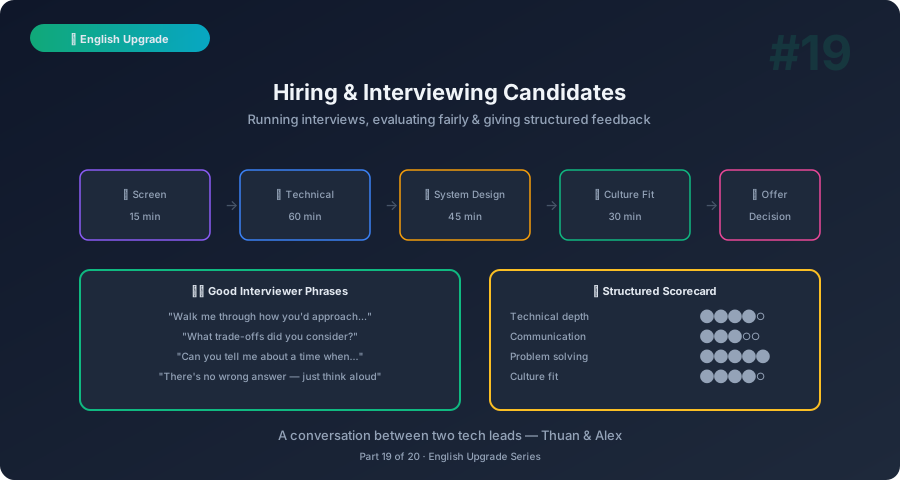
Thuan: My company asked me to start interviewing candidates. I’ve never been on this side of the table. I don’t know what to ask, how to evaluate, or how to write feedback. And all of this needs to be in English.
Alex: Interviewing is one of the highest-impact things you do as a tech lead. One good hire can transform a team. One bad hire can sink a sprint. And everything you say and write becomes part of a formal hiring record. Let’s build your toolkit.
Before the Interview: Preparation
Define What You’re Looking For
Before you start, clarify the role:
| Question | Why It Matters |
|---|---|
| ”What level is this role?” | Sets the bar for technical depth |
| ”What’s the primary tech stack?” | Guides your technical questions |
| ”What team will they join?” | Helps assess culture fit |
| ”What’s the biggest gap on the team?” | Tells you what to prioritize |
Reading the Resume (5-Minute Scan)
| Look for | Note |
|---|---|
| Relevant experience | How much matches your stack/domain? |
| Progression | Are they growing? (junior → mid → senior) |
| Projects | Anything interesting to ask about? |
| Gaps or switches | Career changes or gaps — prepare a question |
| Education vs. experience | Both are valid — don’t over-weight degrees |
During the Interview: Structure
The Interview Framework
| Phase | Duration | Purpose |
|---|---|---|
| Intro | 5 min | Welcome, set expectations |
| Background | 10 min | Walk through their experience |
| Technical | 25 min | Problem-solving, coding, design |
| Behavioral | 10 min | Soft skills, teamwork, conflict |
| Their questions | 10 min | They interview you |
| Wrap-up | 5 min | Next steps |
Opening the Interview
“Hi [Name], thanks for taking the time today. I’m Thuan, a tech lead on the [team] team. Today’s interview will be about [X minutes], and we’ll cover your background, some technical questions, and leave time for your questions. Sound good?”
Thuan: Should I make small talk first?
Alex: Brief small talk is good — it helps the candidate relax:
- “How’s your day going so far?”
- “Where are you based? How’s the weather there?”
- “Have you had a chance to look at our product?”
Background Questions
| Question | What You’re Assessing |
|---|---|
| ”Walk me through your most recent role.” | Communication clarity, experience relevance |
| ”Tell me about a project you’re most proud of.” | Technical depth, ownership |
| ”What was your role in the team?” | Individual contribution vs. leadership |
| ”What was the hardest technical challenge?” | Problem-solving, technical depth |
| ”Why are you looking for a change?” | Motivation, red flags |
Technical Questions
| Type | Example Questions |
|---|---|
| Problem-solving | ”How would you design a URL shortener?” |
| Code review | ”Here’s a code snippet. What would you change and why?” |
| Architecture | ”How would you break this monolith into services?” |
| Debugging | ”Users report the app is slow. Walk me through your debugging process.” |
| Domain-specific | ”Explain how [technology they listed] works under the hood.” |
Helpful Interview Phrases
| Moment | Phrase |
|---|---|
| Guiding | ”There’s no single right answer. I’m interested in your thought process.” |
| Encouraging | ”Good direction. What would you consider next?” |
| Hinting | ”What if the data volume was 100x larger?” |
| Redirecting | ”Good point. Let me steer us to a different area.” |
| Time management | ”We have about 10 minutes left. Let’s move to behavioral questions.” |
| Candidate is stuck | ”That’s okay. Let me rephrase: [simpler version].” |
Behavioral Questions (STAR Assessment)
| Question | What You’re Assessing |
|---|---|
| ”Tell me about a time you disagreed with a teammate.” | Conflict resolution, professionalism |
| ”Describe a situation where you missed a deadline.” | Accountability, learning |
| ”Tell me about a time you had to learn something quickly.” | Adaptability, learning speed |
| ”How do you handle code review feedback you disagree with?” | Ego management, collaboration |
| ”Tell me about a time you mentored someone.” | Leadership potential |
Evaluating Candidates
The Scorecard
After each interview, score the candidate on predefined criteria:
| Criteria | 1 (No Hire) | 2 (Weak) | 3 (Meets Bar) | 4 (Strong) | 5 (Exceptional) |
|---|---|---|---|---|---|
| Technical depth | |||||
| Problem-solving | |||||
| Communication | |||||
| Collaboration | |||||
| Culture add |
Writing Interview Feedback
Your feedback should be specific and evidence-based:
Weak Feedback (Avoid)
“Seemed smart. Good culture fit. I liked them.”
Strong Feedback (Use)
| Section | Example |
|---|---|
| Summary | ”Strong hire for mid-level backend role. Solid problem-solving, good communication.” |
| Technical | ”Designed a clean system for the URL shortener. Correctly identified caching as a bottleneck. Missed the database sharding question but acknowledged the gap.” |
| Behavioral | ”Gave a specific example of handling conflict with a PM — showed maturity. STAR answer was well-structured.” |
| Concerns | ”Limited experience with distributed systems. Would need mentoring in this area.” |
| Recommendation | ”Hire — with a 3-month ramp-up plan for distributed systems.” |
Feedback Phrases
| Assessment | Phrase |
|---|---|
| Strong hire | ”I recommend hiring. [Name] demonstrated [specific skills] that align well with our needs.” |
| Hire with reservations | ”I lean towards hire, with a note that [Name] needs development in [area].” |
| No hire | ”I don’t recommend moving forward. [Name]‘s [specific area] didn’t meet our bar. Specifically: [evidence].” |
| Need more info | ”I’d like another conversation focused on [area] before making a decision.” |
Questions Candidates Ask You
Thuan: What if they ask me hard questions about the company?
Alex: Be honest. Candidates detect BS immediately.
| Common Questions | How to Answer |
|---|---|
| ”What’s the team culture like?" | "We’re a team of [X]. We value [Y]. Day-to-day, we [specific example]." |
| "What’s the biggest challenge?” | Be honest: “We’re dealing with [real challenge]. Joining now means you’d help solve it." |
| "Why did the previous person leave?" | "They moved to [reason]” or “This is a new role.” Never badmouth. |
| ”What’s the tech stack?” | Give the real answer. Include the messy parts: “Mostly [X], with some legacy [Y] we’re migrating." |
| "What does growth look like?" | "We have clear levels. In this role, growth means [examples]." |
| "What don’t you like about working here?” | Be genuine but constructive: “We’re still improving [X]. It’s a work in progress.” |
Legal Safety in Interviews
Alex: Important: there are questions you should never ask in an interview:
| Never Ask About | Why | What to Ask Instead |
|---|---|---|
| Age | Discrimination | ”How many years of experience do you have with [X]?” |
| Marital status | Discrimination | Nothing — it’s irrelevant |
| Religion | Discrimination | Nothing — it’s irrelevant |
| Nationality | Discrimination | ”Are you authorized to work in [country]?” |
| Health / disability | Discrimination | ”Are you able to perform the key functions of this role?” |
| Salary history | Illegal in many places | ”What are your salary expectations?“ |
10-Minute Self-Practice
The Interview Prep (5 min)
- Write an opening script for a technical interview
- Prepare 3 technical questions for your specific stack
- Prepare 2 behavioral questions
- Practice your opening aloud
The Feedback Writing Practice (5 min)
- Think of a recent colleague you worked with
- Write feedback as if they were a candidate: Summary, Technical, Behavioral, Concerns, Recommendation
- Make it evidence-based — no vague judgments
What’s Next
You can now interview with confidence. Final post: Remote Work and Async Communication — the English skills that matter most when your team is distributed across time zones.
This is Part 19 of the English Upgrade series. Related: Tech Coffee Break #10: Interview Prep — the other side of the interview table.
Also see: English Upgrade #13: Onboarding — after you hire them, onboard them well.