Thuan: Alex, I sent an important email to the client three days ago. No reply. I followed up yesterday — still nothing. Am I being ghosted?
Alex: Show me the email.
Thuan: reads “Dear Sir/Madam, I hope this email finds you well. Regarding the above-mentioned matter, I would like to kindly request your confirmation on the deployment schedule at your earliest convenience. Looking forward to your favorable reply. Best regards.”
Alex: Found your problem. That email says absolutely nothing urgent, nothing specific, and reads like it was written in 1997. Let me help you fix this.
The Anatomy of an Email That Gets Replies
Thuan: So what’s wrong with my email? It’s polite!
Alex: It’s too polite. It’s so polite that the recipient has no idea what you need or when you need it. Professional English email writing has three rules:
- Be specific — What exactly do you need?
- Be brief — Respect their time
- Include a deadline — “When you get a chance” means never
Here’s the framework:
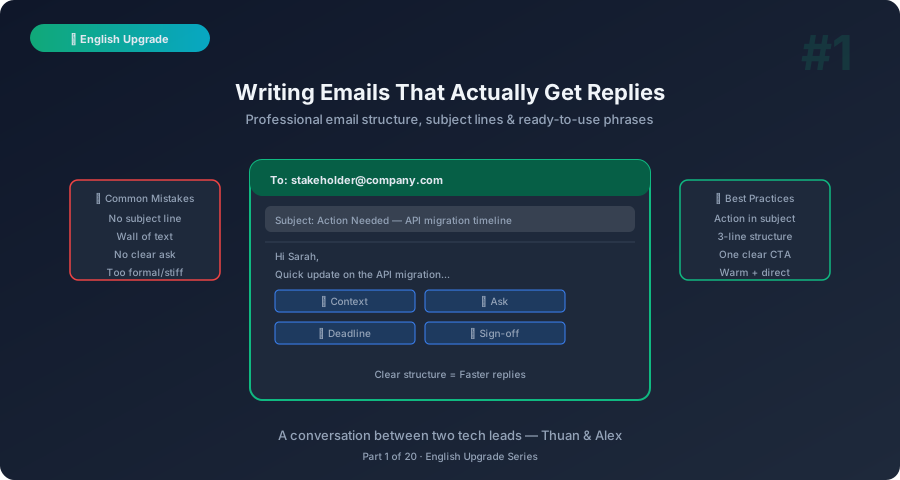
📧 Subject Line → specific + action needed Line 1 → Context (one sentence) Line 2-3 → The request (clear, specific) Line 4 → Deadline or next step Sign-off → Short
Thuan: That’s it? Four lines?
Alex: The best emails are the ones people can reply to in 30 seconds. If they need to think about what you’re asking, they’ll put it off — forever.
Subject Lines That Get Opened
Thuan: I usually write “Re: Project Update” or “Quick Question.”
Alex: “Quick Question” is the email equivalent of “Can I ask you something?” — it tells you nothing and creates anxiety. Here are subject line patterns that work:
❌ Bad Subject Lines
- “Hello”
- “Quick Question”
- “Update”
- “FYI”
- “Important”
✅ Good Subject Lines
| Pattern | Example |
|---|---|
| [Action] + Topic + Deadline | ”Need approval: staging deployment by Thursday” |
| [Decision needed] + Topic | ”Decision needed: Redis vs Memcached for caching layer” |
| [FYI — no action] + Topic | ”FYI: API v2 migration completed” |
| [Blocked] + What’s blocking | ”Blocked: waiting on AWS credentials for staging” |
| Question + Specific topic | ”Question: should we support IE11 for the admin panel?” |
Thuan: So the subject line already tells them what to do before they even open it?
Alex: Exactly. Busy people scan subject lines. If they can see “need approval by Thursday,” they know the priority immediately. If they see “Update,” they’ll read it next week — maybe.
The 4-Line Email Template
Thuan: Show me a real example.
Alex: Let’s rewrite your email from earlier.
Before (Your Version)
Subject: Regarding Deployment Schedule

Dear Sir/Madam,

I hope this email finds you well. Regarding the above-mentioned
matter, I would like to kindly request your confirmation on the
deployment schedule at your earliest convenience.

Looking forward to your favorable reply.

Best regards,
Thuan
After (Upgraded Version)
Subject: Need confirmation: production deployment date — by Wed

Hi Sarah,

We're ready to deploy the payment module to production.
Could you confirm the target date? Our team is available
March 15 or March 18.

If I don't hear back by Wednesday, I'll pencil in March 18.

Thanks,
Thuan
Thuan: That’s so much shorter! But isn’t “If I don’t hear back” a bit pushy?
Alex: It’s not pushy — it’s helpful. You’re giving them a default option. If they’re too busy to reply, things still move forward. That phrase is called a “soft deadline with a default.” It’s one of the most effective email techniques in business English.
Essential Email Phrases (Copy-Paste Ready)
Thuan: Give me more phrases I can steal.
Alex: Here’s your cheat sheet:
Opening (Skip “I Hope This Email Finds You Well”)
| Instead of… | Use… |
|---|---|
| ”I hope this email finds you well” | Just start with the point |
| ”Dear Sir/Madam" | "Hi [Name]” or “Hello [Name]" |
| "I am writing to inform you that…" | "Quick update:” or “Heads up:" |
| "As per our previous discussion" | "Following up on our chat yesterday” |
Requesting Action
| Situation | Phrase |
|---|---|
| Need approval | ”Could you approve this by [date]?” |
| Need information | ”Could you share [specific thing] by [date]?” |
| Need a decision | ”We need a decision on X. Options are A or B. Which do you prefer?” |
| Need feedback | ”Could you take a look at [link] and share your thoughts by [date]?” |
| Gentle nudge | ”Just checking if you had a chance to look at this” |
Following Up
| Timing | Phrase |
|---|---|
| First follow-up (2-3 days) | “Hi Sarah, just following up on the below. Let me know if you need anything from our side.” |
| Second follow-up (5-7 days) | “Hi Sarah, circling back on this. Is there anything blocking the decision? Happy to jump on a quick call.” |
| Final follow-up | ”Hi Sarah, I’ll go ahead with [default option] unless I hear otherwise by [date].” |
Giving Bad News
| Situation | Phrase |
|---|---|
| Delay | ”We’ve hit a blocker with [X]. Revised timeline is [date]. Here’s what we’re doing to get back on track.” |
| Can’t do it | ”After looking into this, [X] isn’t feasible because [reason]. An alternative would be [Y].” |
| Missed deadline | ”We missed the initial target for [X]. Root cause was [Y]. We’ve [fixed it / adjusted]. New ETA: [date].” |
Thuan: I’m saving this entire table.
Alex: Good. The key insight: professional English isn’t about big vocabulary. It’s about clear structure and specific language.
Common Mistakes Vietnamese Speakers Make
Thuan: What mistakes do you see from people like me?
Alex: Here are the top five:
1. Over-Politeness That Obscures the Message
❌ “I would like to kindly request if it would be possible for you to perhaps consider…” ✅ “Could you confirm by Friday?“
2. Missing the “Why Should I Care” Context
❌ “Please review the attached document.” ✅ “Attached is the API spec for the payment module. Your feedback on the error handling section (pages 3-4) would be especially helpful.”
3. No Clear Next Step
❌ “Let me know what you think.” ✅ “Let me know by Thursday if you’d like to go with Option A or B. If I don’t hear back, I’ll proceed with A.”
4. Using “ASAP” Without a Real Date
❌ “Please do this ASAP.” ✅ “Could you complete this by end of day Wednesday?“
5. Reply All When You Shouldn’t
Alex: This is more cultural than linguistic, but: only Reply All if everyone on the thread needs to see your response. In Western business culture, unnecessary Reply Alls are considered a minor sin.
10-Minute Self-Practice Exercise
Thuan: How do I practice this alone?
Alex: Here’s a daily exercise you can do during your commute or coffee break:
The Email Rewrite Game (10 minutes)
- Open your Sent folder
- Pick one email you sent this week
- Rewrite it using today’s framework:
- Subject: [Action] + Topic + Deadline
- Line 1: Context
- Line 2-3: Specific request
- Line 4: Deadline/default
- Compare the two versions
- Use the new version as a template for future emails
Thuan: I can do this on the bus. No teacher needed.
Alex: That’s the point. You’re already writing emails every day. You’re not learning English — you’re upgrading the English you already use.
Quick Quiz — Which Subject Line Wins?
Test yourself. For each pair, pick the better subject line:
Pair 1:
- A: “Question”
- B: “Question: should we throttle the webhook endpoint?”
Pair 2:
- A: “Need your approval: staging deploy by Thursday 5pm”
- B: “Important — please read”
Pair 3:
- A: “Meeting follow-up”
- B: “Action items from Monday’s API review”
The answers are always B. Specific beats vague, every time.
What’s Next
Now you know how to write emails that get replies. In the next post, we’ll tackle the Daily Standup — how to give a clear update in 90 seconds without sounding like you’re reading a script.
This is Part 1 of the English Upgrade series — practical Business English for busy tech leads who learn by doing. If you’re also working on your English foundation, check out the English for Tech Leads series for pronunciation, learning tools, and daily routines.
Related: Tech Coffee Break #12: From Senior Dev to Tech Lead — the career shift that makes communication skills essential.