Thuan: I dread the daily standup. It’s only 15 minutes, but those 90 seconds when it’s my turn? My brain goes blank every single time.
Alex: What usually happens?
Thuan: I start okay — “Yesterday I worked on the search feature.” But then I ramble. I add too many details. I say “um” a lot. Then I realize I’ve been talking for three minutes while everyone stares. Or worse — I freeze and say “Nothing else from me” even when I have blockers.
Alex: Classic. The standup is actually one of the hardest communication formats because it combines three things non-native speakers struggle with: speed, brevity, and spontaneity. Let’s fix that.
The 3-Line Standup Template
Thuan: Give me a template I can use every day.
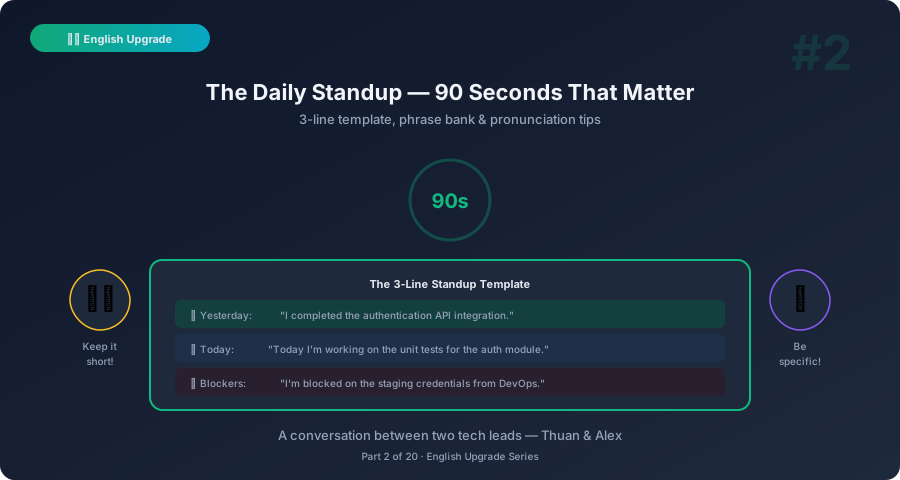
Alex: Here’s the format that works globally:
Line 1: What I completed (past tense) Line 2: What I’m working on today (present/future) Line 3: Blockers or help needed (if any)
That’s it. No stories, no explanations, no apologies. Save the details for the parking lot.
Example: Bad vs Good
❌ Rambling Version
“So yesterday I was looking at the search feature, and I found some issues with the Elasticsearch query, because the analyzer was set to the wrong language, and then I also noticed that the pagination wasn’t working right because there was an off-by-one error, and I also reviewed Minh’s PR but I had some questions about the approach so I left some comments, and today I think I’ll continue with the search thing, and also I need to update the documentation…”
✅ Clean Version
“Yesterday I fixed the Elasticsearch analyzer issue — search accuracy should be better now. Today I’m tackling the pagination bug. No blockers.”
Thuan: That’s an 80% reduction in words.
Alex: And a 200% increase in clarity. The audience doesn’t need the journey — they need the destination.
Phrases for Every Standup Situation
Thuan: But what about the days when nothing is simple? What do I say when I’m stuck, or when something went wrong?
Alex: Here’s your phrase bank:
Reporting Progress
| Situation | Phrase |
|---|---|
| Finished something | ”Yesterday I completed [X]. It’s deployed/merged/ready for review.” |
| Made progress | ”I made good progress on [X]. About 70% done.” |
| Still working | ”I’m continuing with [X] from yesterday.” |
| Started new task | ”I picked up [X] — starting with [specific part].” |
Reporting Blockers
| Situation | Phrase |
|---|---|
| Waiting on someone | ”I’m blocked on [X] — waiting for [name]‘s input. I pinged them yesterday.” |
| Technical issue | ”I hit an issue with [X]. I’m investigating, but may need help from [name].” |
| Missing info | ”I need clarification on [X] before I can proceed. [Name], could we sync after standup?” |
| External dependency | ”Blocked by the third-party API — their team hasn’t responded. I’ve escalated.” |
When There’s Bad News
| Situation | Phrase |
|---|---|
| Underestimated effort | ”The [X] task is larger than estimated. I’d say it’s a 3-day effort, not 1. I’ll update the sprint board.” |
| Found a bug | ”I found a regression in [X] during testing. I’m fixing it now — should be done today.” |
| Going to miss a deadline | ”I won’t make the deadline for [X]. Revised ETA is [day]. Let me know if we need to reprioritize.” |
Thuan: “I won’t make the deadline” — is that okay to say directly?
Alex: Yes! Hiding bad news is worse than sharing it. In Agile, transparency wins. What matters is: you name the problem, give a new estimate, and suggest what to do about it on the same sentence.
The Scrum Master Turn: Running the Standup
Thuan: As a tech lead, I sometimes run the standup. How do I do that in English?
Alex: Here are the key phrases:
Opening
- “Alright, let’s get started. Who wants to go first?”
- “Morning everyone. Let’s do a quick round. [Name], you’re up.”
Keeping It Focused
- “Good stuff. Let’s take that offline — can you and [name] sync after?”
- “Sounds like a discussion. Let’s parking-lot that and move on.”
- “We’re running long — let’s keep it brief for the remaining folks.”
Handling Blockers
- “I’ll follow up on that after standup.”
- “[Name], can you unblock [other name] today? That’s priority.”
- “Let’s schedule 15 minutes after standup to dig into that.”
Closing
- “Anything else? No? Great — go build things.”
- “Thanks everyone. Parking lot items: [X] — I’ll set up a meeting.”
- “Any final blockers? Alright, have a good day.”
Thuan: “Go build things” — I like that. Better than “Let me know if you have any concerns regarding the matters discussed.”
Alex: laughs Please never say that in a standup.
The “I Have Nothing” Problem
Thuan: What about days when I genuinely don’t have much to report? Like when I spent the day in meetings?
Alex: Meetings are work. Knowledge transfer is work. Planning is work. Here’s how:
| What You Did | How to Report It |
|---|---|
| Meetings all day | ”Yesterday was mostly meetings — sprint planning and client sync. Today I’ll have heads-down time for [X].” |
| Code reviews | ”Yesterday I reviewed three PRs and helped [name] debug the auth flow. Today I’m picking up [task].” |
| Research | ”I spent yesterday researching options for [X]. Today I’ll share my recommendation with the team.” |
| On-call / support | ”I handled two production alerts yesterday. Both resolved. Back to feature work today.” |
Thuan: Oh! I always felt guilty saying “I was in meetings.” Like it wasn’t real work.
Alex: If it wasn’t real work, why did they invite you? Own your time. Report it.
Pronunciation Quick Wins
Thuan: Are there specific words I keep mispronouncing in standups?
Alex: Here are the top ones I hear from Vietnamese speakers:
| Word | Wrong | Right | Tip |
|---|---|---|---|
| ”deployed" | "dee-ploy" | "dih-PLOYD” | Stress on second syllable |
| ”merged" | "mer-jed" | "MURJD” | One syllable |
| ”blocker" | "block-air" | "BLOCK-er” | Short “er" |
| "issue" | "is-sue" | "ISH-oo" | "Sh” not “S" |
| "priority" | "pry-or-ih-tee" | "pry-OR-ih-tee” | Stress on “OR" |
| "scheduled" | "shed-yooled" | "SKED-jewld” | American: “SK” start |
| ”cache" | "ka-SHAY” or “catch" | "KASH” | Rhymes with “cash” |
Thuan: Wait, “cache” is pronounced “cash”?!
Alex: Yes. Not “ka-shay” (that’s “cachet”), and not “catch.” Just “cash.” You’ve probably been saying it wrong in every standup for years.
Thuan: dies inside
10-Minute Self-Practice Routine
The Standup Rehearsal (Before Your Meeting)
- 2 minutes before standup, write down:
- One thing you finished (past tense)
- One thing you’re doing today (present/future)
- Any blockers (or “no blockers”)
- Read it aloud once — time yourself (aim for 30 seconds)
- During standup, use your notes as a guide — don’t read word for word
- After standup, write down one word you stumbled on. Practice it once.
The Mirror Standup (Weekend Practice)
Pick a random Jira ticket from last week. Give a fake standup update about it:
- Timer: 60 seconds
- No “um” or “so” allowed
- Record yourself on your phone and listen back
Thuan: Recording myself sounds painful.
Alex: It is painful. And that’s why it works. You’ll hear your fillers, your speed, your pauses. After two weeks, you’ll cut your filler words by half.
What’s Next
You can now give clear, confident standup updates. In the next post, we’ll tackle Sprint Planning — how to discuss estimates, push back on overloaded sprints, and commit to a scope without over-promising.
This is Part 2 of the English Upgrade series — practical Business English for busy tech leads. Pairs well with English for Tech Leads Part 3: Meeting Mastery for deeper meeting strategies.
Related: Tech Coffee Break #1: Microservices — practice your English while learning about architecture.