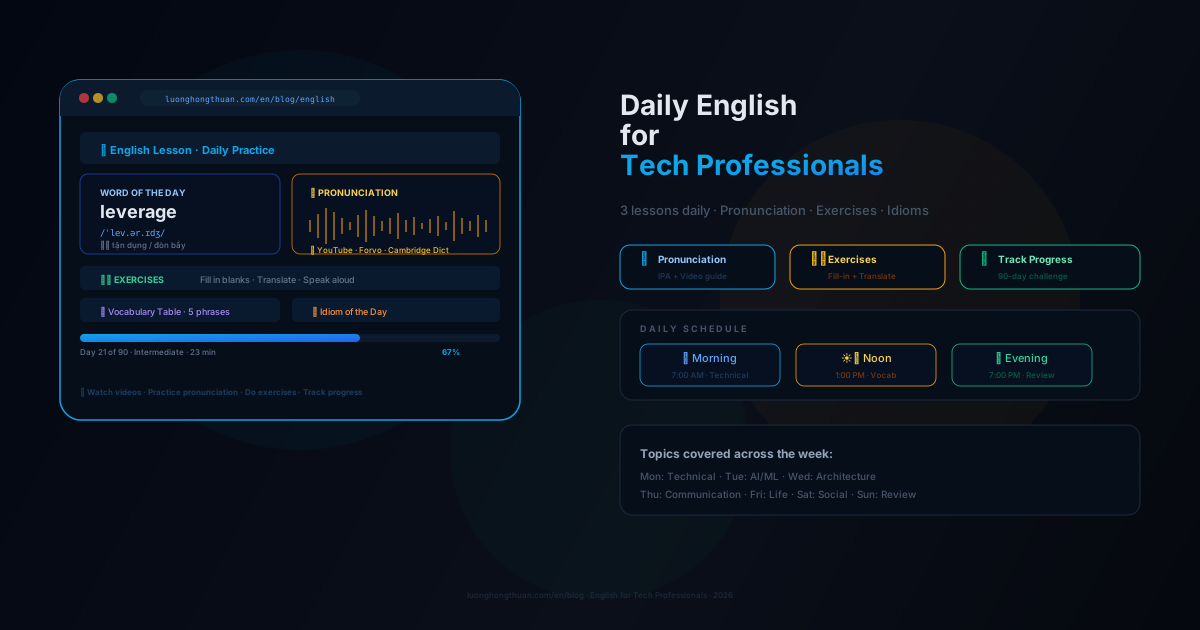
Good morning! It’s Monday — the perfect day to sharpen the English you’ll actually need this week: the vocabulary your teammates use in code reviews, PRs, standups, and Slack threads. Today we go deep on technical English, starting with a word every developer says constantly but often mispronounces.
🌟 Word of the Day: Refactor
IPA Pronunciation: /riːˈfæktər/
Vietnamese meaning: Tái cấu trúc code / Viết lại code mà không thay đổi chức năng
To refactor means to restructure existing code without changing its external behavior — you clean it up, simplify it, make it more readable or efficient, but the output remains the same. It’s one of the most important words in a professional developer’s vocabulary.
“The code works, but before we add new features, we should refactor this module — it’s gotten too complex to reason about.”
🗣️ 3 Example Sentences
- “I’m going to refactor the authentication service this sprint — the current code has too many responsibilities in one file.”
- “The PR looks good, but we really need to refactor this function before it ships — it’s 200 lines and does 5 different things.”
- “Martin Fowler literally wrote the book on refactoring. If you haven’t read it, it’ll change how you think about code quality.”
🔗 Practice Links
- Cambridge Dictionary: https://dictionary.cambridge.org/dictionary/english/refactor
- YouGlish (hear native speakers say it): https://youglish.com/pronounce/refactor/english
📋 Technical Vocabulary Table
| Phrase | Vietnamese | Example Sentence |
|---|---|---|
| merge conflict | xung đột khi merge code | ”I got a merge conflict on main — can you rebase before I finish review?“ |
| breaking change | thay đổi phá vỡ tương thích ngược | ”Upgrading to v3 introduces a breaking change in the auth API — we need to update all clients.” |
| rubber duck debugging | debug bằng cách giải thích vấn đề ra ngoài | ”I spent 2 hours stuck, then tried rubber duck debugging with my coffee mug — and found the bug in 5 minutes.” |
| ship it | triển khai / phát hành (đưa lên production) | “Tests are green, review is approved — let’s ship it.” |
| code smell | dấu hiệu code có vấn đề thiết kế | ”This nested if-else 8 levels deep is a classic code smell — it needs to be refactored.” |
🎯 Pronunciation Guide
Word of the Day Breakdown: refactor
| Syllable | Sound | Stress |
|---|---|---|
| re | /riː/ | long “ee” — like “ree” |
| FAC | /ˈfæk/ | primary stress — “fack” with short “a” like “cat” |
| tor | /tər/ | schwa + r — unstressed, like “ter” |
Full word: ree-FAC-ter
Common mistakes for Vietnamese speakers:
- ❌ “re-FAK-tor” (the final vowel is not a strong “o”)
- ❌ “reh-FAC-tor” (the first syllable uses long “ee”, not short “eh”)
- ✅ “ree-FAC-ter” — stress the middle syllable, unstressed schwa at the end
Related forms:
- refactoring /riːˈfæktərɪŋ/ — “We’re refactoring the payment module this sprint.”
- refactored /riːˈfæktərd/ — “I refactored the service into three smaller modules.”
🔊 Practice Sentence (read aloud 3x)
“Before adding new features, the team decided to refactor the legacy authentication code to reduce complexity and improve testability.”
Break it down:
- be-FORE add-ing NEW fea-TURES
- the TEAM de-CID-ed to ree-FAC-ter
- the LEG-a-cy au-THEN-ti-ca-tion CODE
- to re-DUCE com-PLEX-i-ty and im-PROVE test-a-BIL-i-ty
✏️ Exercise 1: Fill in the Blank
Use: (refactor / merge conflict / breaking change / ship it / rubber duck debugging / code smell)
- “I found the bug by doing ______ — explaining the function out loud to myself made me realize the off-by-one error.” (debug bằng cách nói ra)
- “The new SDK version introduces a ______ — all teams must update their integration before the deadline.” (phá vỡ tương thích)
- “CI is green and the PM gave the thumbs up — ______!” (triển khai thôi)
- “This 500-line class with 30 methods is a ______ — it needs to be split into focused components.” (dấu hiệu code có vấn đề)
- “There’s a ______ on the login branch — can someone rebase before I start my review?” (xung đột merge)
- “We should ______ the data processing pipeline before adding the new export feature.” (tái cấu trúc)
✅ Answers
- rubber duck debugging
- breaking change
- ship it
- code smell
- merge conflict
- refactor
✏️ Exercise 2: Translate to English
Translate these Vietnamese developer sentences into natural English:
- “Tôi cần tái cấu trúc module thanh toán trước khi thêm tính năng mới vào.”
- “Có xung đột merge trên branch main, bạn có thể rebase không?”
- “Đây là thay đổi phá vỡ tương thích — tất cả client đều phải được cập nhật trước khi deploy.”
- “Code này có mùi — class này đang làm quá nhiều việc.”
✅ Sample Answers
- “I need to refactor the payment module before adding new features.”
- “There’s a merge conflict on the main branch — can you rebase?”
- “This is a breaking change — all clients need to be updated before we deploy.”
- “This code smells — this class is doing too many things.” (or: “This is a code smell — the class has too many responsibilities.”)
💡 Idiom of the Day: “Yak Shaving”
Meaning: The practice of doing a long series of small tasks that are all prerequisites to the actual task you wanted to do — where each task reveals another sub-task needed first.
Vietnamese: Làm hàng loạt việc nhỏ không liên quan để dẫn đến việc thực sự cần làm / Rẽ ngã rẽ không hồi kết
Origin: Coined by Carlin Vieri at MIT Media Lab in the late 1990s. The image: you want to shave a yak, but first you need clippers, but to get clippers you need a ladder, but to get the ladder you need to borrow a key… and suddenly you’re doing things that seem completely unrelated to the original goal.
2 Real Examples in Tech:
- “I spent 3 hours yak shaving today — wanted to add a feature, but first had to update my local env, which broke the Docker setup, which required a newer version of Node, which caused my test runner to fail…”
- “Before you go down that yak shaving rabbit hole, ask yourself: what’s the actual ticket I need to close?”
When to use it:
- When you’re explaining why a simple task took all day
- When warning a teammate that a task is going to chain into many other tasks
- In retrospectives: “Let’s talk about the yak shaving we did this sprint and how to prevent it”
📺 Recommended Watching
For Technical English & Developer Communication
-
Fireship (YouTube) — Short, fast-paced tech explainers in native English. Each 5-minute video covers a real concept (Git, Docker, APIs, databases) with clear, informal developer English. Perfect for absorbing the natural vocabulary of how devs explain things. → Search: “Fireship youtube”
-
TechLead (YouTube) — A former Google/Facebook engineer who speaks very clear, measured English. Great for understanding how senior engineers discuss architecture, career decisions, and code quality without jargon overload. → Search: “TechLead youtube programming”
-
ThePrimeagen (YouTube) — A fast, opinionated senior developer. More advanced vocabulary and casual slang — great for when you want to understand how developers actually talk in informal settings (Slack, Discord, team lunches). → Search: “ThePrimeagen youtube”
🎯 Monday Challenge: Say It In Code Review Today
The specific practice challenge:
Today, when you give or receive a code review — or when you write a comment in Jira, GitHub, or Slack — use at least 2 of today’s vocabulary words in English.
Examples:
- “This looks like a code smell — might be worth refactoring before we ship it.”
- “I think this PR introduces a breaking change — we need to update the docs.”
- “I spent the morning yak shaving — trying to fix a bug, but kept finding prerequisite issues.”
If you don’t have a code review today, write 2 sentences in English in your notebook describing something you’re currently working on — using today’s words.
The goal: When you’re in a meeting or code review next week and someone says “we have a merge conflict” or “this is a breaking change,” you should understand immediately and be able to respond naturally in English. Today’s practice makes that automatic.
🗓️ Coming Up This Week
- Tuesday (AI): Inference, token budget, grounding, hallucination — the words you need to talk about LLMs at work
- Wednesday (Architecture): Bulkhead, blast radius, circuit breaker, idempotent — reliability pattern vocabulary
- Thursday (Professional): “Circle back,” “action item,” “let’s take this offline” — meeting English for tech professionals
- Friday (Career): Interview English — how to talk about your technical decisions and leadership experience in English
- Saturday (Social): Weekend plans and casual tech-person small talk
- Sunday (Review): Consolidate this week’s best words with spaced repetition
Start the week strong. Pick one word from today, use it once before noon, and it’s yours forever. See you tomorrow morning! 🚀