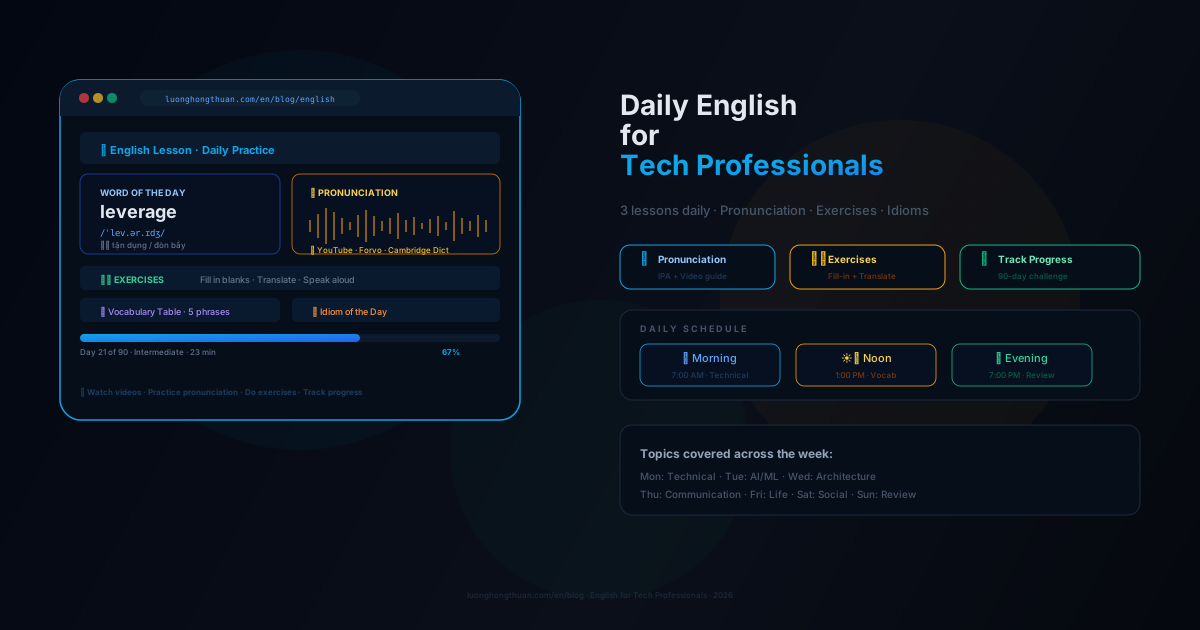
Good morning! ☀️ Today is Wednesday — Architecture & System Design day. Let’s level up your technical English with vocabulary that every cloud engineer, backend developer, and tech lead uses daily.
Word of the Day: idempotent
IPA: /aɪˈdem.pə.tənt/ Vietnamese: bất biến (thực hiện nhiều lần cho kết quả giống nhau)
An idempotent operation is one where performing it multiple times produces the same result as performing it once. No side effects accumulate.
Example sentences:
- “A PUT request in REST APIs is designed to be idempotent — sending the same payload ten times has the same effect as sending it once.”
- “HTTP DELETE is idempotent: deleting a resource that no longer exists still returns the same final state — the resource is gone.”
- “In our distributed payment system, we make every transaction handler idempotent so network retries never cause double charges.”
Learn more:
Vocabulary Table
| Phrase | Vietnamese | Example |
|---|---|---|
| fault tolerance | chịu lỗi | ”Our system has fault tolerance built into every layer — a single node failure won’t bring it down.” |
| horizontal scaling | mở rộng ngang | ”We achieve horizontal scaling by adding more servers behind a load balancer instead of upgrading one big machine.” |
| eventual consistency | nhất quán cuối cùng | ”The database uses eventual consistency across regions — writes propagate within seconds, not milliseconds.” |
| circuit breaker | cầu dao ngắt mạch | ”The circuit breaker trips automatically when the downstream service fails, preventing a cascade of errors.” |
| service mesh | mạng lưới dịch vụ | ”Istio acts as our service mesh — it handles traffic management, mTLS, and observability between microservices.” |
Pronunciation Guide: “idempotent”
Break it down syllable by syllable:
i · dem · po · tent
| Syllable | Sound | Memory trick |
|---|---|---|
| i | /aɪ/ | like the word “eye” |
| dem | /ˈdem/ | like “them” but starting with D |
| po | /pə/ | a soft schwa sound (unstressed) |
| tent | /tənt/ | like a camping “tent” |
Full word: /aɪˈdem.pə.tənt/ — stress falls on the second syllable (DEM).
Practice sentence — read aloud 3 times:
“An idempotent API call produces the same result whether it runs once or a hundred times across our distributed microservices.”
Try it slowly first, then at normal speed. Focus on the stress: i-DEM-po-tent.
Exercises
Exercise 1 — Fill in the Blank
Complete each sentence with the correct word or phrase from today’s vocabulary:
- “If your API endpoint isn’t __________, retrying a failed request could charge the customer twice.”
- “We implemented a __________ pattern so that when the payment service is slow, we stop forwarding requests and return a cached response instead.”
- “The team chose __________ over a single powerful server because it’s cheaper and easier to scale incrementally.”
- “We use a __________ to manage service-to-service communication, enabling canary deployments without changing application code.”
- “DynamoDB Global Tables use __________ — data written in Tokyo will appear in Frankfurt within a few seconds.”
Answers
- idempotent
- circuit breaker
- horizontal scaling
- service mesh
- eventual consistency
Exercise 2 — Translate to English
Translate these Vietnamese sentences into natural English:
- “Hệ thống của chúng tôi được thiết kế để chịu lỗi — ngay cả khi một máy chủ bị hỏng, hệ thống vẫn hoạt động bình thường.”
- “API thanh toán phải bất biến để tránh tình trạng trừ tiền hai lần khi có lỗi mạng.”
- “Chúng tôi đã loại bỏ điểm thất bại duy nhất bằng cách triển khai cơ sở dữ liệu trên nhiều vùng khả dụng.”
Answers
- “Our system is designed for fault tolerance — even if one server goes down, the system continues to operate normally.”
- “The payment API must be idempotent to prevent double charges when network errors occur.”
- “We eliminated the single point of failure by deploying the database across multiple availability zones.”
Idiom of the Day: “single point of failure”
Vietnamese: điểm thất bại duy nhất — nếu thành phần này hỏng, cả hệ thống sập
In engineering, a single point of failure (SPOF) is any component whose failure brings down the entire system. Architects design to eliminate SPOFs through redundancy and distribution.
Example 1:
“The CEO is a single point of failure for the company’s strategy — we need to document and distribute that knowledge.”
Example 2:
“We redesigned the architecture to eliminate the database as a single point of failure by adding read replicas and a failover cluster.”
Use it at work: Next time you review an architecture diagram, ask: “Where is the single point of failure here?” — it signals mature systems thinking.
Recommended Watching
Build your visual understanding of system design:
- ByteByteGo — Clean animations explaining distributed systems, databases, and API design. Great for visual learners.
- Fireship — “System Design in 100 Seconds” series gives fast, memorable overviews of key concepts.
- Hussein Nasser — “Fundamentals of Backend Engineering” playlist goes deep on networking, protocols, and database internals.
Tip: Watch with English subtitles, then replay with subtitles off. This builds both vocabulary and listening comprehension simultaneously.
Daily Challenge
Today’s challenge:
Explain one system design decision you made — or observed — using the word “idempotent” or “fault tolerance” in a sentence. Write it in your notes.
Example response:
“We made our order confirmation endpoint idempotent by storing processed order IDs in Redis — duplicate webhook deliveries from our payment provider are safely ignored.”
Can’t think of a real example? Write a hypothetical one. The act of constructing the sentence is where the learning happens.
Quick Review
| Concept | Key point |
|---|---|
| idempotent | Same result, no matter how many times you call it |
| fault tolerance | System keeps working despite component failures |
| horizontal scaling | Add more machines, not a bigger machine |
| eventual consistency | All nodes agree — but not instantly |
| circuit breaker | Stops cascading failures by cutting off failing dependencies |
| service mesh | Infrastructure layer managing service-to-service communication |
| single point of failure | The component whose failure kills everything |
See you at noon for Communication & Phrases! 🎯