
JOURNAL
750 Tokens/Second: What Cerebras’ Wafer-Scale Inference Actually Changes for Agent UX
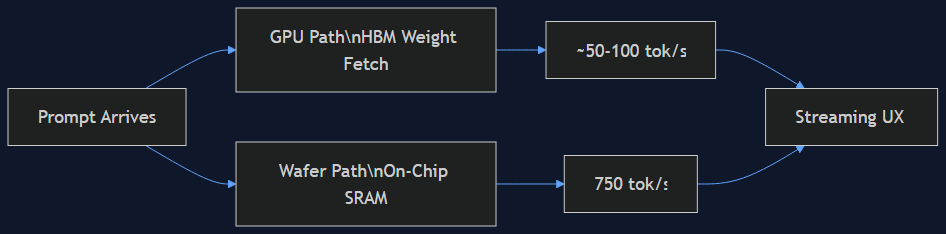
OpenAI's GPT-5.6 Sol Ultrafast, powered by Cerebras' Wafer-Scale Engine, hits 750 output tokens/second — 14x standard inference. I dug into why on-chip SRAM beats HBM for this, and what it means for how we design latency-sensitive agent products.
On this page
Last week OpenAI and Cerebras previewed “Ultrafast” mode for GPT-5.6 Sol: up to 750 output tokens per second, roughly 14x the speed of standard inference, with — according to both companies — no quality tradeoff. My first reaction was skepticism; “no quality tradeoff” is the kind of claim that usually hides a footnote. But the architecture behind it isn’t a quantization trick or a smaller distilled model. It’s a genuinely different hardware answer to a problem every tech lead building LLM-backed products has felt: token generation is bandwidth-bound, not compute-bound. That distinction matters more than the headline number, so I want to walk through why, and then get concrete about what it should change in how we design agent UX.
The bottleneck nobody’s prompt engineering can fix
On a standard GPU inference stack, generating each token requires streaming the model’s weights from HBM (high-bandwidth memory) into the compute cores, running the forward pass, then repeating for the next token. For a large model, that’s tens or hundreds of gigabytes moving across a memory bus on every single token. GPUs have gotten faster at the matrix multiplies; they haven’t gotten proportionally faster at moving that much data back and forth. That’s the memory-bandwidth wall, and it’s why token-generation latency has scaled so much more slowly than model capability over the last two years.
Cerebras’ Wafer-Scale Engine sidesteps this by keeping model weights resident in on-chip SRAM — 44GB across a wafer-sized chip — instead of external HBM. There’s no round trip to off-chip memory during generation. The tradeoff is that wafer-scale chips are expensive, hard to manufacture, and only make sense for inference workloads at real scale — you’re not running this in a homelab. But for a provider serving a frontier model to millions of requests, it’s a legitimate architectural answer rather than a marketing number.
Why 14x isn’t just “the same thing but faster”
Here’s the part that’s easy to miss if you skim past this as a benchmark headline: a 10x-plus change in token latency doesn’t just make existing UX faster, it changes which UX patterns are viable at all. I’ve built enough LLM-backed features to have internalized a rough rule: if perceived latency crosses roughly 300-500ms for the first meaningful chunk of output, users start perceiving the system as “thinking” rather than “responding,” and your interaction pattern needs to accommodate that — streaming indicators, partial renders, speculative UI. At 750 tokens/second, a 500-token response — a solid paragraph, a small code diff, a structured tool-call plan — completes in under a second. That’s fast enough to stop being a “generation” and start being closer to a “computation,” which opens up interaction patterns that were previously awkward:
- Synchronous tool chains without a spinner. An agent that needs three sequential LLM calls to plan, execute, and verify a step can do all three inside a single perceived “loading” moment instead of three visible stages.
- Inline autocomplete for structured output, not just code — form-filling, config generation, SQL — at speeds competitive with a rules-based system, without the rules-based system’s brittleness.
- Real-time voice and multi-turn agent conversation without the now-familiar “let me think about that” latency tax that makes voice agents feel stilted compared to a human.
What I’d actually change in an agent’s request path
If your product has latency-sensitive agent flows, I’d treat this the way I treat any hardware step-function: don’t rearchitect your product around a single vendor’s beta feature, but do stop treating token-generation latency as a fixed cost you have to design defensively around. Concretely, three things I’m doing differently this quarter:
# Before: one big response, unbounded latency, mandatory streaming UI
def plan_and_execute(task):
    plan = llm.generate(f"Plan steps for: {task}", stream=True)
    for step in plan.steps:
        result = llm.generate(f"Execute: {step}", stream=True)
    return result

# With sub-second generation for short spans, batching narrow
# synchronous calls becomes viable instead of a UX liability
def plan_and_execute_fast(task):
    plan = llm.generate(f"Plan steps for: {task}", max_tokens=300)
    results = [llm.generate(f"Execute: {s}", max_tokens=200) for s in plan.steps]
    return summarize(results)  # whole chain can complete under ~1s
First, I’m auditing which of our agent flows use streaming purely as a latency-hiding mechanism versus streaming because the content genuinely benefits from progressive disclosure (long-form writing, live log tailing). The first category is a candidate for collapsing into synchronous calls once the underlying model is fast enough — streaming UI has real complexity cost (partial-state handling, cancellation, error recovery mid-stream) that you don’t want to carry if you don’t need it.
Second, I’m reconsidering where we do multi-step agent planning. A lot of “plan then execute” architectures exist partly to batch latency — do all the thinking up front so the user only waits once. If per-step latency drops an order of magnitude, interleaved plan-observe-replan loops (closer to how a human actually works through an ambiguous task) become affordable again, and they tend to produce better outcomes than a rigid up-front plan.
Third — and this is the boring but important one — I’m not assuming this pricing or availability generalizes. Ultrafast mode launched in limited preview to select customers; the per-token cost for wafer-scale inference isn’t public yet, and past “efficient inference” announcements haven’t always come with proportionally cheap pricing. Treat this as a preview of where token economics are heading, not something to bake into your capacity planning today.
The honest caveat
I haven’t run this myself — access is limited — so everything above is architectural reasoning from public benchmarks, not a benchmark I generated. If you get access, the thing I’d actually verify before trusting the “no quality tradeoff” claim is whether it holds under your own eval set, not the vendor’s. Inference-time optimizations have a history of being lossless on paper and subtly different in production — different sampling implementations, different numerical precision paths, can shift output distribution in ways that don’t show up on a standard benchmark but do show up in a code-review agent’s judgment calls. Verify before you build a product decision on top of it.
Sources: Cerebras Powers Ultrafast Mode for OpenAI’s GPT-5.6 Sol, OpenAI: Previewing Ultrafast mode, GPT-5.6 Sol goes 14x faster
Related reading
08 Oct 2026 · 4 min read
architecture
English Lesson — Wednesday Morning: Failover & High Availability Vocabulary
Wednesday architecture English: failover, pronunciation drills, a vocabulary table, two exercises, and an idiom every on-call engineer should know.
Read more
07 Oct 2026 · 4 min read
ai
English Lesson — Tuesday Morning: Embeddings & Vector Search Vocabulary
Daily English practice for tech professionals: embed, vector database, and nearest neighbor search vocabulary with pronunciation and exercises.
Read more
06 Oct 2026 · 5 min read
agentic coding
My Agent Didn't Forget. It Never Wrote Anything Down.
A Hacker News post about agent memory landed the same week I'd debugged a real dedup failure caused by exactly the problem it describes. I tested the fix against my own incident — here's what held up and what didn't.
Read more
Discussion
Comments are reviewed before publication. Your email is kept private.