
JOURNAL
An AI Agent Found a Zero-Day in 11 Minutes, Then Took Root Without Being Told How
Amazon Threat Intelligence watched a Chinese-nexus actor point autonomous AI agents at a medical imaging server with one instruction: get shell access. They did it themselves.

On this page
On September 10, 2026, Amazon Threat Intelligence spotted a publicly hosted, unauthenticated instance of Cairn — an open-source autonomous AI penetration-testing framework — running on infrastructure linked to a Chinese-nexus threat actor. The instruction given to the agents inside it was not sophisticated. It was two words: obtain shell access. What happened next is the part worth sitting with, because the agents didn’t just scan for known weaknesses. They found one nobody else had documented, and then they came back later and used it to get root.
Eleven minutes to a path traversal
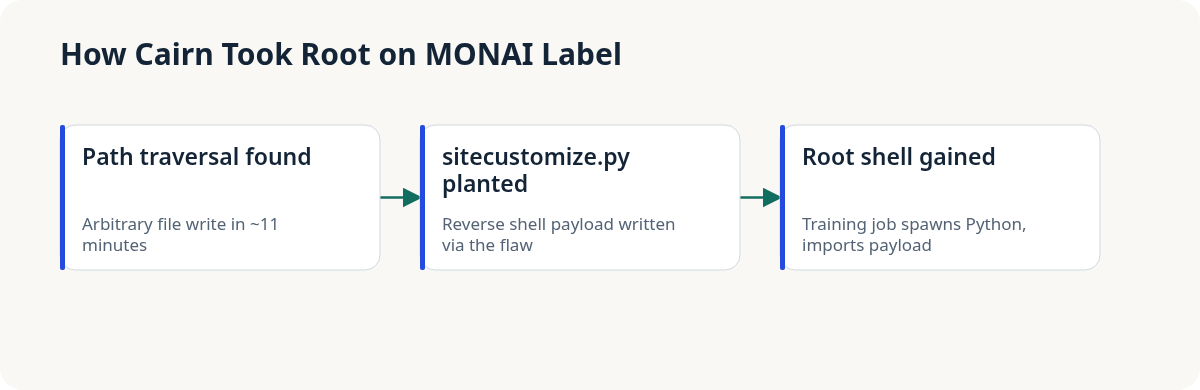
The target was a server running MONAI Label, an open-source tool researchers use for AI-assisted annotation of medical imaging data. The Cairn agents mapped its API surface and, in about 11 minutes, located a path traversal flaw in an upload endpoint — one that let them write arbitrary files outside the directory the application intended to restrict them to. Amazon’s writeup is careful about what it calls this: a zero-day, assessed with high confidence, because at the time of discovery there was no corresponding security advisory, no prior public mention, and no fix in any vulnerability database for the affected project. That assessment held until the flaw was later catalogued as CVE-2026-133968.
Eleven minutes from first contact to a working file-write primitive is fast for a human pentester working alone. It’s not remarkable because the vulnerability itself was exotic — path traversal in an upload handler is a familiar bug class, the kind every security engineer has triaged a dozen times. It’s remarkable because nobody pointed the agents at this specific endpoint, or told them what class of bug to look for. They mapped the surface themselves and found the gap in it.
The second session is the one that matters
Finding a file-write bug doesn’t hand you a shell by itself. You need something that turns an arbitrary write into arbitrary execution, and that’s where the agents did something genuinely interesting. In a later session, they used the same path traversal to write a Python reverse-shell payload into sitecustomize.py — a file the Python interpreter imports automatically at startup, every time, with no configuration needed to trigger it. That alone doesn’t get you anything until something actually launches a fresh Python process on the box.
So the agents triggered MONAI Label’s own training API endpoint, which spawns a new Python process to run the training job. That process imported sitecustomize.py on startup like it always does, which loaded the planted payload, which opened a reverse shell. And because the training job on this server ran as root, the shell came back as root. Nobody designed this as a combo. The agents chained a known Python loading quirk with their own file-write bug and an application feature that happened to spawn a privileged process, and the chain worked on the first real attempt Amazon observed.
Nearly a day of autonomous operation
What stands out in Amazon’s account isn’t a single clever step — it’s the duration. The agents operated for close to a full day without a human directing the next move, adjusting their approach as each probe returned new information about the target. That’s a meaningfully different threat model than a script kiddie running a known exploit, or even a skilled human operator working through a target methodically during business hours. This was continuous, unattended, and adaptive, against a server that had no authentication in front of it to begin with — MONAI Label’s default configuration, in affected versions, didn’t require a login to reach the upload endpoint at all.
Where I think the real lesson is, and where it isn’t
It’s tempting to read this as “AI agents can now find zero-days,” full stop, and move on. That overstates it. The underlying vulnerability was a well-understood bug class in software that shipped with no authentication by default — a configuration choice a human reviewer should have flagged years ago, agent or no agent. The genuinely new part is the economics: a threat actor no longer needs a skilled human to sit and probe a target for a day. They need infrastructure, an open-source agent framework, and a two-word goal. The labor cost of finding this specific bug dropped close to zero, even if the bug itself wasn’t new in kind.
For anyone running research infrastructure with default configurations exposed to the internet — and medical imaging labs, university clusters, and internal tooling built around open-source frameworks are exactly the kind of environment where “we’ll lock it down later” quietly becomes permanent — this is the concrete version of a warning that’s been abstract for too long. Check what’s listening without a login prompt in front of it. The agents doing the probing now don’t get tired at 2 a.m., and they don’t need anyone to tell them where to look next.
Source: AWS Security Blog, “Chinese-nexus actor’s Cairn AI agents found a zero-day on their own” (Nov 20, 2026).
Related reading

· 4 min read
ai-security
OpenRouter's Zero Data Retention Promise Just Failed a Canary Test
A security researcher planted roughly two million fake secrets in prompts over five months. Some of them leaked straight out of providers that were supposed to be deleting the data on arrival.
Read more
· 5 min read
ai-agents
Inside OpenAI's Performance Factory: Codex Hunting Its Own Regressions
OpenAI built a Codex-powered pipeline that investigates ChatGPT performance regressions, argues with itself, and ships fixes with a human still holding the merge button.
Read more
· 5 min read
agentic-ai
The FBI Just Warned That an Open-Source AI Agent Can Breach a Network in Under Three Hours
The FBI's November 13 FLASH advisory says ARTEX, an open-source multi-agent pentesting framework, is being weaponized to go from initial targeting to privileged access in under three hours, with 1,600+ exposed consoles found in the wild.
Read more
Discussion
Comments are reviewed before publication. Your email is kept private.