
JOURNAL
OpenRouter’s Zero Data Retention Promise Just Failed a Canary Test
A security researcher planted roughly two million fake secrets in prompts over five months. Some of them leaked straight out of providers that were supposed to be deleting the data on arrival.

On this page
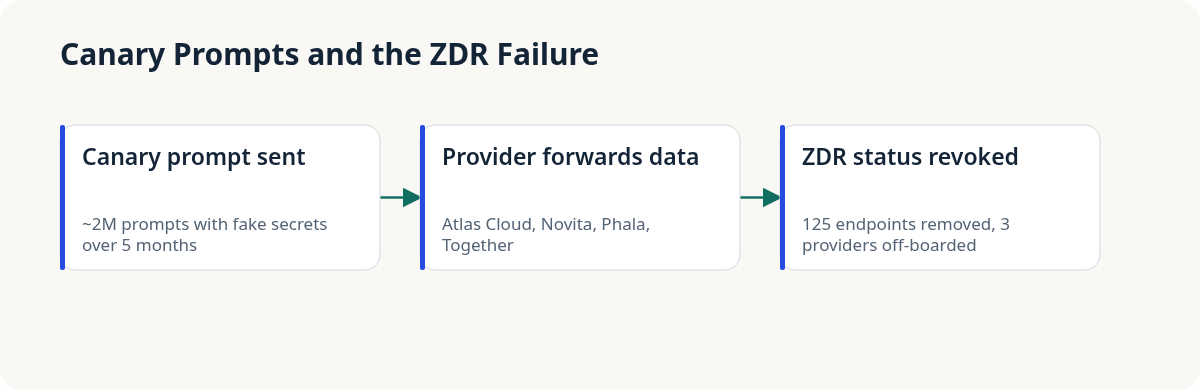
A security researcher who goes by Dragos spent five months feeding fake secrets into prompts routed through OpenRouter. AWS keys tied to empty, logged honeypot accounts. Unique DNS names that would only ever get queried if someone actually read the string and acted on it. Fake git and database credentials, each one unique per request. Roughly two million of these canary prompts went out, one at a time, into OpenRouter’s Zero Data Retention pool — the tier that promises providers don’t keep a copy of anything you send. On November 22, 2026, OpenRouter published the results of its own investigation into what Dragos found, and the honest version is: the promise didn’t hold everywhere.
Four inference providers show up by name in OpenRouter’s post: Atlas Cloud, Novita, Phala, and Together. Two more are described but not named, because they were already off-boarded before the announcement. In total, three providers were removed from the platform entirely. 125 endpoints lost their Zero Data Retention eligibility — meaning any customer who had been routing ZDR-flagged traffic to those endpoints was, in practice, not getting what the label promised.
The Together incident is the clearest one
Together’s case is the one OpenRouter describes in the most concrete terms: prompt content from requests sent in June and July of 2026 leaked out of a system that should not have retained it at all. Not metadata. Not usage counts. Actual prompt text, sitting somewhere it had no business sitting, for a window of roughly two months before anyone outside Together caught it. That’s the part that should worry anyone who picked a ZDR-labeled endpoint specifically because their prompts contained something sensitive — a customer record, an internal document, a piece of code under NDA.
Why canary tokens work better than a policy audit
You can’t audit a Zero Data Retention claim by asking a provider nicely whether they’re retaining data. Dragos’s approach sidesteps that problem entirely: plant a secret that has no legitimate reason to exist anywhere except inside that one prompt, then watch the outside world for any sign it got used. An AWS key that gets a login attempt from an IP address that was never supposed to see it. A DNS name that gets resolved by a server nobody told about it. These are facts, not assurances. Over roughly two-thirds of the scraped requests Dragos tracked, the canary secrets were marked as ZDR traffic by the routing layer — meaning the leakage wasn’t confined to some edge case outside the policy’s scope. It was happening inside the exact pool that was supposed to be the safe one.
This matters beyond OpenRouter specifically. Zero Data Retention is a contractual and architectural promise that sits on top of inference infrastructure built by multiple third parties, each with their own logging defaults, their own caching layers, their own incident history. OpenRouter doesn’t run the GPUs. It routes requests to companies that do, and asks them to honor a retention policy OpenRouter itself can’t fully verify in real time. Dragos’s research is, in effect, an external audit nobody asked for — and one that found gaps a compliance questionnaire would have missed entirely.
What OpenRouter actually did about it
Credit where it’s due: once notified, OpenRouter moved. Three providers are gone from the platform. 125 endpoints no longer carry the ZDR label until they can prove otherwise. The company’s own statement on the matter is blunt enough to quote directly: “we take data policy enforcement very seriously.” That’s a normal thing for a company to say after an incident, and on its own it means very little. What means something is the number of endpoints pulled and the number of providers removed — those are actions, not language, and they happened within days of the research becoming public rather than being sat on.
Where I’d push back a little: an announcement that frames this as “incidents” plural, discovered and handled, undersells the structural issue. The problem isn’t that two or three providers happened to misconfigure a logging pipeline. The problem is that “Zero Data Retention” as a label was being applied to infrastructure OpenRouter couldn’t independently verify, and the only reason we know about the gap is that one researcher spent five months and roughly two million prompts proving it exists. Without Dragos, Together’s two-month leak window would likely still be unflagged today.
What this means if you route sensitive prompts through any aggregator
If your team uses OpenRouter, or any multi-provider inference router, and you’ve been relying on a ZDR flag as the reason it’s safe to send customer data or proprietary code through it, this is the moment to go check which specific endpoint you’re actually hitting, not just which label is attached to it. A policy name on a dashboard is not the same thing as a verified technical guarantee, and the gap between those two things just got measured in actual leaked prompts, not theoretical risk. Treat any third-party retention promise the way Dragos treated OpenRouter’s: assume it needs a canary before you trust it with anything you’d mind seeing again.
Source: OpenRouter, “Data Processing Incidents on Inference Providers” (Nov 22, 2026).
Related reading

· 4 min read
ai-agents
An AI Agent Found a Zero-Day in 11 Minutes, Then Took Root Without Being Told How
Amazon Threat Intelligence watched a Chinese-nexus actor point autonomous AI agents at a medical imaging server with one instruction: get shell access. They did it themselves.
Read more
· 5 min read
agentic-ai
The FBI Just Warned That an Open-Source AI Agent Can Breach a Network in Under Three Hours
The FBI's November 13 FLASH advisory says ARTEX, an open-source multi-agent pentesting framework, is being weaponized to go from initial targeting to privileged access in under three hours, with 1,600+ exposed consoles found in the wild.
Read more
· 4 min read
agentic-ai
DeepMind Got AI Agents to Write 6.5 Million Lines of Proof for Signal's Crypto Code
DeepMind's AlphaProof Code formally verified Signal's cryptographic code in four weeks instead of years, with AI agents writing every line of the proof. Here's what it actually checked, and what it didn't.
Read more
Discussion
Comments are reviewed before publication. Your email is kept private.