Team rituals — standups, refinements, sprint planning, reviews, retrospectives — exist for human coordination, not information exchange. The AI era gives teams the opportunity to strip out the information-exchange parts (which AI handles better) and reinvest that time in the genuine collaboration, decision-making, and relationship-building that only humans in conversation can do.
The result: shorter meetings, better decisions, and stronger teams.
The Problem With Traditional Ceremonies
In most teams, ceremonies carry too much administrative overhead:
- Standups: 20 minutes of status updates that could be a Slack post
- Refinements: Rehashing stories that aren’t ready because no one read them before the meeting
- Sprint planning: Rushing estimates on stories that aren’t fully understood
- Reviews: Demos interrupted by questions that could be answered by reading the story
- Retros: General complaints without concrete patterns or actionable proposals
AI pre-processing solves all of these.
Async-First: The AI Team’s Meeting Philosophy
In the AI era, the rule is: information is async, decisions are synchronous.
AI handles information preparation and distribution. Humans gather exclusively to make decisions, align on priorities, solve hard problems, and build the working relationships that make everything else function.
Every ceremony gets a pre-meeting AI prep and a post-meeting AI summary.
Standup: Redesigned
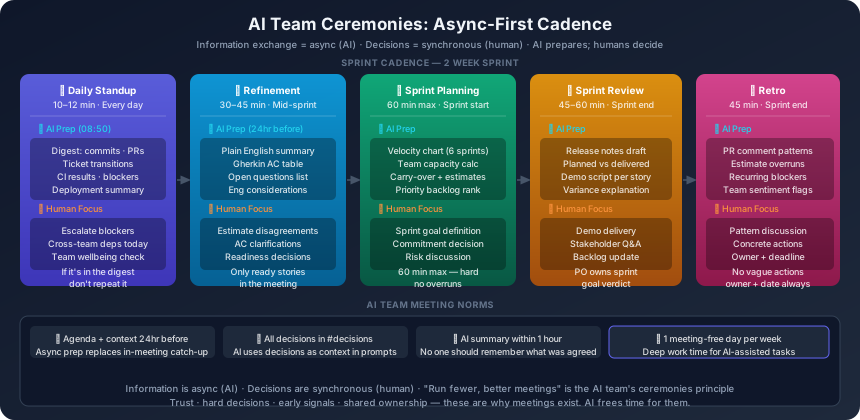
Before the daily standup
AI aggregates across your tooling stack overnight:
- Git commits and PR activity from the previous day (per person)
- Linear/Jira ticket transitions: what moved to Done, In Progress, Blocked
- CI/CD result summary: what passed, what failed, what’s blocking
- Customer feedback items (if integrated with support tools): new themes
AI Standup Digest — posted to the team channel at 08:50:
## Standup Digest — 24 Feb

**Completed yesterday:**
- Alice: merged access control PR (AUTH-341), tests green
- Bob: design review on payment flow with SA — conclusion in #decisions

**In progress:**
- Charlie: checkout refactor (COM-219) — 2 files changed, PR tomorrow
- Diana: waiting on API spec from BA for integration story (INT-109) ⚠️

**Blockers flagged:**
- INT-109: blocked on open question from BA (see Linear comment)
- CI failure on feature/bob-payment: test flake, investigating

**Deployments:**
- Staging updated at 18:43 with 3 PRs — QA signed off at 20:11
The standup itself (10–12 min target)
With information pre-shared, standup focuses on:
- Blockers — does anything need escalation or human decision? (5 min)
- Today’s cross-team dependencies — who needs what from whom today? (5 min)
- Team energy — any signal that someone’s struggling or needs support (2 min)
Rule: If it’s in the digest and has no unresolved dependency, it doesn’t get mentioned in standup. The Tech Lead enforces this.
Refinement: AI-Prepared
The perennial problem with refinement: half the stories aren’t ready, so the first 20 minutes are wasted reading the card together.
Before refinement
The BA feeds stories into an AI refinement prep session:
Prompt:
Prepare these stories for our refinement session.
For each story, produce:
1. A one-paragraph plain English summary (for the dev reading it cold)
2. The Gherkin acceptance criteria in a table (Given/When/Then)
3. Questions that need answers before this story is estimate-ready
4. Engineering considerations: likely complexity, suggested approach, edge cases

Stories:
[paste stories]
Output is posted to the meeting channel 24 hours before refinement. Team members are expected to read it async.
Refinement itself (30–45 min target)
The agenda is now only stories that are estimate-ready (BA confirms before meeting). Stories with open questions go back to BA for async resolution.
- Engineer proposes estimate, explains reasoning (2 min per story)
- Team discusses estimate disagreements only
- BA clarifies AC if engineers have questions (remaining questions added as story comments for async follow-up)
Achievable throughput: 8–12 stories in a 45-minute refinement.
Sprint Planning: Context-Rich
AI provides the sprint planning context pack:
- Velocity chart (last 6 sprints, actual vs planned)
- Team capacity this sprint (accounting for absences, ceremonies)
- Carry-over stories and their updated estimates
- Top-priority backlog stories (PO’s ranking) with readiness status
PM facilitates; PO owns priority; team owns estimates. Sprint planning runs 60 min maximum.
Sprint Review: Demo-Ready
Before the review
AI generates:
- Release notes for the sprint: features delivered, bugs fixed, metrics moved
- A summary of what was planned vs delivered (and why for any variance)
- Open questions and risks for the retrospective
In the review
- Product Owner presents the sprint goal outcome (achieved/partial/not achieved)
- Each story owner demonstrates the feature (AI pre-generates the demo script: here is the story, here is the AC, here is the verification approach)
- Stakeholder feedback is captured in real time (note-taker + AI transcript)
- PO updates backlog based on feedback immediately after
Retrospective: From Venting to Learning
Before the retro
AI analyses the sprint’s data and generates a retrospective briefing:
- Recurring themes in PR review comments (pattern across the sprint)
- Stories that took significantly longer than estimated (and why, if comments explain it)
- Blockers that appeared more than once
- Team sentiment patterns (if sentiment-tagging of standup blockers is in place)
This replaces the “What went well / What didn’t / Actions” cold start where everyone stares blankly for 5 minutes.
The retro itself (45 min)
Facilitated by the Tech Lead or Scrum Master (rotated):
- Review last sprint’s action items (5 min): Done? Still relevant?
- React to AI’s pattern analysis: Is this accurate? What did AI miss? (10 min)
- Discuss the top 2–3 themes in depth (20 min)
- Generate specific, owned action items (10 min): “Alex will add X to the PR template by Wednesday”
Rule: Every retro action item has an owner and a deadline. “We should do X more” is not an action item.
Meeting Norms in AI Teams
| Norm | Why |
|---|---|
| Agenda and context shared 24 hrs before | Async preparation replaces in-meeting catch-up |
| AI digest pre-populates standups | Standup is for decisions and blockers only |
| All decisions documented in #decisions channel | AI can reference decisions for context in future prompts |
| Post-meeting AI summary within 1 hour | No one should have to remember what was agreed |
| 1 meeting-free day per week | Deep work time for AI-assisted complex tasks |
The Human Purpose of Meetings
AI makes information exchange nearly free. But meetings have never been primarily about information exchange — they have been about:
Building trust between people who depend on each other.
Making hard decisions with partial information and competing priorities.
Detecting early signals — who’s disengaged, pressured, confused.
Shared ownership of the team’s direction and commitments.
None of these things happen in a Slack digest. Efficient, focused meetings — meetings that respect everyone’s time and achieve genuine human coordination — are what the freed capacity from AI should be invested in.
“Run fewer, better meetings” is the AI team’s ceremonies principle.
Previous: Part 10 — The AI DevOps Engineer ←
Next: Part 12 — The Full AI Team Playbook →
This is Part 11 of the AI-Powered Software Teams series.