The DevOps or Platform Engineer is the team’s force multiplier. Their job is to ensure every other engineer on the team can deliver quickly, safely, and repeatably — by building and maintaining the pipelines, environments, observability, and platform tooling that accelerate every other role. In the AI era, the Platform Engineer gains a powerful second instrument: AI that can generate CI/CD pipeline configuration, diagnose incidents from log data, suggest capacity changes, and write runbooks — while the human focuses on the reliability and developer experience decisions that require deep context.
The Platform Engineer’s Scope
Platform/DevOps engineers typically own:
- CI/CD pipelines: Build, test, scan, and deploy pipelines for every service
- Environment management: Dev, staging, production — provisioning, configuration, access control
- Observability stack: Logging, metrics, distributed tracing, alerting
- Platform tooling: Developer portal, internal service catalogue, golden paths
- Incident response support: On-call rotation, runbooks, post-incident review
- GitOps: Deployment automation, branch strategies, environment promotion
- Cost awareness: Infrastructure cost visibility and optimisation
Where AI Changes the Platform Game
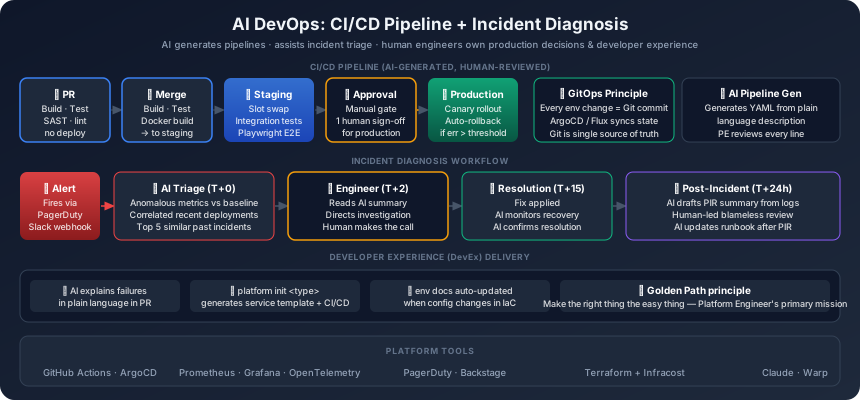
1. CI/CD Pipeline Generation
Writing GitHub Actions, Azure DevOps, or Tekton pipelines from scratch is boilerplate-heavy. AI generates pipeline configurations from plain-language descriptions.
Prompt example:
Generate a GitHub Actions pipeline for a .NET 10 web application:

Triggers:
- PR: run tests + SAST scan (no deploy)
- Merge to main: build, test, scan, deploy to staging
- Release tag: deploy to production (requires manual approval)

Pipeline stages:
1. Build: dotnet build
2. Test: dotnet test with coverage report (minimum 80%)
3. Security: Semgrep SAST + Snyk dependency scan
4. Docker: build and push to Azure Container Registry
5. Deploy staging: Azure App Service, slot swap strategy
6. Integration tests: run Playwright specs against staging
7. Deploy production: requires 1 manual approval, slot swap

Environment: Azure
Secret management: Azure Key Vault references
Notifications: Teams webhook on failure, Slack on release
The Platform Engineer reviews and adjusts (agent configurations, retry logic, concurrency controls) before committing.
2. AI-Assisted Incident Diagnosis
When alerts fire, AI reduces time-to-diagnosis by analysing log patterns, error rates, and deployment history simultaneously.
Incident workflow:
1. Alert fires → Slack/PagerDuty notification
2. On-call engineer opens incident channel
3. AI Agent (integrated with observability) provides:
   - Which metrics are anomalous (compared to baseline)
   - Recent deployments that correlate with the anomaly start time
   - Top 5 similar historical incidents and how they were resolved
   - Current error log patterns (top recurring errors)
4. Engineer uses this context to direct investigation
5. Resolution applied → post-incident review
Prompt for AI incident analysis:
An alert has fired: HTTP 5xx error rate increased from 0.1% to 8% on [service name].

Here is the observability data:
[paste relevant metrics, error logs, recent deployment times]

Analyse:
1. What changed in the last 30 minutes (deployments, config changes, traffic pattern)?
2. What is the most likely root cause?
3. What remediation steps should be tried first?
4. Is this a known pattern from previous incidents?
3. Runbook Generation and Maintenance
AI generates runbooks from existing incident history and system documentation. This solves the common “the runbook is outdated” problem — AI can update runbooks after each incident.
Pattern: After each post-incident review, the Platform Engineer updates the system context and asks AI to update the relevant runbook. Runbooks are version-controlled in the same repo as the code.
4. GitOps and Deployment Automation
In AI-augmented teams, deployment promotion is increasingly automated, with AI assisting in:
- Generating ArgoCD / Flux manifests from Helm chart descriptions
- Suggesting progressive delivery strategies (blue/green, canary rollout percentages)
- Generating rollback procedures for each deployment type
- Writing environment promotion policies
Deployment philosophy in AI teams:
- Every environment change is a Git commit (GitOps: Git is the source of truth)
- AI can propose changes; only humans approve production changes
- Canary rollouts with automated quality gates: AI monitors error rate and auto-rolls back if it exceeds threshold
5. Platform Observability Configuration
AI generates observability configuration from SLA targets:
- Prometheus rule files from availability/latency targets
- Grafana dashboard JSONNET from golden signal templates
- Log parsing rules for structured log extraction
- SLO burn rate alerts from Service Level Objectives
The Developer Experience (DevEx) Mission
The Platform Engineer’s deeper mission is developer experience. In AI-augmented teams, this expands significantly:
| Traditional task | AI-era platform extension |
|---|---|
| Build pipeline | AI-assisted local development with fast feedback |
| Service templates | AI generates from platform init <service-type> |
| Error pages | AI explains deployment failures in plain language |
| Env documentation | AI keeps environment docs current with config changes |
| Incident docs | AI generates post-incident summaries automatically |
The golden path principle: Make the right thing the easy thing. The Platform Engineer’s job is to build a platform where following best practices (security, testing, observability) is the path of least resistance.
The Human-Irreplaceable Platform Work
On-call judgment: When a production system is degrading and you have three possible causes, limited time, and uncertain data, the decision of which to investigate first requires experience, system intuition, and occasionally the courage to make a call that turns out to be wrong. AI narrows the search space; humans make the call.
Developer experience design: Understanding why engineers find a particular tool frustrating, what change would unblock them most, what friction is necessary versus unnecessary — requires empathy and observation, not data analysis. The best Platform Engineers talk constantly to the developers they serve.
Trade-off decisions in production: When a production system is experiencing an incident, the decision to “take the risk and roll forward” versus “roll back and lose that data” involves business context that no AI has access to. Platform Engineers with deep system knowledge make these calls.
Platform architecture: Designing the internal developer platform — what abstractions to provide, which complexity to hide, which to expose — is a product design challenge (the Platform Engineer’s users are the other engineers). This requires product thinking, user research, and architectural taste.
The AI Platform Engineer’s Incident Rhythm
| Time | Activity |
|---|---|
| Alert fires | AI Agent auto-queries observability data, posts analysis to incident channel |
| T+2 min | On-call engineer reads AI summary, begins investigation with context |
| T+5 min | Engineer either follows AI’s top recommendation or redirects |
| T+15 min | Resolution applied; AI monitors for recovery confirmation |
| T+30 min | Incident closed; AI drafts post-incident summary |
| T+24 hr | Post-incident review (human-led); runbook updated (AI-assisted) |
Tools for the AI DevOps/Platform Engineer
| Tool | Purpose |
|---|---|
| GitHub Actions / Azure DevOps | CI/CD pipelines |
| Terraform + Infracost | IaC + cost estimation |
| ArgoCD / Flux | GitOps continuous delivery |
| Prometheus + Grafana | Metrics and dashboards |
| OpenTelemetry | Distributed tracing |
| PagerDuty / Opsgenie | On-call management |
| Backstage | Developer portal |
| Claude | Pipeline generation, incident analysis, runbook generation |
| Warp / AI shells | AI-assisted command-line operations |
Previous: Part 9 — The AI Security Engineer ←
Next: Part 11 — AI Team Rituals →
This is Part 10 of the AI-Powered Software Teams series.