📅 Tech Digest | April 1, 2026 — 07:00 AM GMT+7 Curated reads and news for Tech Leads & Senior Engineers this week.
🤖 1. The AI Coding Tools War: No Longer Just “Completion”
The competitive landscape for AI coding assistants has crossed a critical threshold in 2026: every major tool is now racing toward the “agent” category.
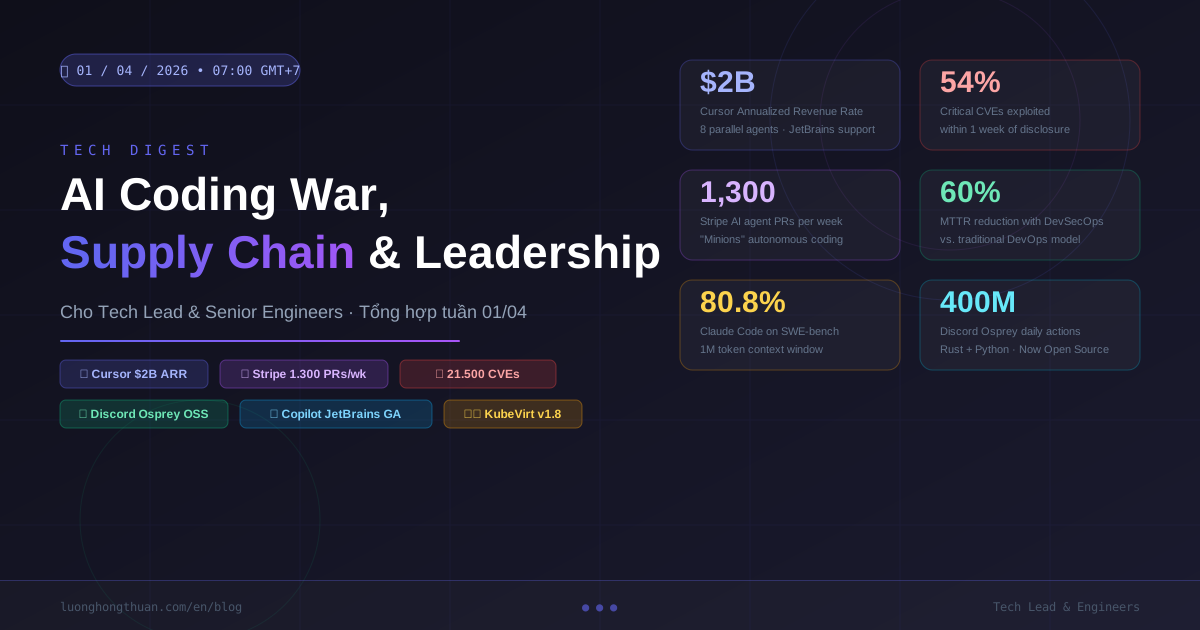
Cursor crossed a $2B annualized revenue run rate — a remarkable pace for what started as a developer tool. Their February 2026 update shipped parallel agents: run up to 8 agents simultaneously on separate git worktrees. JetBrains support arrived via the Agent Client Protocol, though still less mature than the native VS Code experience. Known caveat: billing trust issues with credit overages — one team reportedly depleted an annual subscription in a single day.
GitHub Copilot hit GA for Agent Mode on both VS Code and JetBrains (previously VS Code only — a big deal for Java/Kotlin/Python developers). Agentic code review shipped in March 2026: it gathers full project context before suggesting changes and can auto-generate fix PRs. Claude and Codex access opened to all paid users. GitHub Spark lets users describe an app in plain English and get generated code with live preview.
Claude Code leads several rankings with Opus 4.6 at 80.8% SWE-bench, 1M token context, and Agent Teams. The community pattern: use Cursor or Copilot for routine feature work, switch to Claude Code for hard multi-file bugs and architectural reasoning.
Windsurf controversially overhauled pricing on March 19 — moving from credits to daily/weekly quotas with a new Max tier at $200/month. Heavy users are unhappy.
OpenAI Codex launched as a standalone cloud agent with its own desktop app.
💡 Takeaway: The optimal 2026 setup is a combo: Copilot Pro ($10/month) as always-on completion + Cursor Pro ($20) or Claude Code Pro ($17) as your primary reasoning tool. More importantly: these aren’t editors anymore — they’re execution environments for software work. Which control plane does your team want?
⚡ 2. Stripe’s “Minions”: 1,300 Autonomous PRs Per Week
Stripe engineers recently shared details on “Minions” — their autonomous coding agent system generating over 1,300 pull requests per week in production.
Tasks originate from Slack messages, bug reports, or feature requests. Minions use LLMs + blueprints + CI/CD pipelines to produce production-ready changes, with human review gates before merge.
This isn’t “vibe coding” — it’s systematic engineering automation.
💡 Takeaway: This is a preview of the engineering org of 2027: AI agents handle repetitive changes, humans focus on architecture, review, and judgment calls. The question isn’t “will AI replace developers?” — it’s “does your team have the process to leverage agents safely and at scale?”
🔐 3. Software Supply Chain — The #1 Attack Vector of 2026
The numbers from recent research are stark:
- 21,500+ CVEs disclosed in the first half of 2026 — up 16-18% vs 2024
- 54% of critical CVEs face active exploitation within one week of disclosure
- 32% of vulnerabilities remain unpatched after 180+ days
The headline finding: software supply chain is now the dominant attack vector. Modern application codebases consist of less than 15% proprietary logic; the rest is open-source dependencies, build scripts, and container images. Attackers now target package managers, CI/CD pipelines, and cloud-hosted source repositories.
Industry-specific surge (YoY attacks):
- Banking/Financial: +149%
- Insurance: +220% (highest of any sector)
- Manufacturing: +167%
DevSecOps effectiveness:
- Organizations adopting DevSecOps reduced MTTR by up to 60% vs traditional models
- 73% of traditional DevOps orgs experienced deployment delays from manual security reviews
- 30% of DevOps teams spend >50% of their time on JVM vulnerability false positives
The median dependency is now 278 days behind its latest major version. Deployment frequency is not just a productivity metric — it’s a security control.
⏰ Incoming deadline: EU Cyber Resilience Act — manufacturers of products with digital elements must begin reporting actively exploited vulnerabilities from September 11, 2026. Full compliance mandatory by December 11, 2027.
💡 Takeaway: Audit your CI/CD pipeline. Is dependency hygiene automated, or manual? The attack surface isn’t your code — it’s everything around it.
📦 4. Short Dispatches from the Ecosystem
Java & JVM
- GraalVM Native Build Tools 1.0 GA — a milestone for Java native compilation
- EclipseLink 5.0 GA
- Spring Boot & Spring — 4th milestone releases, moving toward end-of-year GA
- KubeVirt v1.8 with a new Hypervisor Abstraction Layer (HAL), aligned with Kubernetes v1.35
Open Source of the Week
- Discord open-sources Osprey — a safety rules engine processing 400 million daily actions at 2.3 million rules/second. Architecture: Rust coordinator for traffic routing + stateless Python workers executing logic via a Python-based DSL called SML. Trust and safety teams can deploy real-time threat mitigations without full engineering cycles. If you’re building content moderation at scale, study this architecture.
AI Infrastructure
- OpenAI GPT-5.3-Codex-Spark — their first production model deployed on Cerebras wafer-scale chips instead of Nvidia GPUs. Result: higher throughput, lower latency for real-time coding. The broader signal: OpenAI is diversifying away from Nvidia dependency.
Cloud
- AKS: Ubuntu 24.04 GA as default node OS for Kubernetes v1.32+. New NCv6 VM series brings next-gen Nvidia GPUs for LLM fine-tuning/inference. Azure SRE Agent expanding with automated incident triage.
- AWS + Google Cloud partnered on simplified multi-cloud networking (Azure expected to join).
👨💼 5. Engineering Leadership in 2026: The Ground Has Shifted
Key insights from QCon London 2026 and recent leadership research:
📉 Fewer managers, more accountability Post-pandemic org chart flattening continues. Management positions are increasingly “dead ends” — fewer opportunities, every hire requires justification. The era of hiring freely is definitively over.
🎯 The #1 leadership skill: Managing Expectations With stakeholder AI FOMO at peak levels, the most important job for engineering leaders right now is navigating unrealistic expectations — without over-committing. Communicating change, reorganizing teams efficiently, and motivating engineers in lean environments are increasingly core skills.
🏗️ “The Hidden Power of Boring Problems” — Yinka Omole at QCon London 2026
“Investing deeply in foundational problems — those that appear less exciting but deliver long-term value — matters more than chasing the newest technology.”
🏛️ Decentralizing Architecture Decisions — Andrew Harmel-Law at QCon London 2026
“Architecture needs to be decentralized, similar to how we have decentralized our systems. The way we practice architecture hasn’t kept up with how system architectures have evolved.”
📊 Numbers to know:
- Entry-level tech hiring at the 15 biggest firms fell 25% from 2023 to 2024
- AI/ML roles grew from 10% → 50% of tech job postings between 2023-2025
- Gartner: 80% of the engineering workforce will need to upskill for generative AI by 2027
📚 Recommended Reading This Week
- 🔗 AI Coding Agents 2026: Cursor vs. Claude Code vs. Copilot vs. Kiro — Full Comparison
- 🔗 46 Vulnerability Statistics 2026: Key Trends in Discovery, Exploitation, and Risk
- 🔗 QCon London 2026: The Hidden Power of Boring Problems
- 🔗 Decentralizing Architectural Decisions with the Architecture Advice Process
- 🔗 DevSecOps vs Traditional DevOps: Security Integration & Shift-Left
- 🔗 Why Would Anyone Be an Engineering Manager in 2026? — LeadDev
- 🔗 GitHub Copilot 2026: Agent Mode, Pricing & Features — Complete Guide
- 🔗 Application Security Trends Every DevSecOps Team Should Watch in 2026
Tech Digest publishes every Tuesday and Wednesday. Got a great link or insight to share? Send it my way.