The Business Analyst sits at the intersection of human need and technical possibility. It has always been a role defined more by conversation than by coding — and that is precisely why AI is so useful here. AI is exceptionally good at processing large volumes of unstructured input (interview notes, workshop outputs, legacy documentation) and producing structured, consistent outputs (user stories, acceptance criteria, process maps).
This post covers how the BA role changes in an AI-augmented team: what accelerates, what stays human, and the concrete workflows and prompts that make it real.
What the BA Role Looks Like Today (Without AI)
A traditional BA sprint cycle typically involves:
- Discovery workshops (1–3 days) — facilitated sessions with stakeholders
- Interview synthesis (1–2 days) — manually collating themes, pain points, requirements from notes
- User story writing (1–2 days) — translating requirements into structured stories with acceptance criteria
- Refinement sessions (ongoing) — reviewing stories with the dev team, resolving ambiguity
- Documentation (ongoing) — updating specs, process diagrams, decision logs
Total: a well-scoped feature set for a mid-sized product can take 2–3 weeks of BA time before the first line of code is written.
Where AI Changes the Game
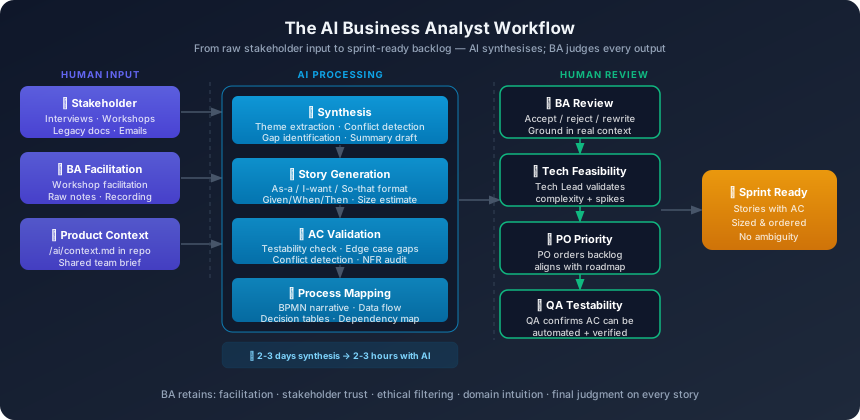
1. Interview & Workshop Synthesis (90% faster)
Raw interview notes, workshop flipcharts, and stakeholder emails are fed into Claude (with the shared product context from /ai/context.md). The AI identifies:
- Recurring themes and pain points
- Conflicting stakeholder requirements
- Unspoken assumptions that need validation
- Gaps in the information collected
Prompt example:
You are acting as a senior BA for [Product Name].
Context: [paste /ai/context.md]

Here are raw notes from 4 stakeholder interviews:
[paste notes]

Please:
1. Extract the top 8 requirements organised by theme
2. Identify any conflicting requirements between stakeholders
3. List the 5 most important clarifying questions still unanswered
4. Draft a one-paragraph executive summary of the discovery findings
Time saved: What took 2 days of synthesis now takes 2 hours of AI-assisted processing + 3 hours of BA review and refinement.
2. User Story Generation (80% faster)
Once requirements are synthesised, AI can draft a full backlog of structured user stories from a requirements list.
Prompt example:
Using these requirements, write user stories in the format:
"As a [persona], I want to [action] so that [benefit]."

For each story include:
- Acceptance criteria (Given/When/Then format, minimum 3)
- Story size estimate (S/M/L) with reasoning
- Identification of any technical unknowns or spikes needed

Requirements: [paste list]
Personas: [paste persona definitions]
The output is a first-draft backlog. The BA reviews, reorders, and challenges — it is not shipped as-is. But 80% of the mechanical writing work is done.
3. Acceptance Criteria Validation (AI as Devil’s Advocate)
Before stories go into refinement, AI reviews the acceptance criteria for:
- Ambiguity (“the page should load fast” — not testable)
- Gaps (happy path covered, but no error states)
- Conflicts with other stories in the backlog
- Missing non-functional requirements (performance, accessibility, security)
Prompt example:
Review these acceptance criteria for ambiguity and gaps:
[paste story + AC]

Check for:
- Vague language that cannot be tested (flag and rewrite)
- Missing error states or edge cases
- Conflicts with these related stories: [list slugs]
- Missing non-functional requirements
4. Process Mapping & Documentation
AI can draft BPMN-style process descriptions, data flow narratives, and decision tables from rough notes. The BA reviews for accuracy and draws the final diagrams.
The Human-Irreplaceable BA Work
AI accelerates the mechanical parts of requirements work. The following remain deeply human:
Facilitation: Running workshops, reading the room, knowing when to push back on a stakeholder versus when to accept their constraint. AI cannot facilitate; it can only process what was facilitated.
Stakeholder trust: The BA is often the face of the team to the business. That relationship — built on judgment, consistency, and empathy — is not something an AI can replicate. Stakeholders need to trust the person asking them questions, not just the output.
Ambiguity resolution: When two stakeholders want conflicting things, the BA must navigate the politics, understand the underlying needs, and find the compromise. AI can identify the conflict; humans must resolve it.
Domain intuition: An experienced BA knows which requirements sound reasonable but will create enormous technical complexity. That intuition comes from years of seeing projects fail for particular reasons. AI can flag risks, but the BA must judge which to escalate.
Ethical filtering: Requirements sometimes embed assumptions that are discriminatory, legally risky, or ethically problematic. A senior BA is supposed to catch these and challenge them. Do not delegate this to AI.
The AI BA’s Daily Workflow
In a team using AI well, a senior BA’s day looks like this:
| Time | Activity | AI Role |
|---|---|---|
| 9:00 | Review AI-synthesised notes from yesterday’s workshop | AI pre-processed; BA validates |
| 10:00 | Stakeholder call (no AI in the room) | None — pure human |
| 11:00 | Prompt AI for user story drafts from call notes | AI drafts; BA refines |
| 13:00 | Review AI’s acceptance criteria critique | BA accepts/rejects each flag |
| 14:00 | Refinement session with dev team | BA leads; AI-produced stories as input |
| 15:30 | Update /ai/context.md with new decisions | BA + AI to draft |
| 16:00 | Review next sprint’s backlog for gaps | AI scans for missing stories |
Tools for the AI BA
| Tool | Purpose |
|---|---|
| Claude (with project context) | Story synthesis, AC generation, gap analysis |
| Notion AI | Documentation, meeting notes, wiki updates |
| Linear AI | Backlog management, story labelling, dependency detection |
| Miro AI | Workshop board summarisation, affinity mapping |
| Playwright MCP (review) | Validating that acceptance criteria are actually testable |
Building the BA Prompt Library
Every BA team should maintain a /ai/prompts/ba/ folder with templates. Minimum viable set:
/ai/prompts/ba/
  01-synthesise-interviews.md
  02-generate-user-stories.md
  03-critique-acceptance-criteria.md
  04-identify-gaps.md
  05-draft-executive-summary.md
  06-map-dependencies.md
Each template includes the system context injection at the top (@include /ai/context.md) so AI always has the product background before answering.
Quality Controls
AI-generated requirements artefacts must pass through:
- BA review (every story — non-negotiable)
- Tech Lead feasibility check (before sprint commitment)
- PO priority alignment (before backlog ordering)
- QA testability check (before story is marked “ready”)
No AI-generated story enters a sprint without passing all four.
Common Mistakes to Avoid
Taking AI stories straight to the team: The AI’s user stories are a starting point. They often use generic persona language (“as a user…”) and need to be grounded in the real personas and constraints of this specific product.
Skipping the validation workshop: AI synthesis is not a replacement for having stakeholders read the outputs and confirm them. AI can misrepresent emphasis. Always run a brief “does this reflect what you said?” session.
Letting AI define the scope: AI will happily add stories for features that are out of scope if the context isn’t tight. The BA must curate the prompt context rigorously.
Previous: Part 1 — The AI Team Model: Every Role Reimagined ←
Next: Part 3 — The AI Product Owner & PM: Backlog, Planning & Stakeholder Alignment →
This is Part 2 of the AI-Powered Software Teams series.